

Gutter Company Serving Dallas County, TX
Gutter Company Serving Dallas County, TX
Dallas County has the oldest housing stock in the Metroplex, and that single fact decides most of what a gutter job here looks like. Eight hundred and seventy-three square miles, thirty-one incorporated cities and towns, and a range that runs from pre-war bungalows inside Loop 12 to houses finished last spring on the southern edge. Drive from Coppell in the northwest corner to Wilmer in the south and the housing changes completely, and the tree cover over those roofs changes with it.
That is why repair, fascia carpentry and cleaning make up more of the work in this county than new installation does, and why a quote in Richardson and a quote in Lancaster start from different questions. One thing does not change anywhere in the county, and it sits under all of it: the ground.




How the County Splits Into Four Working Areas
This county isn’t one market, and for gutter purposes it divides into four working areas that each want a different first question asked.
- The city itself and its enclaves. Dallas, plus Highland Park, University Park and Cockrell Hill, which are separate municipalities wrapped by the city, not parts of it.
- The inner ring. Irving, Garland, Mesquite, Richardson, Carrollton, Farmers Branch, Balch Springs and Addison. Overwhelmingly a 1950s to 1970s postwar product, built out, and where most of our repair and replacement work lands.
- The southwest and the escarpment. Grand Prairie, DeSoto, Cedar Hill and Duncanville, where the White Rock Escarpment gives the county its only real topographic break and slope drainage becomes a live issue.
- The southern growth corridor. Lancaster, Glenn Heights, Hutchins, Wilmer and Seagoville, where almost all of the county’s genuinely new housing is going up alongside the Inland Port warehouses.
Rowlett, Sachse and Sunnyvale sit out on the eastern side toward Lake Ray Hubbard, and Coppell holds the northwest corner near the airport. We cover all of it from one shop, and a Wilmer address is measured, quoted and scheduled exactly the way a Highland Park one is.
Three Housing Eras, and What Each One Needs First
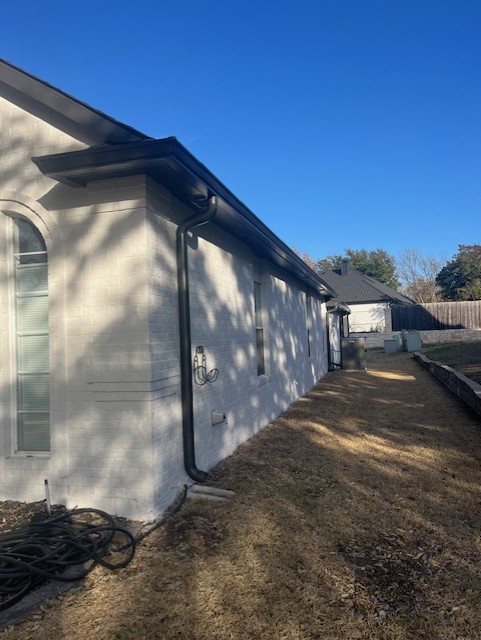
The county sorts into three broad eras, and each one arrives at us with a different complaint. The inner-ring suburbs went up between roughly 1950 and 1975 and have barely changed footprint since. Those houses are now on their second or third gutter system, their fascia has been through fifty or more freeze and heat cycles, and a good share of them still carry the original spike-and-ferrule hanging.
New construction in the county is now concentrated almost entirely in the south, plus infill and teardown inside the city. So a contractor working this county does two different jobs on the same week: pulling failed metal off a 1962 ranch in Mesquite on Tuesday, hanging first-time gutter on a 2024 slab in Lancaster on Wednesday.
Canopy Splits North to South Across the County
Of the counties we cover, this one carries the most tree cover, and the spread inside it is what matters to a quote. The old inner-ring streets sit under forty to seventy years of growth. The southern growth corridor, Lancaster and Glenn Heights and the new build around the Inland Port, is sodded lots and nursery stock. Two houses of identical size and identical roof, twenty miles apart, can need a different guard decision and a different cleaning interval.
The two places that spread shows up hardest each have their own page. Garland pairs the heaviest mature canopy in the county with the shallowest roof pitches, and the city of Dallas runs district by district from single digits to sixty percent cover. At county scale the rule is blunt: budget guards and a second annual clearing inside Loop 12 and through the inner ring, and budget neither on a lot south of I-20 that was bare dirt eight years ago.
The One Thing Every Address Here Has in Common
Whatever era the house is from and whatever is growing over it, the ground under the slab is the same. It is Blackland Prairie clay from edge to edge, on both banks of the Trinity, with no sandy relief anywhere in the county. Blackland clay is deep, dark, alkaline and expansive. It takes on water and swells, then dries out and shrinks back, and it does that hard enough to move a slab. Neighboring counties get some relief from sandy Cross Timbers bands. Dallas County gets none. There’s no pocket of this county where a downspout can dump at the foundation without consequence, and no stretch of it where the answer changes from the street before.
That turns downspout discharge placement from a finishing detail into a structural question on essentially every job we quote. Where the water leaves the last elbow, and how far from the slab edge it lands, matters more here than the brand of gutter above it. It’s the one thing we’ll push a homeowner on even when they called about something else.
Getting Water Away From the Slab
Above-ground extensions carry discharge out past the foundation to a point where the grade takes it away, and they start at a $250 minimum charge. On a standard suburban lot that’s a short run to a side yard. On a zero-lot-line house or a tight infill lot it takes some working out, because draining onto a neighbor’s slab instead of your own solves nothing.
Downspout size does as much work as placement. Two-by-three aluminum starts at $7 per foot and suits short runs on small roofs. Three-by-four starts at $8 and moves roughly twice the water, which is what belongs under a six-inch trough or at the bottom of a long two-story elevation. Round smooth aluminum from $14 and copper from $45 are the finished looks. We work through the routing on our downspout extensions page.
One thing worth saying plainly, because other companies here sell the opposite: what we fit runs above ground. You can see it, you can see when one blocks, and clearing it needs a garden hose instead of a shovel. On the lots where the discharge genuinely has to go somewhere a surface run can’t reach, that is a conversation for the estimate rather than a line on a price list.
Repair Before Replacement, When Repair Will Hold
Given the age of the stock, repair is the largest single category of what we do in this county. Every item starts at a $250 minimum charge: end cap replacement, hidden hanger replacement, downspout reattachment, seam and joint leak sealing, corner miter reseal, re-pitching a run that has lost its fall, and re-securing one that has begun to sag.
The judgment isn’t complicated. One or two failing stretches with the rest of the perimeter sound points to repair. If the fasteners are pulling out along several elevations, if the fascia has gone behind more than one run, or if the trough was never the right size for the roof it sits under, a repair buys a season or two and the same call comes back. We tell you which one you’re looking at while we’re still standing under it. Each item is set out on our gutter repair page, and the threshold between the two on our gutter replacement page.
Fascia, and the Boards Nobody Sees Until the Gutter Comes Down
On postwar Dallas County housing, rot behind the gutter is the rule and not the exception, and it hides until the old system comes off. It starts where an overflowing trough has been wetting the board for years. From the ground the signs are a run that dips in the middle, fasteners that have backed out, or paint lifting in a line along the fascia.
Forty years of tear-offs across this county have taught us to quote the board as a possibility before we quote the metal as a certainty. Where fascia needs replacing it happens before the new gutter goes up, because that’s the only order the work can be done in, and it’s the single item most likely to move a number after the estimate has been written.
Cleaning and Guards on Mature Streets
Gutter work carries a $500 minimum. Downspout work, repairs, cleaning and cleanouts all start at $250. Under a genuinely mature canopy the honest schedule is twice a year. On a newer lot in Lancaster or Glenn Heights with young planted trees, once a year covers it.
For guards we install two products. Expanded steel screen, the Roll Lock type, starts at $5 per linear foot and handles leaf-sized debris well. Micro-mesh in stainless and aluminum starts at $10 and stops shingle grit, seed and samara as well as leaf, which is what the tree mix in this county actually delivers. Leaf Blaster, Hydroflow and Flow Shield are the micro-mesh names people tend to recognize. Which of the two belongs on your roof is worked through on our gutter guard installation page, and what a clearing visit includes is on our gutter maintenance page.
Sizing New Systems Across the County
Five-inch K-style is the sensible default on a single-story house with a simple roofline and modest cover overhead. Six-inch is what we recommend on two-story homes, steep pitches, long valleys and anything under real trees, and it pairs with a three-by-four downspout. Seven-inch and oversized profiles are for large custom homes and commercial roofs. Half-round suits the older architecture, and box gutter is built into the structure itself instead of hung off a fascia board.
Aluminum is what we hang on most houses in this county and copper sits at the other end of the range. Size, though, is usually the smaller half of the question. A county this wide holds nearly every roof shape there is, and it’s the number of outlets a roof needs that separates a system which copes from one that spills at the same corner every May. The whole material range sits on our gutter styles and materials page and the process on our installation page.
Exposure moves the fastening rather than the metal. On a house facing open water at Lake Ray Hubbard or Joe Pool, or sitting up on the escarpment with a long clear run in front of it, hidden hanger spacing comes in tighter than the standard interval, and six-inch earns its place because wind-driven rain crosses a trough that was sized for rain falling straight down.
The Order the Work Happens In
We come to the property, because the two items that move a price most are the state of the fascia and the number of downspout drops the roof actually needs, and neither is visible from the street or from an aerial photo. On site we measure every run, count the corners, look at where the valleys discharge and check the board behind the existing gutter. You leave with a written number split into gutter, downspout and anything else the building turns out to need.
On the day, the old system and its hangers come off first and go on the truck. The new run is set to a deliberate fall toward the outlet, hidden hangers go through the back of the trough into the fascia at a spacing that tightens on long or exposed runs, and the corners, end caps and outlets get detailed carefully. Most single-story homes are done in a day, and two-story properties or fascia work can run into a second.
Commercial and Industrial Property
The office inventory in this county is deep, and the industrial side concentrates hard in the far south at the Inland Port, spread across Dallas, Lancaster, Hutchins, Wilmer and Ferris around a Union Pacific intermodal terminal. Both matter here for one reason: there’s no fascia board anywhere on either of them, so a job on those buildings doesn’t start where a residential job starts.
Those buildings are low-slope tilt-wall with internal drains, overflow scuppers and downspout leaders, not residential K-style, and capacity gets calculated for a cloudburst, never for an annual average. The commercial installation minimum is $750. Downspouts on those buildings are from $20 per linear foot against a $300 minimum, and box gutter sits at $20 to $30 per foot. We also work multi-building apartment and retail portfolios, where the useful arrangement is scheduled maintenance rather than a call after every storm.
Prices Across the County
Nothing goes below a $500 minimum on gutter work or a $250 minimum on downspouts. Within that, here is where the numbers start.
| Starting figures across the county | Per linear foot |
|---|---|
| Aluminum 5-inch K-style, seamless | $7 to $14 |
| Aluminum 6-inch K-style, seamless | $8 to $16 |
| Box gutter, residential or commercial | $20 to $30 |
| 2×3 aluminum downspout | from $7 |
| 3×4 aluminum downspout | from $8 |
Half-round, copper, oversized profiles and guards are priced separately, and the full range is on our gutter styles and materials page.
A quote moves up those ranges with height, access, the number of corners and drops, the condition of the fascia and how much of the run sits over beds and shrubs. Half-round on a Highland Park elevation and five-inch aluminum on a Seagoville ranch sit at opposite ends of that table, which is why the visit comes before the number.
What Stands Behind the Job
Five years on our workmanship, twenty years from the manufacturer on materials. Both are written down and handed over at the end of the job. If a seam opens in year three, the call goes to 214-324-4674 and we come back out to look at it.
Towns We Cover In and Around Dallas County
Along with the city of Dallas we work in Garland, Mesquite, Richardson, Farmers Branch, Coppell, Sachse, DeSoto, Cedar Hill, Duncanville, Lancaster, Glenn Heights, Hutchins, the Town of Addison and Rowlett, which straddles the line into Rockwall County. Irving, Grand Prairie, Carrollton, Balch Springs, Seagoville, Sunnyvale, Wilmer, Highland Park and University Park sit on the same routes.
We work just past the southern county line too, and it’s worth being exact about where that line falls. Ovilla straddles it. Oak Leaf and Pecan Hill are Ellis County addresses and not Dallas County ones, whatever the mail suggests. Bear Creek Ranch is unincorporated Dallas County with a Lancaster mailing address, and Combine reaches over into Kaufman. All of them are large-lot properties down long private drives, and they get measured and quoted the same way everything else here does.
Questions We Get From Around the County
Do you cover the whole county or just the city?
The whole county, and four more besides. Dallas, Collin, Denton, Rockwall and Tarrant.
Does the clay really matter that much for gutters?
It’s the reason the job does not end at the downspout. Blackland clay swells and shrinks with moisture, and a downspout releasing at the slab edge cycles that clay in one spot dozens of times a year. Moving the discharge out past the foundation is the cheapest part of the whole job.
My house was built in 1965 and still has its first gutters. Should I replace them?
Look at the hangers and the fascia before you look at the metal. Sixty-year-old aluminum can still be sound. Spikes that have backed out, a run that dips, or a soft board behind the trough all say the system has reached the end regardless of how the gutter itself looks.
Will you run the downspout drainage under the yard?
Our extensions run above ground, from a $250 minimum, and on most Dallas County lots that is the answer we would argue for anyway. Anything hidden under sod blocks where nobody can see it, and by the time you notice, water has been going back toward the slab for a season. If your lot is the exception, bring it up when we measure.
Can you handle several buildings on one property?
Yes. Apartment communities, retail centers and multi-building industrial sites are regular work for us, and scheduled maintenance across a portfolio costs less than reacting to each building separately.
How quickly can you get out after a hailstorm?
Slower than in a quiet week, and we won’t pretend otherwise. Spring storm weeks fill up fast. Call and you’ll get a date we can actually keep, not a comfortable one.
Is seamless gutter worth the difference?
On a run of any length, yes. Sectional gutter has a joint every ten feet and every joint eventually leaks, and this climate cycles metal hard between August heat and January freezes. Seamless leaves joints only at corners, end caps and outlets.
What is the smallest job you will take?
Gutter work has a $500 minimum, downspouts and repairs $250, commercial installation $750. Below those the trip costs more than the material.
Book a Look at Your Property
Whether the address is in Richardson, Cedar Hill or out past Seagoville, the estimate is free and it happens at the house. We’re a family company and you get a person on the phone, not a call center, covering Dallas, Collin, Denton, Rockwall and Tarrant counties since 1984. Call 214-324-4674 or send a quote request and we will come out and measure.
Contact us today to schedule a FREE on-site consultation for gutter installation or repair for your home or business in Dallas, Collin and Rockwall Counties.
214-324-4674