

Residential Gutter Installation in Dallas
Residential Gutters in Dallas TX
A Dallas house mostly tells you which gutter it wants, and the tell is the year it went up. A single-story ranch put up in 1958 with a shallow eave and fascia cut from lumber you can’t buy anymore needs a different answer from a 1992 two-story with painted pine twenty-two feet off the ground, and both need a different answer again from a house finished last spring with perfectly sound fascia and a gutter the builder bought by the mile.
The metal is the same in all three cases. What changes is the width, how it’s fastened, where the water goes, and what has to happen before anything goes up at all. Most people want the number before the essay, so the pricing sits near the top of this page: seamless aluminum from $7 a foot, with a $500 minimum on gutter work.
What Residential Gutter Installation Costs in Dallas
Price follows footage, width and metal, and every number below is a starting point. Gutter work carries a $500 minimum charge and downspout work a $250 minimum. The house-by-house detail starts a little further down.
| Residential work | Per linear foot |
|---|---|
| Aluminum 5-inch K-style, seamless | $7 to $14 |
| Aluminum 6-inch K-style, seamless | $8 to $16 |
| 2×3 aluminum downspout | from $7 |
| 3×4 aluminum downspout | from $8 |
| Expanded steel screen | from $5 |
| Micro-mesh guard, stainless or aluminum | from $10 |
Cleaning, unclogging and repair each start at a $250 minimum charge. Half-round, copper and the oversized seven-inch profiles run to different numbers, and a later section sets out what each of them is for.
To turn that into a house-sized number: allow 150 to 200 linear feet on a house of about 1,500 square feet, 200 to 300 feet at 2,500 square feet, and upward of 350 feet on anything past 3,500. Gutter and downspout together. Stories, corner count, access and the state of the fascia move a quote within its range more than anything else.
Half-Round on a University Park House, Priced Out
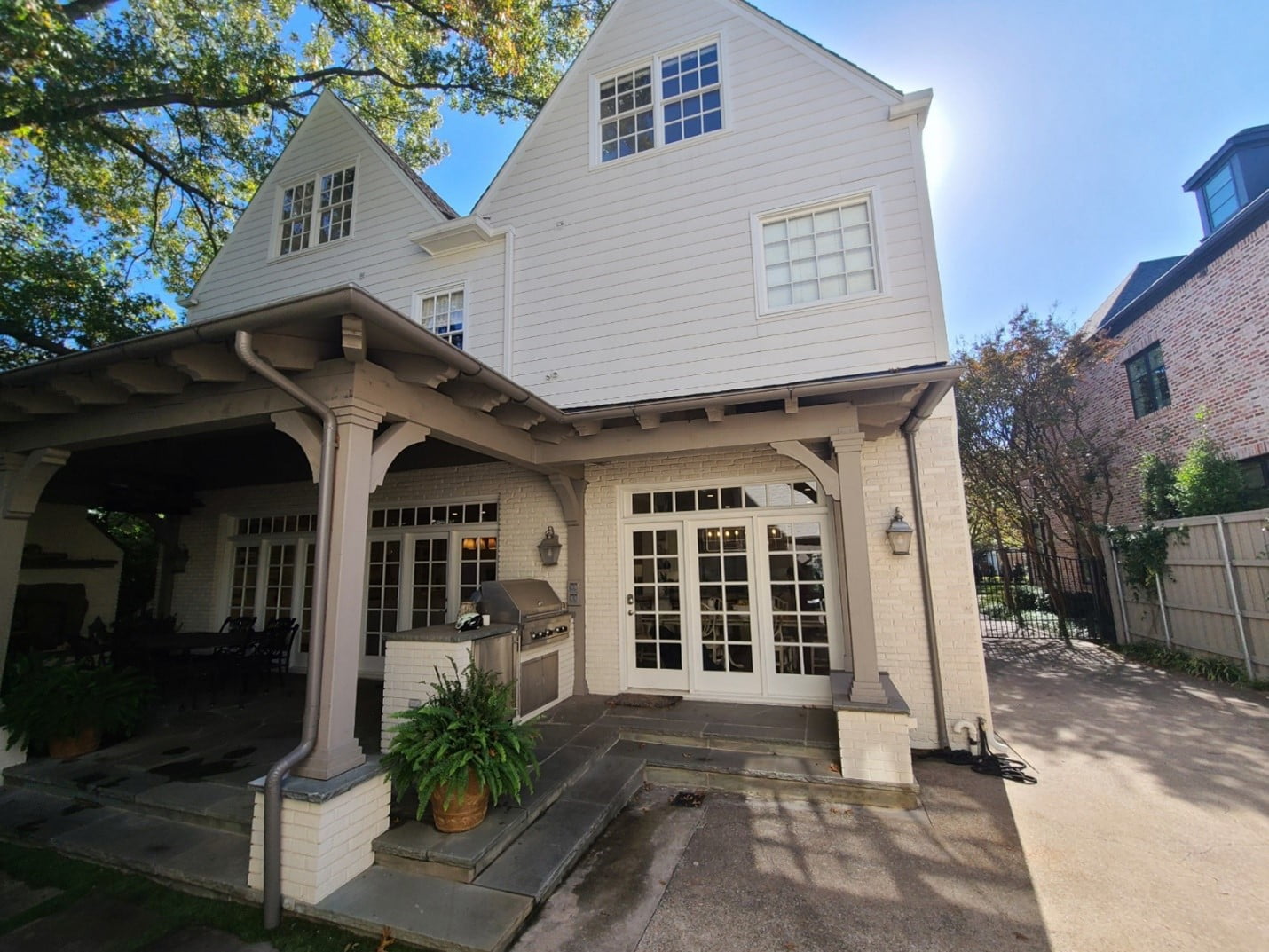
One house carried right through, as an example rather than a number for your address. A 2,400 square foot brick house in University Park, aluminum half-round on visible brackets because a K-style face would look bolted on, roughly 230 feet of trough and five drops. Half-round runs $13 to $25 a foot, so the trough sits somewhere near $3,000 to $5,800, with round smooth aluminum downspout from $14 a foot under it. Copper instead of aluminum multiplies the whole figure. Open access and sound fascia keep a house like that low in its range; two stories, a busy corner count and carpentry behind the old run take it high.
Gutter Installation on a 1950s Dallas Ranch
The inner ring of this metro is full of them. Long, low, single-story houses with a gentle roof pitch and an eave that sticks out just far enough to shade a window. Casa View Oaks, the older streets in Garland and Mesquite, big stretches of Richardson and the post-war edges of Oak Cliff.
The good news on these houses is the fascia. Lumber milled in the fifties is dense and tight-grained in a way modern framing stock isn’t, and where it’s been kept painted, it still takes a screw beautifully at seventy years old. We find sound original fascia on ranch houses far more often than people expect.
The complications are elsewhere. A shallow pitch means water arrives at the edge slowly and clings to the fascia line, and it never launches clear the way it does off a steep roof, so getting the back of the trough tight to the board with the drip edge sitting over it matters more here. Shallow eaves also put the gutter close to the wall, which leaves less room for a downspout to run without crossing a window. And these are the neighborhoods with genuinely mature canopy overhead: hackberry, cedar elm, American elm and green ash. None of them let go in one tidy two-week stretch. They feed grit into a trough all year.
One more thing turns up on houses of this vintage. Plenty of them were hung with spike-and-ferrule, a nail driven through the front face of the gutter and into the fascia, which was standard practice for decades. Those spikes work loose as the wood ages and the metal moves, and they leave a line of holes across the board when they come out. Hidden hangers, screwed through the back of the trough, solve that permanently.
Put together, a ranch usually wants five-inch or six-inch K-style depending on how much roof drains to each edge, hangers set closer than the span alone would suggest because wet leaf load is heavier than people assume, outlets placed where the water actually concentrates, and a serious conversation about screens. Our gutter guard installation page covers that last part.
Sizing Gutters for an Eighties or Nineties Two-Story
Between Loop 12 and the northern suburbs sits an enormous cohort of two-story houses built between roughly 1978 and 1999. East Plano, older Rowlett, the first Allen subdivisions, big parts of Garland’s outer ring. Most of them are still wearing the gutter that came with the house, and most of that gutter is five-inch on a roof that has never been reassessed.
The fascia is the difference. By the eighties, fascia was painted pine or fir, thinner in section, and hung twenty feet or more in the air where nobody repaints it as often as they repaint the front door. Two decades of a gutter overflowing at one corner puts water behind that board, and because it’s high up and behind the gutter, nobody sees it until the run starts to drop.
Height changes the work as well as the price. Everything takes longer, ladder placement gets dictated by landscaping and slope, and a downspout coming off a second story arrives at the ground with real force behind it, which is why the discharge point matters more on these houses than on a ranch.
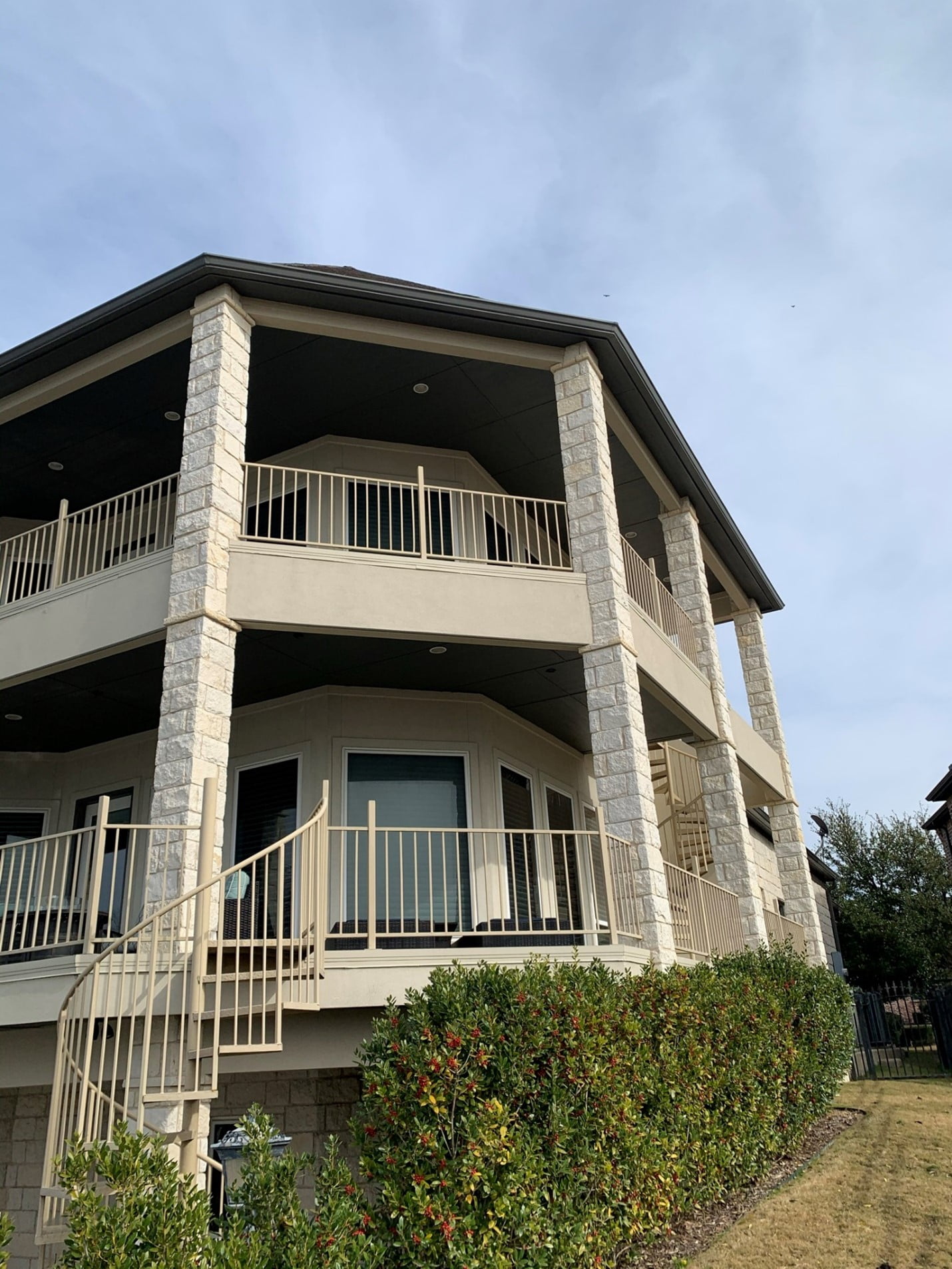
Height changes the recommendation too. On most of these houses it’s six-inch trough with a three-by-four downspout to match, hangers at closer centers than the builder used, and the fascia inspected with the old gutter off it, not glanced at from a ladder. This is also the cohort where the honest answer is replacement more often than repair, and our gutter replacement page walks through where that line sits.
New-Build Homes and Builder-Hung Gutter
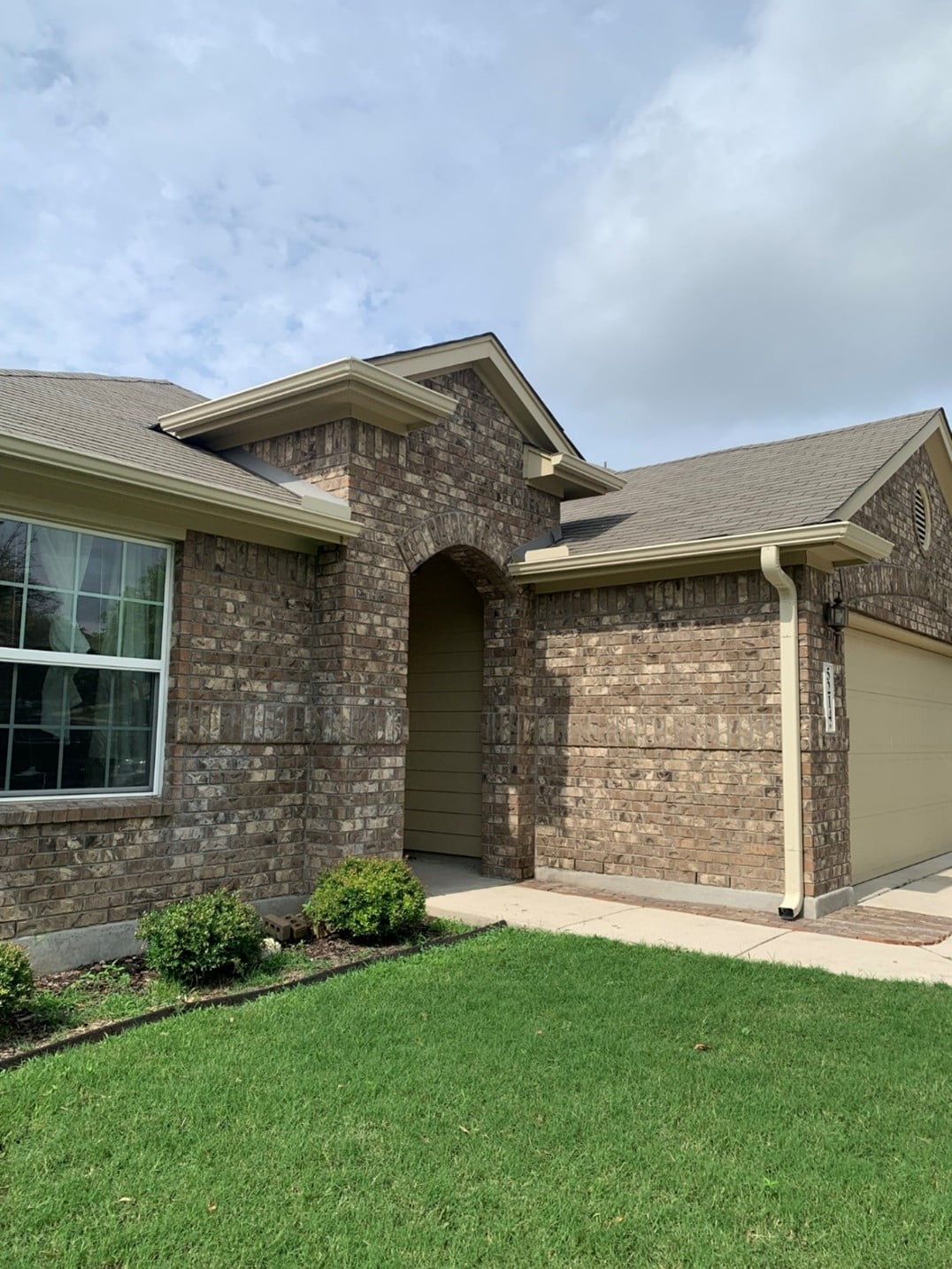
Houses finished in the last fifteen years in Frisco, Celina, Rockwall, Murphy and the newer edges of everywhere else have the opposite problem. The wood is fine. The workmanship on the eave is fine. The gutter is the cheapest thing that could be bolted to it.
Production builders buy five-inch across an entire subdivision because it’s one order, one crew and one price, regardless of which houses on the street got the steeper elevation, the deeper valley or the roof that drains three planes into one corner. So the system fails selectively. Four houses on the block are fine and the fifth pours water over its front door every storm, and the owner assumes it’s clogged.
New builds also come with an empty lot and a raw grade. Landscaping is young, so there’s nothing catching runoff before it reaches the slab, and the fill around a new foundation is still settling. Blackland clay swells when it takes on water and shrinks back hard in a dry August, and a downspout emptying at the slab edge works that cycle at exactly the worst spot.
Builder gutter also tends to be thin coil in a single color, hung on the widest hanger spacing that will pass, with the fewest drops the elevation can be argued into. None of that’s a defect on handover day. It shows up around year eight, when a run starts to wave between hangers and one corner begins to weep.
None of this is expensive to correct. Upsizing only the elevations that need it, adding drops where the roof concentrates water, and getting the discharge out past the foundation is the cheapest of the three eras to put right. It’s also the one owners leave alone longest, because a young house doesn’t look like it has a problem until the year the fascia starts to show one.
Which Profile and Width Suit a House Like Yours
Four things get settled before any metal is formed: profile, width, material and color. Most Dallas houses land on K-style aluminum, and that’s the right answer often enough that it’s worth saying plainly why the alternatives exist at all.
K-style is the profile with the flat back and the shaped front face that reads a little like crown molding. Five-inch suits a small, simple roof. Six-inch is the workhorse on anything with a second story, a steep pitch or valleys emptying into one corner. Seven-inch and oversized troughs handle long rooflines and big drainage areas at $20 to $28 a foot. Half-round hangs in cradles and looks right on Tudor, Spanish and older brick houses around Lakewood and Swiss Avenue, $13 to $25 in aluminum. Box gutter is built into the structure, shows up on commercial roofs and a handful of older homes, and runs $20 to $30.
Material is a shorter list. Aluminum in a baked finish does almost all the residential work here, and it’s what we roll in your driveway. Copper is the long-life option at $40 to $55 a foot in K-style and $45 to $60 half-round, and it belongs on a house where the gutter is meant to be looked at. We don’t hang galvanized steel: it rusts at the cut ends and the seams in this climate, and there’s no version of it we’d stand behind for twenty years. Every figure across the range sits on our gutter styles and materials page.
Why the color decision outlives the gutter
Color outlives the decision that made it, since a baked finish on aluminum holds up for decades here. We bring the sample cards and hold them against the wall in daylight, because a color picked indoors off a phone screen is a different color at two in the afternoon. Our gutter replacement page works through how the choice gets weighed against brick, trim and roof.
Everything We Do on a Residential Roof
Installation is the headline, but a house needs more than one thing from a gutter company over the years, and all of it is on the list below.
- New installation on a house that has never had gutters, or a full system after tear-off. Seamless aluminum or copper, formed in your driveway.
- Repair from a $250 minimum: dropping runs re-secured, flat stretches re-pitched to fall, opened miters cut back and resealed, weeping seams sealed, tired hangers swapped out, end caps renewed, downspouts refastened where they’ve pulled off the wall.
- Replacement of a whole system, including tear-off, haul-away and any fascia carpentry that turns up behind it.
- Cleaning and unclogging, gutters and downspouts both, from a $250 minimum charge.
- Guards and screens, in expanded steel and micro-mesh.
- Downspouts and above-ground extensions, sized to the trough they’re serving.
Partial jobs are fine as long as they clear the minimums. One elevation after hail, one long run that’s given up, one downspout added where the roof has always concentrated water: those are normal calls, not inconveniences.
Guards on a House Under Real Canopy
Guards make sense on a house with mature trees over the roof and they’re hard to justify on an open lot with clear sky above the eave. Dallas canopy runs from about seven percent in some districts to sixty in others, and which end of that your street sits at should drive the decision more than any sales pitch.
Expanded steel screen, sometimes sold as Roll Lock, is the straightforward version. It stops leaves and the bigger material at the top of the trough and lets water down through the mesh, from $5 per linear foot. Micro-mesh has a much finer weave and stops shingle grit, seed and the small stuff that hackberry and elm produce constantly in this metro. It starts at $10 per linear foot, and Leaf Blaster, Hydroflow and Flow Shield are names you’ll have seen.
Somebody will still have to go up there. What a guard buys is a much longer interval and an end to the packed clog that turns a working gutter into a waterfall halfway through a storm. A covered house moves onto a longer schedule, not off the schedule, and our gutter maintenance page sets out what that looks like across a year.
Getting Roof Water Out Past the Slab
A roof gathers a startling amount of water. DFW averages a little over thirty-seven inches of rain a year with peaks in spring and again in October, and the record twenty-four-hour total in September 2018 was more than eight inches. All of that lands on a roof and leaves through however many downspouts the house has.
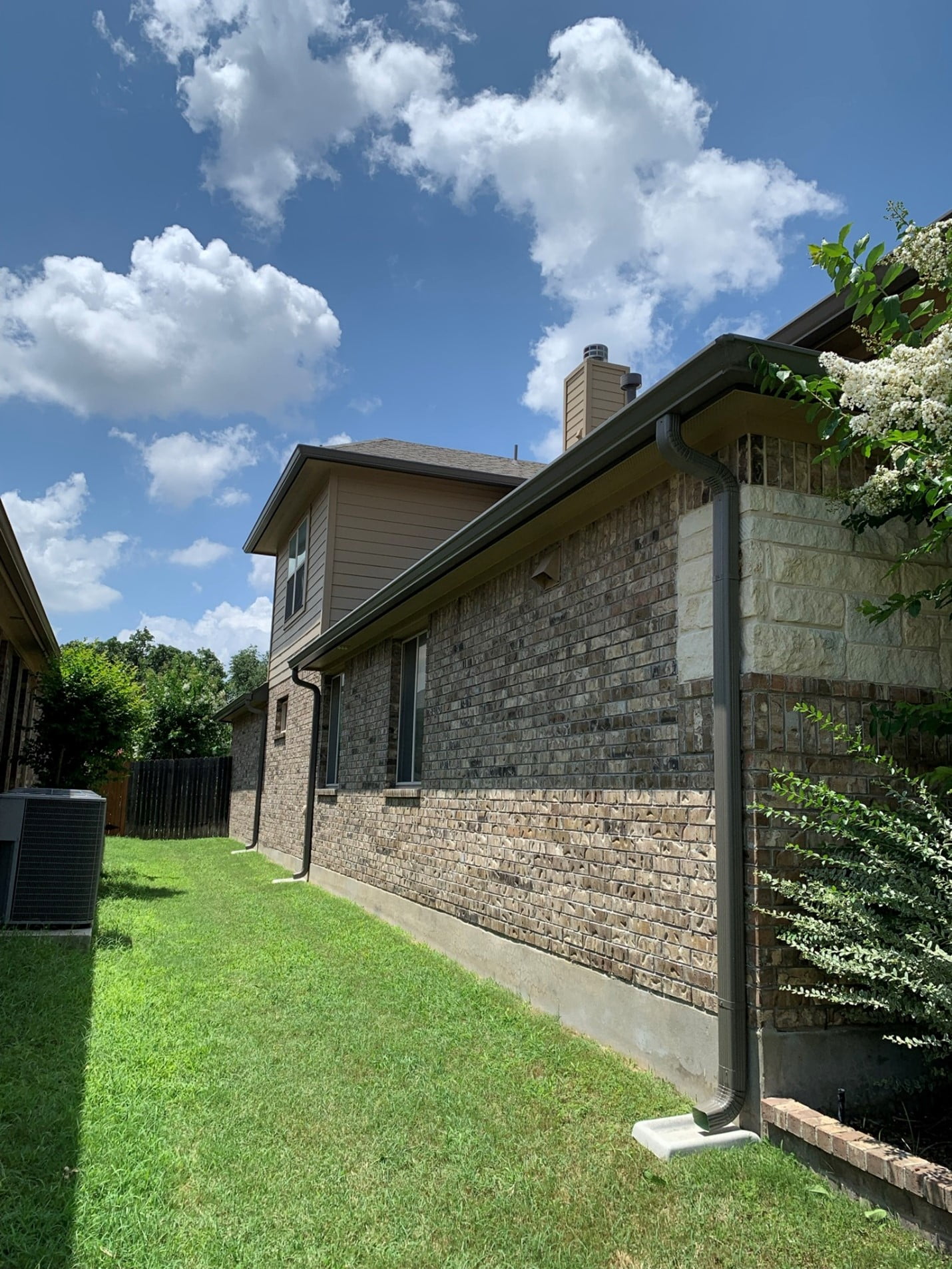
Two-by-three is the standard rectangular downspout and it does the job on a small roof with short runs. Three-by-four opens up a great deal more cross-section. It’s the correct partner for a six-inch trough, and it’s what we fit on second-story elevations and on any stretch of gutter emptying through one outlet. Round smooth downspouts, in aluminum or copper, are the dressier option and they sit naturally beneath a half-round trough.
Where the water lands is the part that costs money later. This metro sits on deep expansive clay that moves with moisture, and where a downspout empties is a foundation question on very nearly every house we quote. Above-ground extensions carry the discharge out past the slab to somewhere the grade takes it away, starting at a $250 minimum. On tight lots we settle the question of where discharge is going to end up before a single outlet gets cut, because moving the problem onto the house next door isn’t a solution. More detail sits on our downspout and extension page.
How to Read a Residential Gutter Estimate
Quotes vary more than they look like they do. A low number usually means something has been left out, not that somebody is being generous with you. Six things worth checking before you sign anything.
- Linear footage, stated. If the quote doesn’t say how many feet it covers, there’s nothing to compare against the next quote.
- Trough width and downspout size, both. Five-inch trough with two-by-three downspouts is a different product from six-inch with three-by-four, and they shouldn’t be within a few dollars of each other.
- Hanger type and spacing. Hidden hangers screwed into the fascia hold vastly better than a nail driven through the front face. If a quote is silent on this, ask.
- Number of drops. Count them against the roof. Fewer downspouts is how a quote gets cheap.
- Seamless or sectional. It should say. Our seamless gutter page explains what the difference actually buys.
- What happens to bad fascia. An estimate that ignores the possibility isn’t an estimate, it’s an opening bid.
Tear-off, haul-away and cleanup belong in the price, not on a supplementary invoice at the end. Ours are.
What Happens While We’re at Your House
The estimate comes first and it’s free. Somebody walks the perimeter with you, measures every elevation, looks at the fascia behind the existing run and points out where water is going now against where it ought to go. You get a written number broken out by item.
On the day, beds and hardscape get covered, the old system comes down and goes on the trailer, the fascia gets checked with the gutter off it, and the new runs are formed in the driveway to exact lengths. Hangers, then seals at corners, caps and outlets, then downspouts and extensions.
You don’t need to be home for the middle of it, though most people like to be there at the start to agree the plan and at the end to see it tested. We run a hose across the roof and watch every elevation drain before we leave, and the beds get walked with a magnet. Single-story houses are usually a day. Two stories and carpentry run longer, and we tell you that up front.
Guarantees on a Residential Installation
Workmanship is warranted for five years. The materials carry twenty years from the manufacturer. Residential gutter has been the bulk of what this family does across the metro since 1984, run from a shop on Fuller Drive over in East Dallas, and it has gone on long enough that we’re now taking down systems we put up in the nineties, on houses where the same people still open the door.
What Homeowners Ask Us Most
My house has never had gutters. Is it too late to add them?
No. Older houses that never had them are more common around here than people assume. The metal and the method are identical. What takes longer is deciding where the water should leave, because there’s no previous routing to copy or correct.
How do I know if five-inch is enough for my house?
Watch it in a real storm when it’s clean. Water coming over the front lip of a gutter you know is clear means the trough, the outlet or both are too small for the roof. A second story, a sharp pitch, valleys emptying into one place, or trees sitting over the roof are each an argument for six-inch.
Do you fix rotted fascia, or do I need a carpenter?
We do it. Fascia has to be solid before gutter can hang on it, so the carpentry is part of the job and it happens on the same visit.
How often should gutters be cleaned in Dallas?
Twice a year suits most Dallas houses, with the heavier clean out after the leaves come down in late fall. An open lot with little canopy sits at the low end of that. Under mature hackberry, elm or pecan, or on a house with no screens, plan on the top of it. Our gutter maintenance page goes through how the interval gets set.
Can you match the new gutter to my brick?
Yes, within the range of baked-on finishes aluminum is made in. Samples come to the house and get held against the wall in daylight before anything is ordered.
Will new gutters help my foundation?
They help by moving roof water away from the slab instead of releasing it at the edge, which is a real contribution on clay soil. They aren’t a foundation repair, and we won’t sell them as one.
Do you work on detached garages, patios and outbuildings?
Yes, and they’re often part of the same visit. The $500 gutter minimum still applies, so it’s worth doing the garage while we’re already there.
How much disruption is there for my family?
A day of ladders and a roll former running in the driveway. Pets are worth keeping inside, cars are worth moving off the drive, and everything else carries on as normal.
Is a bigger gutter worth it on an older house?
On a shallow-pitch ranch with heavy canopy over it, six-inch is often the difference between cleaning twice a year and cleaning after every storm. On a small simple roof with clear sky, five-inch does the job and there’s no reason to pay for capacity the house won’t use.
Do you charge for the estimate?
No. Somebody comes out, measures, and leaves you a written number whether you use us or not.
Have Us Measure Your House
Whichever era your house belongs to, the answer starts with somebody standing in the driveway with a tape and looking up. It’s free, and you’ll get a number that separates gutter from downspout from anything the house turns out to need behind the old run. We work out of East Dallas across Dallas, Collin, Denton, Rockwall and Tarrant counties, and the phone is answered by the family that owns the business rather than a dispatch center. Call 214-324-4674 or request a quote online, and somebody will be out with a tape and a box of color samples.
Contact us today to schedule a FREE on-site consultation for gutter installation or repair for your home or business in Dallas, Collin and Rockwall Counties.
214-324-4674