

Gutter Repair
Creative Gutter has been repairing gutter systems across Dallas, Collin, Denton, Rockwall and Tarrant counties since 1984. Most repair calls we take in North Texas are not leaks. They are hangers that have pulled out of soft fascia, or a run that has lost its pitch and holds water for two days after a storm. We find the cause, put the fix in writing, and tell you plainly when a repair is not worth your money.
Gutter Repair in Dallas, Collin, and Rockwall Counties
Keeping your gutter system in tip top shape is imperative to ensure that they are doing what they are designed to do: to remove water from the roof and direct it safely away from your home or building. When gutters are functioning properly, they help protect your siding, fascia, soffit, foundation, and landscaping from water damage. That damage develops slowly and stays out of sight until the repair is expensive. Even minor issues, if left unaddressed, can compromise the overall performance of your gutter system and lead to larger problems over time.
Most gutter repairs in Dallas TX contain items that come up such as:
- Replacing sections of damaged gutters or downspouts caused by falling limbs, strong winds, hail damage, or old rusted out gutters that have reached the end of their lifespan.
- Sealing leaking corners and joints where water commonly escapes during heavy rainfall.
- Reattaching downspouts that have come loose due to age, improper installation, or storm activity.
- Enlarging or adding additional downspouts to improve your gutter system’s ability to move water away from the structure.
- Re-sloping gutters to ensure that they are draining correctly and not allowing water to sit or overflow.
- Cleaning out debris from inside of gutters and downspouts that can cause clogs and backups.
- Adding downspout extensions or splash blocks to help control water flow at ground level.
- Adding leaf screen to the gutter system to reduce debris buildup and improve long-term performance.
Contacting us to come out and inspect your gutter system and provide a written quote that addresses the necessary repair or maintenance options is a great way to prolong the life of your gutters. This proactive approach also helps fend off potential damage to your siding, fascia, soffit, foundation, and landscaping from ongoing water exposure, which can cost thousands of dollars to repair if ignored.
We work all five counties: Dallas County, Collin County, Denton County, Rockwall County and Tarrant County. The housing stock changes as you move across that footprint, and so does what fails first. That is why we quote from the ladder rather than over the phone.
What Actually Fails on a North Texas Gutter, in the Order We Find It
After forty years of repair calls in this metro, the failures sort themselves into a short list. They are not random. Each one has a cause you can see from the ground or from the top of a ladder, and each one has a different fix at a different price. On most houses two or three of them are happening at once, and one of them is usually causing the others.
1. Fasteners Pulling Out of the Fascia
This is the single most common repair we sell. Older systems were hung on spikes driven through a ferrule into the fascia board. Wood moves with every wet-dry cycle North Texas gives it, the spike backs out a fraction each season, and eventually the front lip of the gutter drops. The metal did not fail. You see it as a dip in an otherwise straight line, usually near the middle of a long run. The fix is not to hammer the spike back in. We pull the old hardware and re-hang the run on hidden hangers screwed into solid wood, spaced tighter than the original.
2. Back-Pitch and Water Standing in the Trough
A gutter needs a small, consistent fall toward the outlet. When a run has been re-hung badly, or when a section has sagged between two hangers, part of the trough ends up level or tilted the wrong way. Water sits there. Standing water breeds mosquitoes, grows a sludge line, adds weight that pulls the hangers further, and rots out the seam sealant faster than rain ever would. Nothing good happens in a level trough. If you can see a tide line of grit inside the gutter after a dry week, you have back-pitch. Re-pitching a run is usually cheaper than anything else on this list.
3. Miters and End Caps Opening at the Seam
Even on a continuous run, the inside and outside corners are made from two pieces joined at a miter, and both ends are closed with a cap. Those are mechanical joints held with sealant. They are the first place a system leaks. The leak usually shows up as a stain on the brick below the corner rather than as a visible drip, which is why it can run for years before anyone calls. On a house with several roof planes there can be six or eight of these joints. Resealing them properly means cleaning the old sealant out, not smearing new sealant over it.
4. Downspouts Separated, Crushed, or Never Sized Right
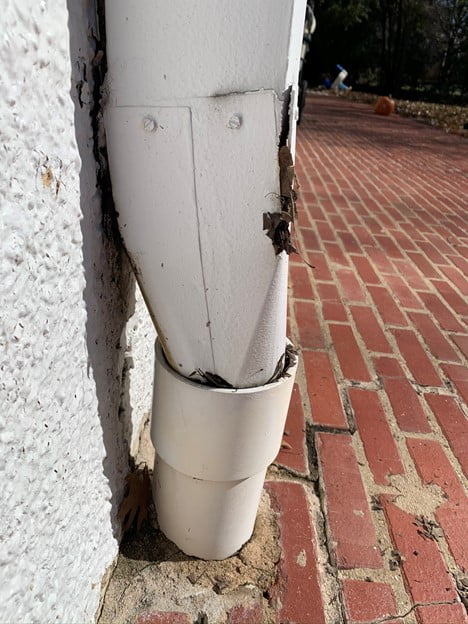
Downspouts come apart at the elbows and at the wall straps. A mower, a ladder, a delivery truck, or twenty years of thermal movement will do it. Once the top elbow separates, water runs straight down the wall and into the bed at the foundation. In this soil that is the worst possible place for it. We reattach and re-strap what is salvageable, replace crushed sections, and add downspout extensions where the discharge is landing too close to the slab. That last one is the cheapest line on the estimate.
5. Hail Damage to the Trough and to the Finish
Aluminum dents. DFW sits in the hail belt and the heaviest storms run March through June. Small hail leaves cosmetic pocking along the top of the trough. Larger stones can crease the front face, split a seam, or knock the crimp out of a downspout. There is also finish damage that is not obvious from the driveway: hail chips the baked-on paint, and once bare metal is exposed the run oxidizes unevenly. One elevation starts to look chalky. We photograph all of it before we quote, because some of it belongs on an insurance claim rather than on your credit card.
6. Sealant That Has Gone Chalky and Hard
Gutter sealant does not fail from freezing here. It fails from ultraviolet exposure and from the temperature swing between a 40-degree January night and a 105-degree July afternoon. The material goes chalky, loses its grip on the metal, and cracks in a fine web. You can usually rub it with a thumbnail and get powder. Once that has happened at one joint, the rest of the joints on the same elevation are the same age and the same exposure. So we quote the elevation, not the single corner.
7. Rotted Fascia Behind the Gutter
This is the failure homeowners do not know they have, because the gutter hides it. Water that gets behind the trough, either from an overflowing run or from a missing drip edge, soaks the top edge of the fascia board where nothing dries it. By the time the paint blisters, the wood behind the hanger can be soft enough to crumble. New hangers screwed into soft wood will pull out again inside two years. We take a section down and probe the board. Then we tell you honestly whether you are buying a gutter repair or a carpentry repair with a gutter on top of it.
8. Two-by-Three Drops on a Roof That Needs Three-by-Four
A 3×4 downspout moves roughly twice the water of a 2×3. Plenty of Dallas homes were built with the smaller size on roof planes that never justified it. The symptom is a gutter that overflows in a hard burst while looking perfectly clean. Clean is not the same as adequate. This is not a defect you can seal or re-hang your way out of. Converting the drops, adding an outlet, or moving up to 6-inch trough is the actual repair. We will say so rather than sell you a cleaning that will not change anything.
The Importance of Timely Gutter Repairs and Maintenance
Regular gutter repair and maintenance play a major role in protecting both residential and commercial properties throughout North Texas. Gutters are often overlooked until a visible issue appears, but water damage typically starts long before it becomes obvious. Small leaks, loose sections, or clogged downspouts can allow water to run behind gutters or pool near the foundation, slowly weakening structural components. By addressing these problems early, property owners can prevent more extensive damage that affects not only the exterior of the building but also interior areas and surrounding grounds.
Another key benefit of timely gutter repairs is improved system efficiency during heavy storms. North Texas weather can produce sudden downpours that put a tremendous amount of stress on gutter systems. When gutters are damaged or improperly sloped, water can overflow and spill onto walkways, entry points, and landscaped areas. Over time, this repeated overflow can lead to soil erosion, cracked foundations, and water intrusion. Routine inspections and repairs ensure that gutters are properly aligned, securely attached, and capable of handling large volumes of water when storms move through the area.
Maintaining your gutter system also helps extend its overall lifespan. Instead of waiting until a full replacement is necessary, repairing worn sections, reinforcing weak points, and keeping debris under control allows your existing system to perform effectively for many more years. This approach saves money over time and reduces the likelihood of emergency repairs caused by sudden failures. Whether the property is a single-family home or a larger commercial building, consistent gutter maintenance is a practical investment that helps protect the structure, preserve curb appeal, and minimize long-term repair costs.
Repair buys time on a system that is otherwise sound. A run that has dropped at one end, a split end cap, two soft feet of fascia behind a hanger: none of those is a reason to take the whole system off the house. Fix them and the original metal has years left in it. The judgment call is knowing which faults are local and which ones mean the system has reached the end, and that is what the sections below are for.
Timing matters as much as intent. The useful window for repair work in this metro is late winter and early fall, before the spring storm line and before the leaf drop. If a run is already sagging in February, it will be overflowing in May. Booking scheduled gutter maintenance ahead of those two seasons costs less than reacting to them, and it keeps small items from turning into section replacement.
Telling a Repair From a Replacement Without Guessing
Repair is the right answer far more often than the industry admits. A gutter is a simple piece of formed metal, and aluminum does not wear out on its own. What fails is the hardware holding it up, the sealant closing its joints, and the wood behind it. All three of those are repairable. We would rather re-hang a sound run than sell you a system you do not need.
These are the conditions where repair is the better buy:
- The trough is straight and the metal is sound, but hangers have loosened in one or two spots.
- Leaks are at corners, end caps and outlets rather than through the body of the gutter.
- One elevation took storm damage and the rest of the house is untouched.
- The sizing is right for the roof and the only problem is pitch, debris or a separated downspout.
- The fascia is solid enough to take a screw and hold it.
And these are the times we will tell you to stop spending on repairs:
- The system is sectional and leaking at multiple joints along a run, because each seam you seal simply moves the load to the next one.
- The trough is undersized for the roof it serves, so the system overflows even when it is clean and correctly pitched.
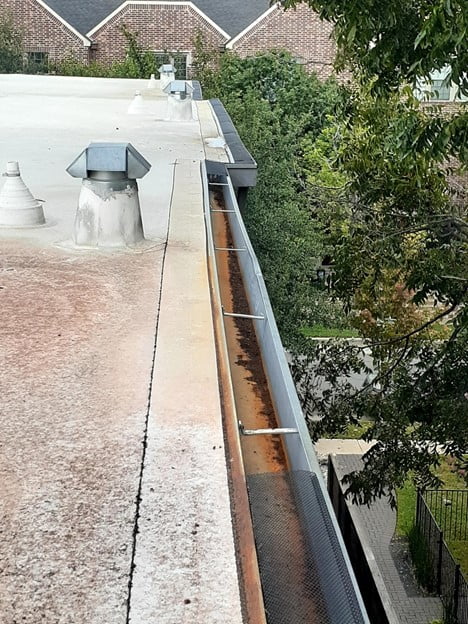
- Steel gutters have rusted through from the inside, which shows as pinholes and brown weeping under the trough.
- Hail has creased the front face along most of the house, which is a cosmetic and structural problem at the same time.
- The fascia needs rebuilding along a full elevation, at which point taking the old gutter off is happening anyway.
When the answer lands on the second list, the conversation moves to what a full gutter replacement actually involves and what it costs. We will give you both numbers, the repair and the replacement, on the same visit so you can compare them yourself instead of taking our word for it.
What We Check on a Repair Call Before We Quote Anything
A useful repair estimate is not a glance from the driveway. We walk the whole roofline, because a symptom on one elevation is often caused by something on another. A downspout that overflows at the back corner is frequently the result of a front run pitched toward it and delivering more water than one drop can take.
On a standard repair visit we look at all of the following:
- Pitch. We check fall along each run toward its outlet and mark where the trough is level or reversed.
- Hanger spacing and grip. Every hanger gets pulled by hand. Anything that moves gets replaced, and we note whether the screw found solid wood.
- Fascia condition. We probe the board behind the gutter at the low spots and at the corners, where water sits longest.
- Seams and outlets. Miters, end caps and every outlet get inspected for sealant failure and for the fine cracking that comes before a visible leak.
- Downspout capacity and condition. Size, count, elbow security, strap security, and whether the run is packed with shingle grit.
- Discharge. Where the water lands, how far it travels, and whether it is running back toward the foundation.
- Roof edge. Drip edge presence, shingle overhang, and whether water is getting behind the trough at the top.
- Debris load. What is in the gutter and what tree it came from, because that determines whether guards will help or just create a new problem.
If the system is simply loaded with debris, we will say that too. A backed-up run that has never been cleaned is a cleaning job, not a repair job. A proper clear-out of the troughs and downspouts costs a fraction of what a repair quote does. Under most DFW canopy, two to three visits a year is the right cadence, four under heavy pecan.
Gutter Repair Prices in DFW, and What Moves the Number
A gutter repair cannot be priced accurately over the phone, because the two variables that drive the cost are how much of the system is affected and how hard it is to reach. What we can do is tell you the shape of the numbers so you know whether the quote in your hand is reasonable. Some of these we can put a range on and some we cannot until we have seen the eave. Every repair estimate we give is free and written down before any work starts, so you are never guessing at what you agreed to.
- A standard repair call. Most single-issue visits on an accessible single-story home are billed as a minimum call charge rather than at a per-foot rate, so ask us for that number when you book and you will know exactly where the job starts. That call typically covers re-securing loose hangers, resealing a corner or two, and putting a separated downspout back together in one trip.
- Resealing seams, miters and end caps. A handful of joints usually fits inside a standard repair call. Resealing every joint on a large or two-story roofline is a bigger job, because the cost is almost entirely ladder time and setup, not material.
- Re-hanging or re-pitching an existing run. Priced by the foot and well below the cost of new gutter, because the trough itself is reused and only the hangers, the pitch and the fixings change. The rate rises where the eave is high or the access is tight, and we put the per-foot figure in writing before anyone gets on a ladder.
- Replacing a damaged section. Section replacement is priced close to the installed rate for that footage, which for seamless aluminum in this metro is about $8 to $14 per linear foot, plus the visit. A 20-foot damaged run is a small job. Four of them is a replacement conversation.
- Downspout work. Reattaching and re-strapping is usually part of a standard call. Adding a new drop, relocating one, or converting 2×3 to 3×4 is priced per drop and depends on the height of the elevation and the number of offsets needed to get around a bay or a chimney chase.
- Fascia repair. Carpentry is quoted separately from the gutter work. Replacing a short soft section behind one hanger is minor. Rebuilding a full elevation of rotted board is a carpentry job with a gutter re-hang attached, and it is worth doing properly because new hangers in bad wood will fail again.
Three things move a repair quote more than anything else. Height is the first: a two-story eave or a steep pitch means different equipment and slower work. Access is the second: a run above a pool, a courtyard, a sunroom or a steep side yard takes longer to reach than one over open lawn. Extent is the third: the cost per joint or per foot falls sharply once we are already set up, and that is why doing one elevation at a time is usually more expensive overall than doing the house in one visit.
For context on the other end of the scale, a complete aluminum system on a typical single-story DFW home of 150 to 200 linear feet runs $1,300 to $2,600, and $2,400 to $4,500 on two-story or complex rooflines. If your repair quote is starting to approach those numbers, we will tell you before you spend the money. Call 214-324-4674 and we will come look at it and give you a free written estimate.
Storm Damage, Insurance Claims, and What to Photograph First
Hail season here runs roughly March through June, with a second run of storms in the fall. After a bad cell moves through, our phones do not stop. The most useful thing you can do before anyone gets on a ladder is document what happened, because a contractor who has already made repairs has also erased the evidence your adjuster needs.
Photograph these, from the ground and with your phone’s date stamp intact:
- The full elevation of each side of the house, so the adjuster can see the whole gutter line in context.
- Close shots of every dent, crease or split, with something in frame for scale.
- Any separated downspout, dislodged elbow, or section hanging off the fascia.
- Hail on the ground, on a driveway or a patio table, ideally next to a coin.
- Debris in the yard, torn screens, and damage to soft metals like vents and flashing, which corroborate the storm’s severity.
- Water staining on brick, siding or soffit that appeared after the storm.
A few honest notes about claims. Cosmetic denting on a gutter is treated differently by different carriers, and some policies exclude it outright. Hail that dents gutters has usually hit the roof as well, so a gutter claim is rarely a gutter-only conversation. And functional damage, meaning splits, creases that hold water, torn seams and dislodged runs, is the part of the claim that carries the most weight. We will write our findings clearly enough that you can hand the document to an adjuster, and we do not tell homeowners what their carrier will or will not pay, because that is not our call to make.
Not every storm produces a claim. Wind damage is often a single run that needs re-hanging, and that is a repair you pay for directly and forget about. The point of documenting first is that you keep the option open.
Emergency Repair Versus Waiting for a Scheduled Slot
Most gutter repair can wait a week or two without consequence. Some cannot. The line between the two is whether water is currently getting somewhere it should not be, and whether anything overhead is at risk of coming down.
Treat it as urgent when a section is hanging loose over a walkway or a driveway, when a downspout has separated and is dumping directly against the foundation, when a run has been torn off by a limb and rain is forecast, or when water is entering the structure at the roof edge. Those are calls for emergency and storm-response gutter repair, where the goal is to make the property safe and get the water going the right way again. A permanent fix can follow once the weather clears.
Everything else is better handled on a scheduled visit, when we can quote the whole system at once instead of solving one symptom under pressure. Standing water in the trough, a chalky seam, a slow drip at a miter, a gutter that overflows only in the heaviest bursts: these are real problems and they all need fixing, but none of them need fixing at nine o’clock at night in the rain.
Looking for Gutter Repair Near Me in North Texas?
If you’ve been searching for gutter repair near me or trying to find a reliable gutter repair company near me, it’s important to work with a team that understands the unique weather conditions and construction styles found throughout North Texas. Not all gutter systems are the same, and having an experienced local company handle your repairs ensures that the solution is both effective and long-lasting.
At Creative Gutter, we’ve helped countless homeowners and business owners who were looking for gutter repair near me and needed fast, dependable service. Whether it’s a small leak, a sagging section, or a more extensive repair, our team takes the time to properly diagnose the issue and provide a solution that restores full functionality. We don’t just patch the problem, we address the underlying cause to help prevent it from happening again.
When comparing options for a gutter repair company near me, it’s important to consider experience, responsiveness, and quality of work. Our team is known for clear communication, honest recommendations, and repairs that are built to last. If your gutters are showing signs of wear or not performing the way they should, reaching out to a trusted local provider for gutter repair near me is one of the best ways to protect your property and avoid more costly damage down the line.
One practical filter when you are comparing companies: ask whether they fabricate on site. A contractor running a roll former can produce a matching replacement section in your driveway rather than joining stock lengths together. That matters on repairs, because a patched section made from seamless gutter rolled to length on the truck introduces no new joints into a system whose joints are already the weak point.
Repairing Gutters on Older Dallas Housing Stock
The pre-war and mid-century neighborhoods inside Loop 12 are a different repair job from a 2010s subdivision, and pricing them the same way is how homeowners end up with a system that fails again in three years. Houses from the 1920s through the 1950s often still carry original fascia, sometimes a true one-by-six or one-by-eight rather than today’s thinner board. That wood is usually better material than anything at a lumberyard now, but ninety years of Texas weather takes its toll at the top edge.
Three things come up repeatedly on these houses. The original gutters are often 4-inch or small 5-inch trough, undersized for the roof area they serve, so the system overflows even when it is perfectly maintained. Some period homes have built-in box gutters integrated into the cornice, which are a carpentry and lining job rather than a hang-and-seal job. And the deep eaves and multiple roof planes common on Tudor and Craftsman elevations mean more miters, which means more joints to seal.
Mid-century ranch houses have the opposite profile. Long, low, uninterrupted roof planes, simple gutter geometry, and shallow pitch. What fails there is almost always hangers and pitch across a very long run, plus too few downspouts for the footage. Those are cheap repairs that make a large difference, and they are the reason we measure rather than assume.
Commercial Gutter Repair: What Fails on a Building Instead of a House
Commercial repair work follows different rules. The trough is often 6-inch or larger, frequently steel rather than aluminum, and the failure modes shift toward corrosion and capacity rather than loose hardware. On a warehouse, a school, a church or a strip retail building, a blocked outlet does not simply overflow onto a lawn. It backs water onto a low-slope roof or through a parapet, which turns a gutter problem into a roofing problem quickly.
What we repair most often on commercial gutter systems is corroded steel trough at the seams, blocked or undersized leaders, failed scupper and conductor head connections, and hanger failure along very long spans where thermal movement has worked the hardware loose. Expansion is a genuine engineering issue at commercial lengths, and a run installed without an expansion joint will eventually tear itself apart at the fixed end.
Scheduling is the other difference. Occupied buildings need work planned around trading hours, delivery bays and parking. We quote commercial repair with that in mind rather than treating it as a bigger house.
How We Serve You
At Creative Gutter, it is our pleasure to ensure that you as the owner of the property are at ease knowing that your gutter system is functioning correctly once the gutter repair and gutter maintenance is complete. We take pride in leaving every job knowing that the system has been properly repaired, secured, and adjusted to perform as intended, even during heavy rainfall.
It’s our mission to ensure that homeowners and commercial building owners alike have the peace of mind that comes from knowing their gutters are working properly and effectively. If you suspect that your gutters are clogged, broken, or faulty, it’s always better to be proactive and have them inspected before damage occurs. In many cases, gutter repair in North Texas can be the saving grace that prevents costly repairs to siding, roofing, or foundations, helping you avoid expenses that can easily reach into the thousands when gutter issues are left unresolved.
Practically, that means we clean up after ourselves, we take the offcuts and the old hardware with us, and we walk the finished work with you before we leave. If we recommended something you decided against, it goes on the written quote anyway so you have a record of it. And if a repair we made does not hold, you call us and we come back.
Gutter Repair Questions We Get Asked on the Phone
How long should a gutter repair last?
A correctly executed repair should outlive the reason you called. Re-hanging a run on hidden hangers into solid fascia is effectively permanent hardware. Resealing a joint is not: sealant is a consumable in this climate and a resealed miter will want attention again eventually, though properly prepped joints last far longer than a smear over old material. If a repair fails early, the underlying cause was usually not addressed, which most often means the fascia.
Is it cheaper to repair gutters or replace them?
Repair is cheaper on a per-visit basis almost every time. The question that matters is cost over the next ten years. If you are paying for a repair call annually on the same system, and the trough is undersized or the seams are failing along the whole run, you will spend more in repairs than a replacement would have cost. We give you both numbers so the comparison is yours to make.
Can you repair just one section of gutter and match it to the rest?
Usually yes. We fabricate on site, so a replacement section can be cut to exact length in your driveway. Color is the honest caveat. A twenty-year-old run has faded, and a brand new section in the same factory color will read slightly different for a while. On a back elevation it is not worth worrying about. On a prominent front elevation, some homeowners choose to redo the full run for that reason.
My gutters overflow even though they are clean. What is wrong?
That is nearly always a capacity or pitch problem rather than a blockage. Either the trough is too small for the roof area draining into it, there are too few downspouts, the drops are 2×3 where they should be 3×4, or the run is pitched away from the outlet. It can also be water overshooting the gutter from a steep roof plane, in which case the fix is a repositioned trough or a diverter rather than a bigger one.
Do you offer gutter repair near me if I am outside Dallas County?
Yes. We run repair work across Dallas, Collin, Denton, Rockwall and Tarrant counties, and the same crews handle gutter installation and repair in Dallas and the surrounding cities. If you are searching for gutter repair near me from Plano, Rockwall, Mesquite, Lewisville or Fort Worth, we cover it.
Will gutter guards fix my leaking gutter?
No, and this is worth being blunt about. A guard is a filter. It does nothing for pitch, hangers, seams or capacity, and screening a failing gutter simply hides the problem under a lid. Fix the run first. Then, if the debris load on your property justifies it, leaf screen and guard options are a reasonable maintenance decision on a system that is already sound.
How quickly can you get out after a storm?
It depends entirely on how widespread the storm was. After a metro-wide hail event, every gutter and roofing company in North Texas is booked, and any company quoting you a guaranteed arrival hour after an event like that is guessing. We would rather give you a realistic window and keep to it. What we can tell you is that genuine emergencies, meaning hanging sections and active water intrusion, get prioritized over cosmetic work, and you will get an honest answer on the phone rather than an optimistic one.
Do I need to be home for the repair?
For the estimate it helps, because we would rather show you the fascia than describe it. For the work itself, usually not, as long as we have access to the full perimeter and any locked gates are open. We will send the written findings either way.
Can you repair copper or half-round gutters?
Yes. Copper and half-round work is a different craft, with soldered joints on copper rather than sealed ones, and it needs the right materials throughout. Never put aluminum or galvanized screen on a copper system. If you want to see the profiles and materials we carry, ask us to bring samples to the estimate.
Guarantee & Warranty
At Creative Gutter, we are fully insured and want to make sure that you have the best experience with your gutter service for your home. We also want to make sure that your gutter system performs flawlessly in years to come.
That’s why we give you a five-year (5) warranty on workmanship AND a twenty-year (20) warranty on all materials.
On repair work specifically, the workmanship warranty covers what we did. If we re-hung a run and it sags, if we resealed a miter and it leaks, if we reset a downspout and it separates, that is ours to put right and there is no argument about it. What it does not cover is the part of the system we did not touch, or a component that was already at the end of its life and that you chose not to replace after we told you so in writing. We would rather set that expectation clearly up front than have the conversation later.
The twenty-year manufacturer warranty applies to the materials themselves, including the finish on new coil we install as part of a section replacement. Keep your written quote and your invoice. They are the record of what was done and when, and they are what we work from if you call us back.
Contact us today to schedule a FREE on-site consultation for gutter installation or repair for your home or business in Dallas, Collin, Denton, Rockwall and Tarrant Counties. 214-324-4674
Have Us Look at It Before the Next Storm Line Arrives
If your gutters are sagging, leaking at a corner, holding water, or overflowing in every hard rain, the cheapest moment to deal with it is now. We will walk the roofline, pull a hanger, probe the fascia, and give you a written repair quote at no charge, along with a straight answer about whether repair or a new seamless system is the better use of your money. Call Creative Gutter at 214-324-4674 and we will come and look at it.
Contact us today to schedule a FREE on-site consultation for gutter installation or repair for your home or business in Dallas, Collin and Rockwall Counties.
214-324-4674