

Gutters in Dallas, TX
Gutters in Dallas, TX: Styles, Materials and Sizes
Choosing gutters in Dallas comes down to three decisions: how much water the gutter has to carry, which profile suits the house, and which metal you want along the roofline. Capacity is settled first, because a handsome gutter that’s too small for the roof above it will still spill over the front edge in a hard storm. Profile and metal follow, and those two are where appearance, upkeep and budget come in.
Each of the gutter styles, gutter sizes and materials Creative Gutter installs has a starting price per linear foot, so you can work out roughly where your own house lands before anybody measures it.
Gutter Sizes for Dallas Homes: Capacity Comes Before Style
A gutter isn’t sized for an average rainy day. The Dallas-Fort Worth area averages roughly 37 to 40 inches of rain a year, but that rain does not arrive evenly, and a single storm can drop inches of it in under an hour. The system has to cope with the heaviest few minutes of that storm, when every square foot of roof is shedding water at once.
Three things decide how much water reaches a given stretch of gutter, and together they point to the right gutter sizes for a house. Roof area is the obvious one. Pitch is the second, since a steep roof delivers water faster and with more momentum than a shallow one. Valleys are the third and often the most important: where two roof planes meet, the runoff from both lands on a short length of gutter, and that’s usually the first place a system overflows.
For early budgeting, footage is a useful guide. A 1,500 square foot home typically needs 150 to 200 linear feet of gutters and downspouts combined. A home around 2,500 square feet usually falls between 200 and 300 feet, and a home of 3,500 square feet or more generally needs 350 feet or more. Those are planning figures only. A quote is built from measurements of the actual roofline.
5-Inch, 6-Inch and Oversized K-Style Gutters Compared
Width is measured across the top of the gutter, and a single inch makes a bigger difference than it sounds. A 6-inch K-style gutter handles roughly 40 percent more water than a 5-inch, because the extra width also brings extra depth. It accepts a larger outlet and a larger downspout too, which matters just as much as the volume the gutter itself can hold.
When a 5-Inch Gutter Is the Right Size
Five-inch is the standard residential size and it works well on a single-story house with a simple roof, moderate pitch and short to medium runs. It costs the least per foot, and there’s no reason to pay for capacity the roof will never use.
When to Move Up to 6-Inch
Six-inch is generally the better fit for steep roofs, long runs, runs below valleys and large uninterrupted roof planes, and a mix of sizes on one house is common. The wider gutter catches fast-moving water that would overshoot a narrow one, and it leaves more room for water to pass around the debris that collects between cleanings. If a clean 5-inch system still overflows in ordinary storms, size is the likely cause.
7-Inch and Oversized Gutters
Seven-inch and other oversized profiles are for large custom homes, commercial buildings, and the occasional residential roof where an unusual amount of water arrives at one spot. They’re a specialty product, and the price per foot reflects that.
Gutter Styles for Dallas Homes: K-Style, Half-Round and Box
Profile is the shape of the gutter in cross-section. It affects how the gutter looks against the house, how much water it holds for a given width, how it’s supported, and how easily debris moves through it. Of all the gutter styles available, three cover nearly every home and commercial building.
K-Style Gutters
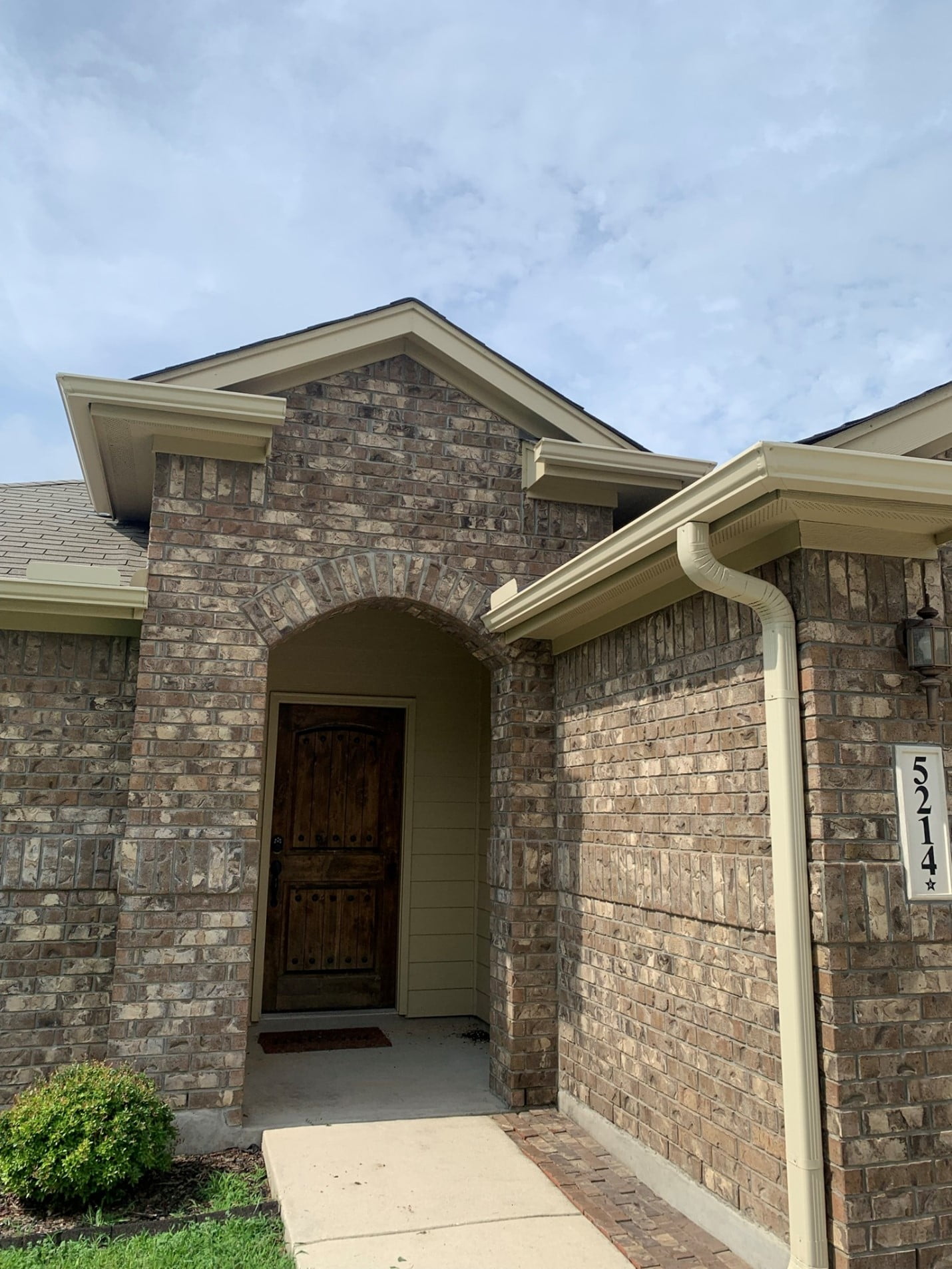
K-style is the most common residential profile in North Texas and across the country. The back is flat so it sits tight to the fascia, the bottom is flat, and the front has a stepped curve that looks a little like crown molding. That shape is efficient: a K-style gutter holds more water than a half-round of the same nominal width, and the folded front edge stiffens the run along its length.
It suits most homes, which is why it’s the usual recommendation for Dallas houses. It’s available in aluminum and copper, in 5-inch, 6-inch and oversized widths, and it’s the profile seamless machines are most often set up to form. One trade-off is worth knowing about. The inside corners of a K-style gutter give shingle grit and fine debris a place to settle, so under heavy tree cover it benefits from a guard or from more regular cleaning.
Half-Round Gutters
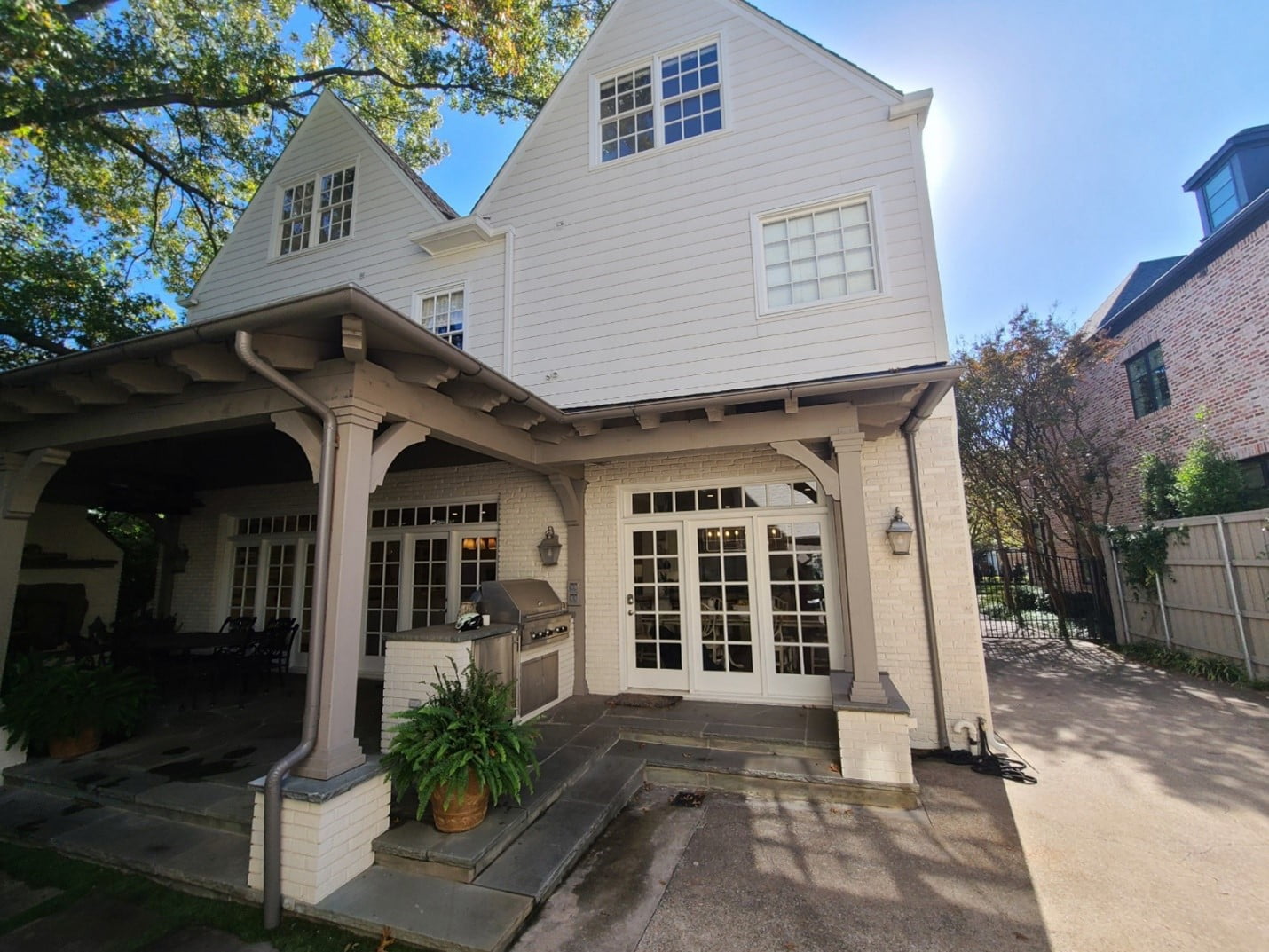
A half-round gutter is a simple semicircular trough, usually carried on brackets that remain visible beneath it. It’s the traditional profile, and it suits older and architectural homes where the squared face of a K-style gutter would look too modern. Tudor, Spanish, Mediterranean and other period elevations are where half-round tends to look most at home.
The smooth curve has a practical benefit. With no inside corners, water sweeps debris along the bottom instead of leaving it packed into an angle, so half-round tends to stay clearer between cleanings. The compromise is capacity. Half-round carries less water than K-style at the same width, which means the size and the number of downspouts need to be worked out carefully on a larger roof. It pairs naturally with round downspouts.
Box Gutters
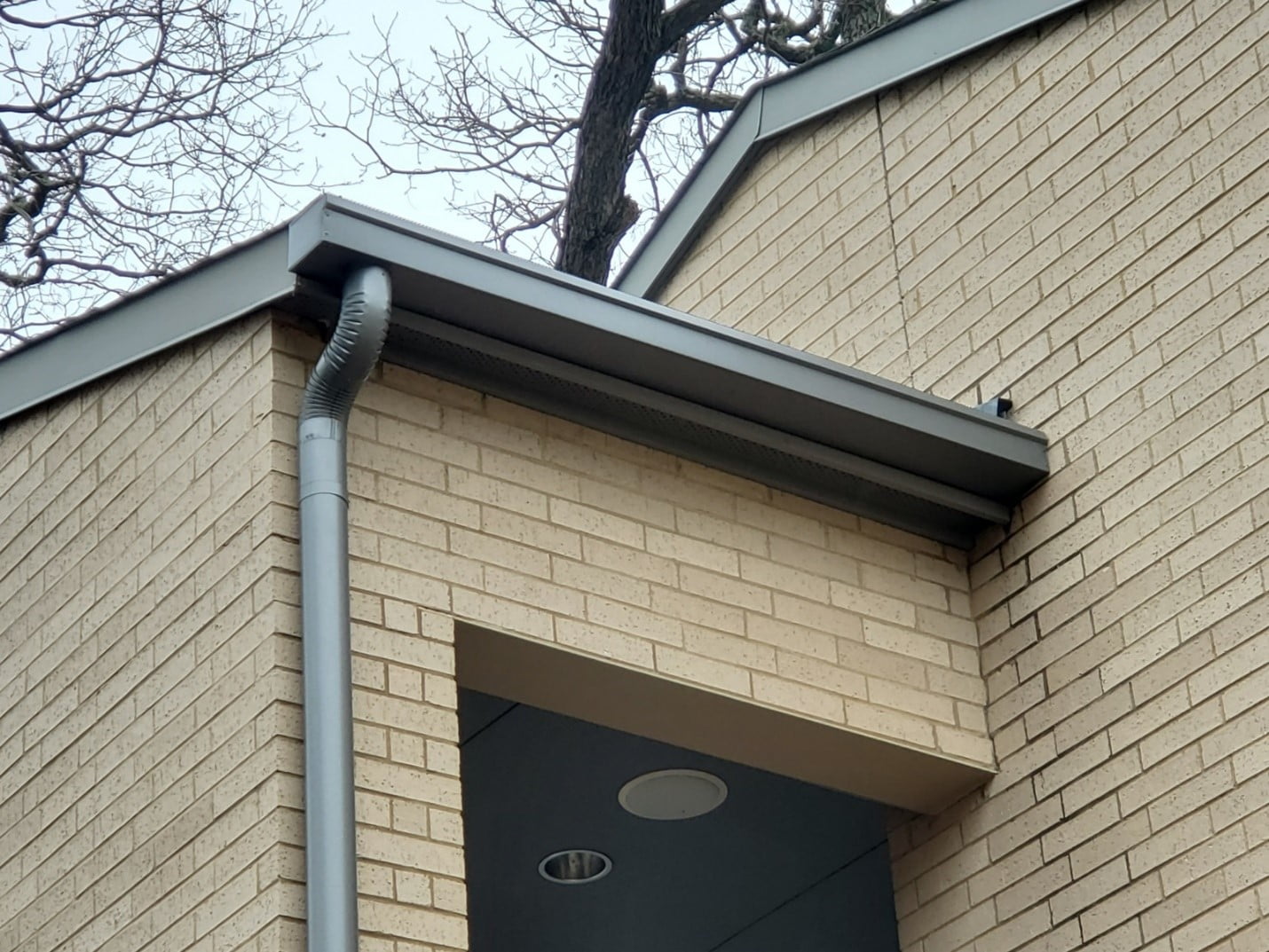
A box gutter has a square or rectangular section with straight sides, and it’s built for volume. Box gutters are the usual choice on commercial buildings, on low-slope and flat-roofed structures, and on some modern homes where a clean rectangular line is part of the design. Large downspouts go with them, because a gutter that holds that much water needs an outlet to match.
We install box gutter on both residential and commercial buildings. One difference from residential seamless work is how the material arrives. Commercial gutter comes in 10-foot or 20-foot sections and is not formed on site, so the joints between sections are part of the design and need to be made and sealed properly.
Copper and Aluminum Gutters: Choosing the Metal
We install two metals, and they sit at opposite ends of the price range. Both last a long time in North Texas conditions when the system is sized and hung correctly. The choice between them comes down to appearance, budget and how long you expect to stay in the house.
Aluminum Gutters
Aluminum is the usual gutter metal for homes. Aluminum does not rust, it’s light enough that a long run puts little load on the fascia, it can be formed seamlessly at the house, and it takes a factory finish in a wide selection of colors. For most houses it’s the sensible default, and it’s available in every profile and width on this page.
The main thing that varies between one aluminum gutter and another is the thickness of the metal. Thicker stock holds a straight line over a long run, resists dents from hail and ladders, and is less prone to rippling as it expands in summer heat. If you’re comparing quotes, ask each contractor what thickness they’re pricing, since two gutters that look identical from the ground can be quite different products.
Copper Gutters
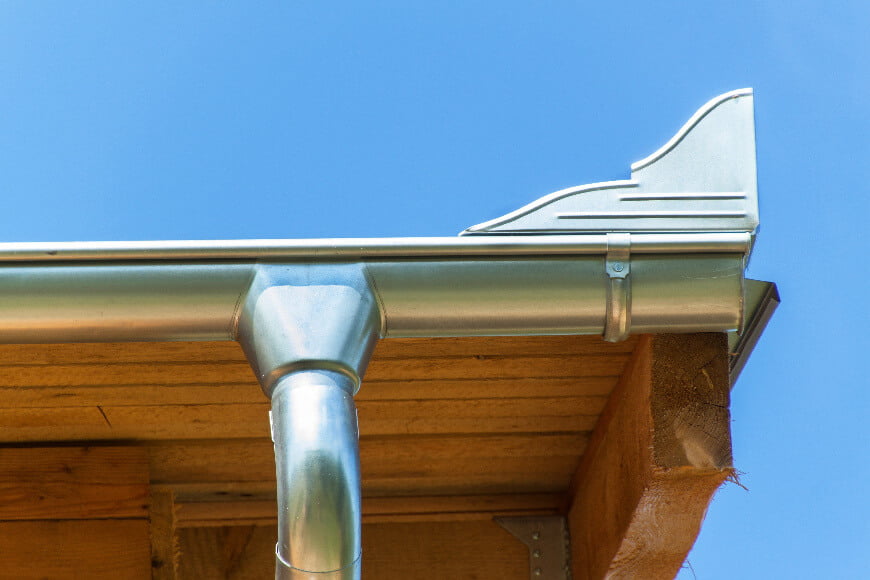
Copper gutters are chosen for appearance and longevity in equal measure. New copper is bright, then it darkens to brown over the first few years, and eventually it develops the green patina seen on old buildings. It needs minimal maintenance, and a well-installed copper system can outlast the roof it serves. We install copper in both K-style and half-round, with copper downspouts to match.
One rule governs every copper job: aluminum and copper must never touch. Where the two metals meet in the presence of water, the aluminum corrodes quickly. A copper gutter therefore needs compatible hangers, fasteners and downspouts throughout, and that’s part of why copper gutters cost what they do. A copper half-round gutter on brackets with round copper downspouts is the classic combination for a traditional home.
How Seamless Gutters Are Formed for Each Run
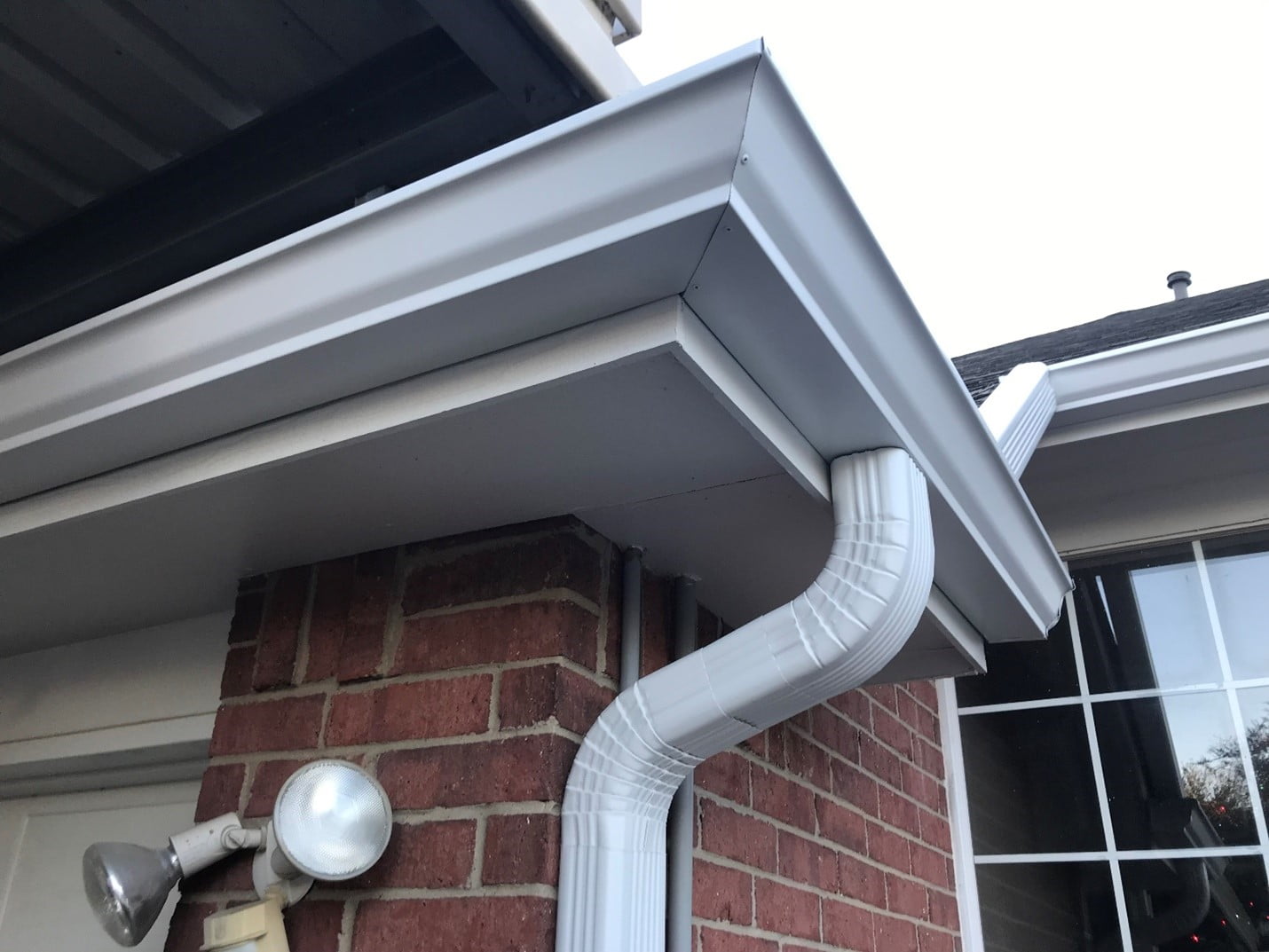
Seamless describes how a gutter is made, and it’s available in more than one profile. Sectional gutter is sold in fixed lengths that get joined along the run, and each of those joints is sealed. Summers here regularly pass 100 degrees, the metal grows and shrinks with every swing in temperature, and over time that movement works on the joints until one begins to drip.
A seamless gutter is formed on site from a coil of aluminum and custom-cut to the length of each run, so a 40-foot side of the house gets one 40-foot gutter. Joints remain only at corners, end caps and downspout outlets. Fewer joints means fewer places to leak and a cleaner line along the eave. Our seamless gutters page explains the fabrication and its advantages in more detail.
Finish, Color and Metal Thickness on Aluminum Gutters
The finish on an aluminum gutter is applied at the factory before the coil ever reaches the machine. A factory finish keeps its color under Texas sun far better than paint applied after installation, and it resists chalking. That matters most on the sides of a house that take the afternoon sun.
Most homeowners match the gutter to the trim or fascia so the system blends into the roofline, and match the downspouts to the wall behind them so they recede. We offer many color options, so picking a color close to your trim is straightforward.
How a gutter is attached deserves a question during any estimate. Hidden hangers clip inside the gutter and fasten through the back into the fascia, where they can’t be seen from the ground. The older spike-and-ferrule method drives a long nail through the front face, and those spikes tend to work loose as the wood and metal move. It’s worth asking any contractor which type of hanger they use.
Downspout Sizes and Shapes That Match the Gutter
A gutter only performs as well as the downspouts draining it. When the outlet can’t empty the gutter as fast as the roof fills it, water backs up and spills over the front, however large the gutter is. Undersized or too-few downspouts are a common cause of overflow.
The standard rectangular downspout is 2×3, and it suits smaller roofs with shorter runs on a 5-inch gutter. A 3×4 downspout moves roughly twice the water of a 2×3, and it’s the right partner for a 6-inch gutter, a large or steep roof plane, or any long run that drains to a single outlet. Its larger opening also passes leaves and twigs that would lodge in a smaller one. Round smooth downspouts, in aluminum or copper, are the finished look beneath a half-round gutter.
Where the water is released matters as much as how it gets down. North Texas has expansive clay soils that swell when wet and shrink when dry, so water dumped at the edge of the slab year after year is hard on a foundation. Downspouts should be placed where the discharge can be directed away from the house, and above-ground extensions carry it further out. What we install runs above ground, so if your lot needs water carried farther than that, mention it when we come out to measure.
Gutter Guard Options for Any Gutter Profile
Guards make the most sense on a house with trees over or near the roof, and they’re harder to justify on an open lot. We install two types. Expanded Steel (Roll Lock) screen is a rigid screen that keeps leaves, twigs and larger debris out of the gutter while letting water through, and it starts at $5 per linear foot.
Micro-mesh, which we offer in stainless and aluminum, has a much finer weave. It stops shingle grit, seeds and small needles along with whole leaves, and it starts at $10 per linear foot. Neither type ends cleaning altogether. Both keep most debris out of the trough and help prevent the packed clogs that cause overflow in the middle of a storm. The gutter guards page compares the two in depth.
What Dallas Gutters Cost Per Foot
Price is driven by footage, metal, width, profile and how difficult the house is to work on. The figures below are starting prices and ranges per linear foot, not fixed rates. Two-story elevations, steep or cut-up rooflines, and limited access all move a job toward the upper end of a range.
- 5-inch aluminum K-style, seamless: $7 to $14 per foot
- 6-inch aluminum K-style, seamless: $8 to $16 per foot
- 7-inch or oversized aluminum K-style: $20 to $28 per foot
- Aluminum half-round: $13 to $25 per foot
- Copper K-style: $40 to $55 per foot
- Copper half-round: $45 to $60 per foot
- Box gutter, residential or commercial: $20 to $30 per foot
Downspouts are priced separately. Aluminum 2×3 starts at $7 per foot and aluminum 3×4 at $8 per foot. Round smooth aluminum starts at $14 per foot and round smooth copper at $45 per foot. An above-ground downspout extension starts from a $250 minimum.
Minimum charges apply to every job. New and replacement gutter work carries a $500 minimum, and downspout work carries a $250 minimum. Commercial installation starts from a $750 minimum, with commercial downspouts from $20 per foot and a $300 minimum. Your actual figure comes as a written, itemized quote based on measurements of your house, and the estimate is always free.
Matching Gutter Styles to the House: Common Combinations
Most choices fall into a handful of familiar pairings. A single-story home with a simple hip or gable roof is usually well served by 5-inch aluminum gutters with 2×3 downspouts. A home with large or steep roof planes and long valleys generally moves to 6-inch aluminum K-style with 3×4 downspouts, sometimes with an extra downspout added where a valley concentrates the flow.
Older and architectural homes are where half-round fits best, in aluminum when budget matters and in copper when the gutter is meant to be a visible feature. Modern designs with flat fascias and sharp lines often suit a box gutter, as do buildings with low-slope roofs.
Residential and Commercial Gutters Across Dallas and DFW
The product choices above are written mainly with homeowners in mind. Newer homes can have larger roof areas and more complicated rooflines than their original gutters were sized for, while older homes may be better suited to a traditional profile. Our residential gutters page covers how a home system is planned and installed.
Commercial buildings ask different questions. Offices, warehouses, retail centers and apartment buildings often need box gutters, large downspouts and high-capacity gutter systems sized for a much bigger roof. The same products apply whether the property is in Dallas or elsewhere in the five counties we serve.
If you arrived here looking for the broader subject, including how rain gutters work and what services keep them working, our page on rain gutters in Dallas is the better starting point. That page covers the same products from the service side.
From Choosing a Gutter to Having It Installed
Once you’ve narrowed down a profile, size and metal, the next step is a free estimate, and we finalize an installation quote only after visiting the site. Being at the house lets us confirm the measurements, work out the elbow and miter configurations, and see whether any offsets are needed. We also look at how the ground falls and where the water needs to go, which decides downspout positions.
On a typical house the installation itself takes 2 to 4 hours, while a very large home can take a full day or occasionally two. If you searched for gutter installation near me from a Dallas address, our shop is close by, and our Dallas gutter installation page describes that service in full.
When Existing Dallas Gutters Need Repair Instead of a New Style
Not everyone reading about products needs a full replacement. A run that sags, a corner that drips, an end cap that seeps or a downspout that has pulled away from the wall is usually a repair, and repairs each start from a $250 minimum charge. On a repair we inspect, identify the issue, and tell you what it takes to correct it. Our gutter repair page lists the common fixes.
Replacement becomes the better value when problems show up on several sides of the house at once, when sectional joints keep leaking after they’ve been resealed, or when the gutters were simply too small for the roof from the start. Soft or rotted fascia behind a gutter is a sign of long-term overflow and worth mentioning when you call about a repair or replacement. A gutter that’s only full of leaves needs cleaning, which also starts from a $250 minimum charge.
Warranty Coverage on New Gutters From Creative Gutter
Every gutter installation we complete comes with a 5-year workmanship warranty, and the materials carry a 20-year manufacturer warranty. Maintenance work, meaning sealing seams, re-pitching a run, adding hangers or re-securing a loose section, carries its own 2-year warranty. The two are different, so it helps to know which applies to the work you’re having done.
Based at 1515 Fuller Dr in Dallas, Creative Gutter has been family owned and operated since 1984. In over 40 years we’ve installed thousands of gutter systems across North Texas, and we’re fully insured. Our customers’ feedback stands at 4.9 stars across 140+ reviews on Google, and we have the experience, equipment and crew capacity to handle a project start to finish, at competitive pricing.
Questions About Gutters in Dallas: Styles, Sizes and Materials
What type of gutters in Dallas do most homes have?
Most homes have 5-inch or 6-inch aluminum K-style gutters, and many new systems are seamless. K-style is popular because it holds a lot of water for its width, suits most architecture and is economical to form at the house. Half-round and box profiles are less common and tend to be chosen for a particular look or a particular kind of roof.
How do I know whether I need 5-inch or 6-inch gutters?
Start with how the current system behaves. If clean gutters overflow in an ordinary storm and the runs still hold their pitch, the gutter or its downspouts are probably too small. A steep pitch, long runs, valleys and large roof planes all point toward 6-inch with 3×4 downspouts. A simple single-story roof is usually fine with 5-inch.
Are half-round gutters as good as K-style?
They’re equally durable, but they behave differently. Half-round sheds debris more easily and looks right on traditional homes, while K-style carries more water at the same width and costs less per foot in aluminum. On a large or steep roof, half-round may need a wider size or additional downspouts to keep up.
Can I use half-round on the front of the house and K-style on the back?
Yes, and some homeowners do this to put the more decorative profile where it’s seen while keeping costs down elsewhere. The two profiles can’t join neatly at a corner, so the change needs to happen where runs end naturally. Keeping the same color and downspout style on both helps the house read as one system.
Are copper gutters worth the extra cost?
That depends on the house and how long you plan to keep it. Copper costs several times what aluminum does per foot, but it lasts a very long time, needs minimal maintenance and gives a look no painted metal can imitate. On a traditional or high-end home it’s often a fitting choice. On a typical house, aluminum delivers the same drainage for far less.
How do I choose a color for new gutters?
Aluminum gutter coil comes in a wide selection of factory finishes. Most people pick a tone near the trim or fascia so the gutter blends in, or a deliberate contrast.
Where is a box gutter a better choice than K-style?
A box gutter is the better choice when the roof is large, low-slope or commercial, and when the volume of water would overwhelm a residential profile. It’s also chosen on modern homes for its square, minimal appearance. For an ordinary pitched-roof house, a 6-inch residential gutter usually provides enough capacity at a lower cost per foot.
Do gutter guards mean the gutters never need cleaning?
No. Guards keep most debris out of the gutter, but fine material still gets through or collects on top. As a general recommendation, gutters should be cleaned 1 to 3 times a year depending on tree cover over the house, the type of trees and the storms that season.
Get a Free Estimate on Gutters in Dallas, TX
If you’d like help choosing between these gutter styles and sizes, or you already know what you want and need a price, we’re glad to take a look. Estimates are always free, and you’ll receive a written, itemized quote based on actual measurements of your home or building.
Call 214-324-4674 to request a free estimate on new gutters in Dallas or anywhere in our service area. Creative Gutter serves homeowners and businesses across Dallas, Collin, Denton, Rockwall and Tarrant counties.

Contact us today to schedule a FREE on-site consultation for gutter installation or repair for your home or business in Dallas, Collin, Rockwall, Denton and Tarrant Counties.
214-324-4674