

Commercial Gutters
Creative Gutter has been sizing, fabricating and hanging commercial gutter systems across Dallas and the surrounding counties since 1984. A commercial roof is not a large house roof. It drains through box gutters, internal valleys, roof drains and through-wall scuppers, and it has to keep doing that while the building stays open for business. We survey the roof, work out what it actually sheds, and quote from measurements.
Most of the buildings we gutter in the Metroplex fall into a handful of shapes: a retail strip with a parapet, a two or three story office with a low-slope membrane, a church with tall steep planes feeding one short eave, a school with long covered walkways, a warehouse with internal valley gutters, and multi-tenant flex space where nobody is quite sure who owns the downspouts. Each of those fails in its own way, and the fix is different for each. So we survey first. Commercial gutter installation on any of them starts on the roof rather than in a catalog.
Professional Commercial Gutter Installation in Dallas & North Texas
Creative Gutter specializes in installing new gutters for commercial properties in Dallas and throughout North Texas. Regardless of the size of your commercial building, it’s extremely important to ensure that your gutter system is sized correctly to the roof area and designed to handle the full range of Texas weather conditions.
Commercial roofs collect and move a large volume of water during storms, and an undersized or poorly designed gutter system can quickly become overwhelmed. Our professional gutter sales personnel will come out to your property and complete a full inspection and analysis, which settles the gutter type, material and size that will work on your building. Nothing gets specified from a phone call.
We take a practical, building-specific approach to commercial gutter installation. During our on-site evaluation, we look closely at roof pitch, drainage points, existing downspout placement, and areas where water may already be causing issues. This allows us to recommend a gutter system that manages runoff efficiently while reducing the risk of water pooling, overflow, or structural damage. A properly installed commercial gutter system helps protect exterior walls, entryways, landscaping, and parking areas from ongoing water exposure.
It is crucial that you have the right gutter system on a commercial building to safely remove water from the roof and direct it to areas where it can drain away from the property. Without proper drainage, excess water can seep into walls or collect near the foundation, leading to long-term damage that is expensive to repair. Broken or clogged downspouts turn up constantly on commercial buildings. Left unaddressed they do irreparable damage to exterior walls and to the foundation below them. Regular inspections and timely replacements play a major role in preventing these issues.
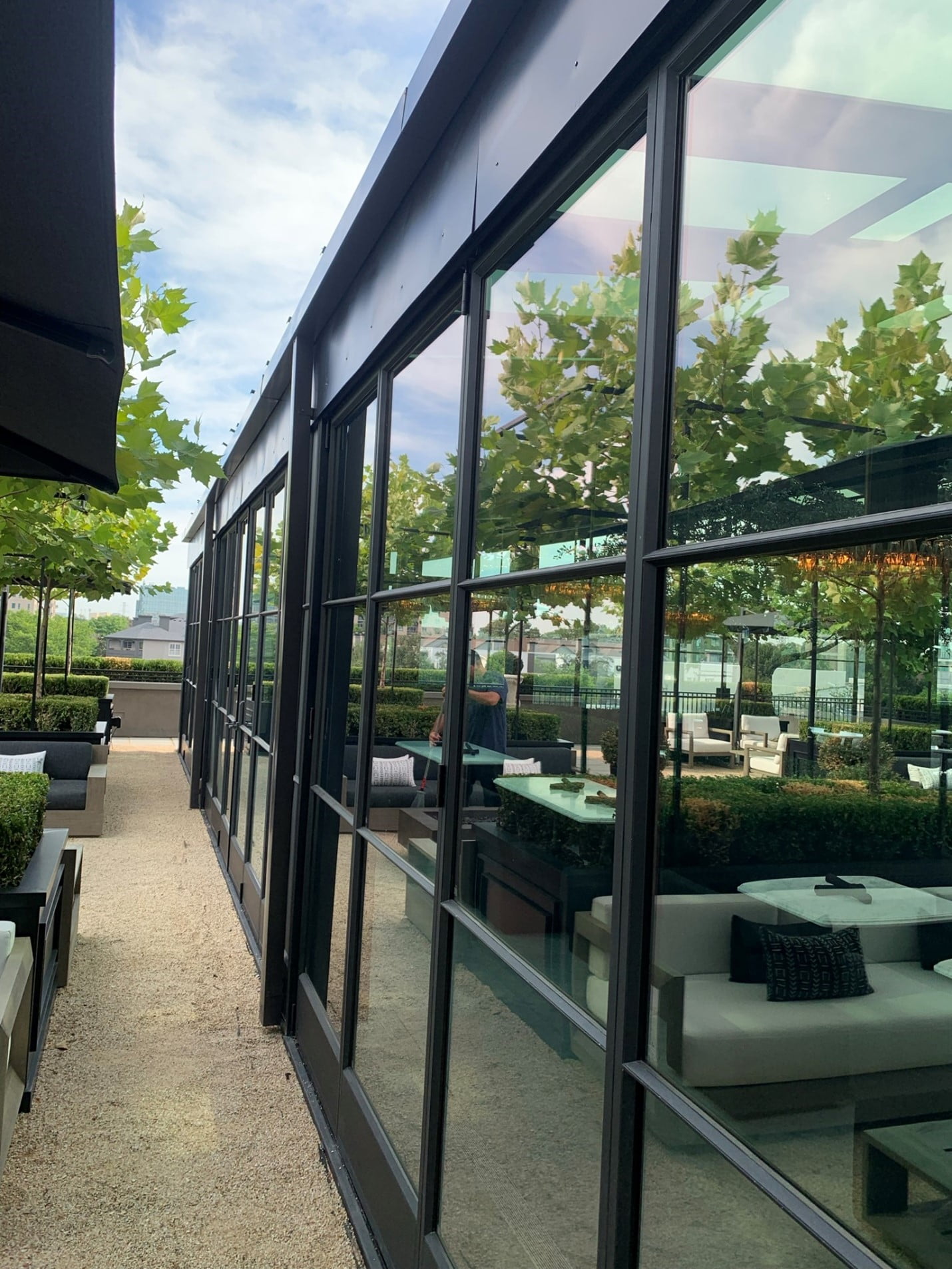
The survey itself is the part that separates a real commercial quote from a number over the phone. We measure every run, count the outlets, look at where the existing leaders land, and check the fascia or edge metal that the new system will hang from. On a low-slope roof we walk it. On a steep church or school roof we work from the ladder line and the drawings if you have them. Nothing gets priced until we know the linear footage and the discharge points.
The same crew that fabricates continuous runs on-site for houses runs the heavier commercial coil through the machine in your parking lot. That matters on a long elevation, because a 140-foot warehouse wall wants one continuous trough, not fourteen sections lapped and sealed. Fewer joints means fewer places for a seal to open up two summers from now.
Sizing a Commercial Roof for Burst Intensity, Not Annual Rainfall
North Texas gets roughly 37 to 40 inches of rain a year, which is unremarkable. What is not unremarkable is how it arrives. A spring cell can drop a large share of a month’s total in under an hour, and gutter capacity is decided by that hour, not by the annual figure. Sizing a commercial system off average rainfall is the single most common design error we find on buildings that overflow.
The arithmetic that matters is roof area feeding one outlet. A 12,000 square foot warehouse roof draining to four downspouts is asking each leader to carry 3,000 square feet of runoff. Halve the number of outlets and you double the load on each one, no matter how wide the trough is. That is why we usually add outlets before we add gutter width: a trough only stores water, the downspout is what moves it.
Plumbing code sizing tables are built from a one-hour rainfall rate for the specific location, and the rate used for this region is high. Lay a system out from national rules of thumb and it will be undersized here. When a property manager tells us the gutters overflow every spring but hold up fine the rest of the year, we are almost always looking at a capacity problem rather than a workmanship problem. Getting the capacity right is the part of commercial gutter installation that goes unremarked until the first hard cell of the spring.
Why Proper Commercial Gutters Matter
- Correctly sized gutters reduce the risk of overflow during heavy rainstorms
- Proper downspout placement helps move water away from walls and foundations
- Well-installed systems protect siding, masonry, and building finishes
- Functional gutters help prevent soil erosion and standing water around the property
- Routine monitoring allows small issues to be addressed before major damage occurs
That’s why it’s so important to consistently monitor your commercial building’s gutter system and address problems early. If you need a new gutter system or are experiencing drainage issues, working with experienced commercial gutter installers in North Texas makes a significant difference. We provide free estimates and clear recommendations so you can make informed decisions that protect your building and help avoid costly repairs down the road.
There is a second cost that owners tend to discover late. Overflow at a storefront does not just wet the masonry, it wets the entryway, and a wet entryway on a retail strip is a slip claim waiting to happen. That is exposure, not maintenance. On an office building it stains the EIFS and streaks the glass, and the tenant complaint arrives before the damage does. Drainage on a commercial building is a liability item as much as a maintenance item.
Box and Internal Gutters: The Drainage You Cannot See From the Parking Lot
A box gutter is a rectangular trough rather than a formed profile hung on the fascia. On older masonry buildings it is often built into the roof edge behind a parapet, so the trough is part of the structure itself. The only visible sign is the leader coming down the wall. On newer metal buildings the same idea shows up as an internal valley gutter running between two roof planes.
The difference that matters is where the water goes when the trough fails. A K-style gutter that overflows spills outside the building. A box gutter or internal valley that overflows spills into the building, over the top plate and down the inside of the wall. That is why we treat these as a different class of work, with heavier metal, wider laps, and sealed and riveted joints rather than sealant alone. Overflow provision gets designed in from the start.
Box gutters are fabricated rather than run off a roll, which changes both the lead time and the price basis. We break them down and quote by the job, not by the foot, because the corners, end dams, outlet tubes and expansion joints are all bespoke to the building. On long runs, expansion joints are not optional. Metal moves a meaningful amount over a Dallas temperature swing, and a 90-foot uninterrupted trough with no relief will tear itself apart at a corner. Long runs need somewhere to go.
- Built-in box gutters on period masonry, usually behind a parapet, often with an original lining at the end of its life
- Internal valley gutters on metal buildings, draining two roof planes into a single trough
- Hung box gutters on modern commercial eaves, chosen for capacity and for a squared-off look under a flat fascia
- Conductor heads and collector boxes where a scupper or a large outlet needs to transition into a leader
Roof Drains, Scuppers and the Overflow Path That Has to Exist
Plenty of commercial roofs in DFW have no perimeter gutter at all. A parapet roof drains through internal roof drains piped inside the building, or through wall scuppers that dump into a conductor head and then into a leader down the face of the wall. In both cases the roof is holding water on purpose until it finds the outlet, and that is fine right up until the outlet is blocked. Then it is a ceiling.
Every one of those roofs needs a second path. On a scupper detail that means an overflow opening set higher than the primary, so it stays dry in normal rain and only runs when the primary is plugged. If you have ever seen water pouring out of a hole in a parapet halfway across a shopping center, that was the overflow doing exactly its job and telling you the primary needs clearing. On a drained roof the equivalent is an overflow drain or a scupper set above the low point.
We do not touch the roof membrane itself. When a problem belongs to your roofer rather than to us, we will say so plainly and put it in the written findings so you have something to hand them. What we do handle is everything from the scupper outward: the conductor head, the leader, the transition at grade, and any perimeter trough. Where a building has both a gutter and a scupper on the same elevation, we make sure they are not fighting each other for the same discharge point.
Different Types of Gutters For Your Commercial Property
At Creative Gutter, we’ve been installing commercial gutters for years throughout North Texas. We’ve worked with property owners, builders, and property managers on a wide range of commercial projects, so we understand the construction styles and drainage demands that are common in this region. It’s extremely important that your gutter system is properly designed for your specific building type, as commercial roofs often handle much larger volumes of water than residential properties. Choosing the right system ensures that water is directed efficiently away from the structure, helping to protect the building and surrounding areas.
That’s why we offer different gutter styles, which are not only different aesthetically, but also vary in how much water they can handle and how they integrate with your building’s design:
- K-Style Gutters
- Box Gutters
- Half-Round Gutters
Each option is selected based on factors such as roof size, slope, drainage requirements, and the overall look of the property. Our team takes the time to evaluate these details so your gutter system performs reliably during heavy rainfall and changing weather conditions.
We can also install leaf screens and downspout extensions as part of your commercial gutter system. Leaf screens help prevent debris from entering the gutters, reducing the risk of clogs that can disrupt water flow and lead to overflow issues. Downspout extensions help move water farther away from the building’s foundation, which matters most on larger structures, where accumulated water does long-term damage if it is left to sit. Volume is the reason.
Call us to come out and we will provide a free gutter inspection for your commercial property. Our professional gutter installers will walk you through all of your options, including different gutter styles, materials, colors, and add-ons. This ensures that your commercial building is equipped with a system that can handle the demands of North Texas weather while maintaining a clean, professional appearance.
Half-round has a narrower use case on commercial work than the catalogs suggest. It is a profile chosen for how a building looks, and on a warehouse or a strip center that is rarely what decides it.
Half-round suits a church, a restored civic building or a period storefront where the look is doing real work. It sheds debris well, since there is no flat bottom for silt to sit in. It does hold less water than a K-style of the same nominal size, so on a large plane we tend to pair it with more outlets rather than talk an owner out of it. You can compare the profiles and metals we carry before the survey if you want a head start.
Six-Inch, Seven-Inch and What Changes Above .027 Aluminum
Five-inch K-style is the residential default and it has almost no place on a commercial building. Six-inch is the practical starting point. It carries roughly 40 percent more water per foot than a five at the same pitch, and on most buildings that margin is the difference between a trough that holds a storm and one that curtains over the front edge. Seven-inch is a genuine commercial profile, run on larger machines, and it is what we specify where a long roof plane feeds a short eave and there is nowhere sensible to add another leader.
Metal thickness matters more than profile once you are on a building. Standard residential aluminum coil is .027. Commercial work runs .032 and heavier. That gauge resists ladder dents, wind-blown debris, and the general abuse of a roof that gets walked by HVAC technicians several times a year. Where impact resistance or fire considerations push past aluminum, we move to galvanized steel. Bear in mind that a lower gauge number is thicker metal, so 24-gauge steel is heavier than 26-gauge.
Downspout sizing follows the same logic. A 3×4 leader moves roughly twice the water of a 2×3, so on commercial work 3×4 is the floor and 4×5 or a round leader is common on tall elevations. Where a building has hail history, steel takes a hail strike better than aluminum, though nothing on the market shrugs off a severe DFW hail event without cosmetic damage.
- 6-inch K-style in .032 aluminum for retail strips, offices and most low-slope perimeters
- 7-inch K-style or a formed box where a large plane drains to a single short eave
- 26 or 24-gauge galvanized steel for loading docks, industrial elevations and hail-exposed runs
- Copper on churches, restored civic buildings and high-end mixed use, usually with matching conductor heads
One fastener note that saves arguments later. Plain steel screws rust and streak an aluminum trough within a season or two, so we do not use them. Where copper is involved we keep aluminum and galvanized components off it entirely, because copper is strongly cathodic to aluminum and will corrode it at the contact point. If your building has copper flashing draining onto an aluminum gutter, that is a problem to fix rather than to live with.
Meeting a Membrane Roof Without Putting the Roofing Warranty at Risk
Most low-slope commercial roofs in DFW are TPO, EPDM or modified bitumen, and all three terminate at a perimeter edge metal or gravel stop that the roofer installed and that the roofing manufacturer warrants. A gutter hung on that edge has to attach below the termination, into structure or into the fascia, without penetrating the membrane or the edge metal flange.
This is where a lot of cheap commercial gutter work goes wrong. Screwing a hanger through edge metal is fast, and it can void a roofing warranty that is worth far more than the gutter. We hang off the substructure or use a fascia bracket detail below the flange, and where the existing edge condition does not allow a clean attachment we say so and coordinate with your roofer rather than improvising.
The same discipline applies on a re-roof. If a membrane replacement is scheduled, the gutter should come off first and go back on after the new edge metal is set. Doing it the other way round means either damaging new gutter or leaving the roofer working around it, and it is the fastest way to end up with two contractors pointing at each other. We are happy to sequence around a roofing schedule, and we would rather do that than come back to argue about a leak at the edge.
Where the Water Goes on a Paved Site With No Lawn to Soak It Up
On a house you can usually run a leader onto grass and be done. On a commercial site the ground is asphalt, concrete and compacted subgrade, and none of it absorbs anything. Water that lands at the base of a leader stays on the surface, runs to the nearest low point, and either sheets across a walkway or sits against the building. In freeze events that same puddle becomes an ice hazard at a door.
The options are limited and they are worth knowing before the estimate lands. A leader can discharge to a splash pad and rely on site grade, which is cheap and works only if the grade genuinely falls away. It can be piped below grade into the site storm system, which is the right answer on most sites and the most expensive one. Or it can be routed above grade in a sleeve across a landscape strip to a swale or an inlet, which is a reasonable middle ground.
Tying into an existing storm line means knowing where that line runs, and on most properties that means the civil drawings. We will not guess at a tie-in point, and we will not cut into a line we have not identified. Where the discharge can stay above grade, extending the discharge away from the wall is often the cheapest meaningful improvement a building owner can make, and it costs a fraction of a below-grade lateral.
Building Types We Gutter Across the Metroplex
The building type tells us most of what we need to know before we arrive. These are the ones we see most across the five counties we cover, and what each one usually needs.
- Retail strip centers. Parapet fronts with scuppers, and a back elevation with a long gutter run over the service alley. The back is where the neglect lives, because it is out of sight from the parking lot.
- Office buildings. Low-slope membrane, internal drains, and a perimeter that has to look tidy from the street. Color matching to the window system usually matters here more than anywhere else.
- Churches. Steep, tall planes dumping into short eaves, often with heritage detailing and sometimes copper. Capacity per foot of eave is the whole problem.
- Schools and campuses. Long covered walkways, multiple small buildings, and hard constraints on when work can happen. Summer break is not a suggestion.
- Warehouse and light industrial. Internal valley gutters, high elevations, and truck traffic that has flattened more than one leader at a dock.
- Multi-tenant flex and mixed use. Shared roofs, split responsibilities, and gutters that get deferred because no single tenant owns them.
- HOA-managed clubhouses and amenity buildings. Board approval on color and finish, and a preference for a system that will not need attention every year.
We work across Dallas, Collin, Denton, Rockwall and Tarrant Counties out of one shop on Fuller Drive. Whether the building sits on a retail corridor in Richardson or on a light industrial park out in Tarrant County, the survey process is the same and so is the crew.
Working Around a Business That Cannot Close for the Day
Almost every commercial job we do happens while the building is occupied. That changes the plan more than the metal does. A restaurant does not want a ladder across its entrance at noon. A medical office does not want a brake press running outside an exam room. A school has bells, buses and a fence line. We build the sequence around those constraints rather than asking you to work around ours.
In practice that means agreeing the staging area before the first day, keeping the fabrication trailer away from customer parking, working elevations in an order that keeps entrances clear, and cleaning up screws and offcuts at the end of each day rather than at the end of the job. On a strip center we usually work the rear elevation first so the storefronts stay untouched for as long as possible.
Where the work genuinely cannot happen during trading hours, tell us early. Early starts and weekend work are things we can plan for when they are part of the quote. They are much harder to accommodate when they come up on the morning of day one.
Tenants, Property Managers and Who Signs Off on What
On owner-occupied buildings the decision is simple. On leased property it rarely is. A triple-net tenant may be responsible for maintaining the gutters but not for replacing them. A management company may hold the maintenance budget while the ownership entity holds the capital budget. We are used to that, and we will write the estimate so it is clear which side of that line the work falls on.
Practical things that keep a commercial job moving: identify who signs the estimate before we quote, confirm who arranges access to locked service areas and roof hatches, and let us know whether tenants need notice before crews are on site. If your management company requires a certificate of insurance naming the ownership entity, ask for it when you schedule rather than on the morning of the work.
We are comfortable working through a property manager, a general contractor, a facilities director or the owner directly. What we ask for in return is one point of contact who can approve a change if the roof turns out to be different from what the drawings show. That happens more often on older buildings than anyone expects.
Planned Maintenance Instead of Waiting for the Failure Call
Commercial gutters fail quietly. A plugged scupper goes unnoticed until the parapet overflows. A back-pitched trough stays invisible until the stain appears on the wall below. Both were visible a year earlier. That is why the buildings that give the least trouble are the ones on a schedule rather than the ones on a callout. Two to three visits a year is the site-wide baseline, and four where heavy pecan canopy overhangs the roof.
A planned visit on a commercial building is not the same as a residential clean. We clear the troughs and outlets by hand, flush the leaders, check every scupper and conductor head, look at hanger spacing along the run, and photograph anything that will need budget attention in the next year or two. That photo record is what turns a maintenance line item into something a facilities director can defend in a budget meeting.
- Clear troughs, outlets, scuppers and conductor heads by hand and bag the debris
- Flush every leader and confirm discharge at grade
- Check hangers, straps and expansion joints along the full run
- Reseal miters and end caps where the sealant has gone hard
- Photograph developing issues with a note on rough timescale
Where the roof sits under heavy canopy, a leaf screen over the trough reduces how much lands in the gutter, though it does not remove the need for the visit. Fine debris still gets through, and the screen itself needs checking. If you would rather start with the basics, a straightforward clear-out and flush tells us more about the condition of the system than any amount of looking from the ground.
What Commercial Gutter Work Costs on a DFW Building
Commercial gutter installation is priced from linear footage, roof height, access and how much fabrication the details demand. Standard formed profiles are quoted per linear foot. Box gutters, scupper transitions and conductor heads are quoted per job, because they are made for the building rather than pulled off a roll. These are the metro-wide bands we work from, and the estimate confirms the number for your building.
- Seamless aluminum runs $4.50 to $12 per linear foot installed. Commercial work in .032 sits at the upper end of that band.
- Galvanized steel runs roughly $9 to $20 per linear foot, which is where most industrial and dock elevations land.
- Copper runs $25 to $40 per linear foot, generally on churches and restored civic buildings.
- Leaf screen and guards are an add-on quoted by the foot, and on a commercial roofline the product choice drives the rate: bulk screen where surrounding trees are the problem, micro-mesh where the problem is fine grit washing off an aging membrane.
Two things move a commercial number more than material choice. The first is height. Anything above single story needs different access, and a three-story elevation over a landscaped bed is slower work than the same footage at eave height over asphalt. The second is discharge. A leader that ends at a splash pad is cheap. The same leader piped below grade to a site inlet involves trenching, and that part of the job can rival the gutter itself.
Cleaning and maintenance on commercial property is quoted by run length and access rather than off a residential rate, because a two-story office with a parapet and a roof hatch is a different job from a single-story retail bay. We are happy to price a one-off visit and an annual program side by side so you can see the difference before you commit to either.
Warranty, Liability and the Paperwork Side of a Commercial Job
Our workmanship warranty is five years and the manufacturer warranty on materials is twenty. That applies to commercial installations the same as it does to houses. What it does not cover, on any building, is damage from an event the system was never designed to survive, or failure caused by a blocked trough that has not been cleared in three years. We would rather say that up front than argue about it later.
Creative Gutter is fully insured. On commercial sites that matters more than it does on residential work, because the property manager is usually carrying an obligation to their ownership and their tenants to only let insured trades on site. Ask us for documentation when you schedule and we will provide it. If your building requires specific site inductions or badge access, tell us at quote stage so the crew arrives ready.
One liability point worth raising with any commercial owner. Water discharged across a public walkway is your exposure, not the weather’s. If a leader is dumping onto a sidewalk at the front of a strip center, that is worth fixing before it is worth debating. It is usually a cheap fix and it removes a genuine risk.
Finding Commercial Gutters Near Me in North Texas
If you’ve been searching for commercial gutters near me, it’s important to choose a company that understands the unique requirements of commercial buildings in North Texas. Larger roof surfaces, higher drainage volumes, and stricter performance expectations mean that commercial gutter systems must be carefully planned and installed to avoid costly issues down the line.
At Creative Gutter, we’ve become a trusted choice for businesses looking for commercial gutters near me because of our experience, attention to detail, and commitment to quality workmanship. We work with a wide range of commercial properties, including office buildings, retail centers, warehouses, and multi-unit developments, providing systems that are built to perform under demanding conditions.
When evaluating options for commercial gutters near me, it’s important to consider not just installation, but long-term performance and maintenance. Our team focuses on designing systems that are durable, efficient, and easy to maintain, helping business owners avoid unnecessary repairs and downtime. From initial consultation to final installation, we provide clear communication and dependable service so you can feel confident in your investment.
Call us to come out and we will give you a free gutter inspection. Our professional gutter installers will show you all of your options from different gutter types, different gutter colors, and add-ons to ensure that your commercial property is equipped to handle any weather in North Texas.
The other thing worth checking when you compare local firms is whether they actually do commercial work or simply accept it. Fabricating a seven-inch trough, detailing a scupper transition and hanging metal off a membrane edge are not the same skills as a residential eave. We do both, and we keep the two sides of the business honest about which is which.
If your search started with commercial gutter installation near me, ask any firm on your shortlist what gauge they run and how they detail a scupper transition. The answers sort the list quickly. If you are looking after a house rather than a building, our residential gutter installation page covers that side properly.
Commercial Gutter Questions Building Owners Ask Us
Do you install gutters on buildings with no fascia to hang from?
Yes, though the detail changes. Where there is no timber fascia we hang from the structure behind the edge, from a bracket detail below the edge metal, or from a strap arrangement designed for that elevation. There is always a way. It just has to be worked out before the metal is cut. Metal buildings and parapet roofs are the two common cases. We work out the attachment during the survey, because it affects both the price and how long the run will stay where we put it.
Can you replace a built-in box gutter without touching the roof?
Sometimes. If the box is a separate lined trough sitting behind a parapet, we can often rebuild it from the trough up without disturbing the field of the roof. If the lining runs under the roof covering, the roofer has to be involved. We tell you which situation you are in after we have opened up enough to see, not before.
How many downspouts does a commercial roof need?
It depends on the area feeding each one and the size of the leader, not on the length of the building. We calculate from roof area per outlet and then place leaders where the water can get away at grade. Adding an outlet is usually a better answer than widening the trough, and it is normally cheaper too.
Will new gutters void our roofing warranty?
Not if the attachment stays below the membrane termination and nothing penetrates the edge metal flange or the roof covering. That is the whole reason we detail the attachment carefully. If your roof is under an active manufacturer warranty, tell us at quote stage and we will coordinate with the roofer where the detail requires it.
Can the work happen outside business hours?
Early starts and weekend work are things we can plan around when they are agreed before the quote is written. Some elevations genuinely cannot be worked while customers are moving underneath them. Raise it during the survey and it becomes part of the schedule rather than a problem on the day.
How often should a commercial gutter system be cleared?
Two to three visits a year is the baseline, and four where the roof sits under heavy pecan canopy. Parapet scuppers and internal valley gutters deserve the higher end of that, because when they block the water goes inside the building rather than over the edge.
Do you handle emergency call-outs on commercial buildings?
Yes. Storm work on a building is usually a torn leader, a section pulled off a long run, or a blocked scupper that has put water inside. Our storm and emergency gutter work covers commercial property as well as houses, and the first job on site is always to stop water going where it should not.
We searched commercial gutters near me and got mostly residential companies. What should we ask?
Ask three things. What profile and gauge would you run on this elevation, how would you attach without penetrating the roof edge, and how many outlets does this roof area need. A firm that does genuine commercial gutter installation will answer all three on the walk. A firm that mostly hangs house gutters will talk about color.
Do you work with general contractors on new construction?
Regularly. On new build we prefer to be in the conversation before the edge detail is finalized, because the cheapest time to solve a drainage problem is on the drawing. Send us the elevations and the roof plan and we will price from those, then confirm on site once the edge metal is up.
Walk Your Roofline With Us Before the Spring Line Moves Through
Hail and high wind season here runs roughly March through June, and the buildings that come through it best are the ones where somebody looked at the roof edge in January. If yours has overflowed at a corner, streaked a wall or dropped a leader, call 214-324-4674 and we will come out and measure. You get linear footage, profile and gauge, outlet count and locations, discharge detail and a written price. Searching for commercial gutters near me gets you a list of names. A measured survey gets you a number you can budget against, whether the answer is repair rather than replacement or a full installation from measurement to walkthrough.
Call and we will come out to the building, walk the roof edge with you and put a written number in your hands at no cost, anywhere in Dallas, Collin, Denton, Rockwall or Tarrant County. The number is 214-324-4674.
Contact us today to schedule a FREE on-site consultation for gutter installation or repair for your home or business in Dallas, Collin and Rockwall Counties.
214-324-4674