

Gutter Installation In Highland Park, TX
Gutter Installation in Highland Park TX: Copper, Half-Round, and Sloping Ground
Highland Park is one of the few places in Dallas County where the ground under a house has real fall to it. Lots step down toward Turtle Creek, so roof water here does not sit and soak in. It runs, and over a few seasons it takes beds, mortar joints, and retaining wall backfill with it. Add 1910s to 1930s architecture that was detailed around half-round profiles and copper, and gutter installation in Highland Park has more in common with restoration than with replacement.




Copper and Half-Round Are the Specification Here, Not the Upsell
In most of the metroplex, copper is something a homeowner talks themselves into. In Highland Park it is frequently the only thing that looks right. A 1925 Tudor with a steep tile or slate roof, exposed rafter tails, and a stone or stucco elevation was drawn around a rounded gutter and a round leader. Hang a modern K-style Ogee trough on that eave and the house reads wrong from the street, even to people who could not tell you why.
Half-round is the profile that belongs on most of this stock, and swapping to it is not a like-for-like exchange. A half-round carries less cross-sectional area than a K-style of the same nominal width, so capacity has to be recalculated rather than assumed. Six-inch half-round with round corrugated leaders is the usual answer on a house that originally had a rounded profile, and where a roof plane is large or steep we go to an oversized half-round rather than falling back to K-style just to gain volume. That is the point where a period elevation stops being a conventional rain gutter installation and starts being a capacity calculation.
Copper earns its place for reasons beyond appearance. There is no paint finish to chalk, fade, or peel at the hanger points, the seams are soldered into a permanent joint rather than sealed with a bead that has a service life, and the material outlasts the roof it hangs under. It runs $25 to $40 per linear foot installed. That is real money, and on most of these houses it is the last gutter anyone will need to buy. If you want to see how half-round, K-style, and box profiles compare before you decide, that is worth reading first.
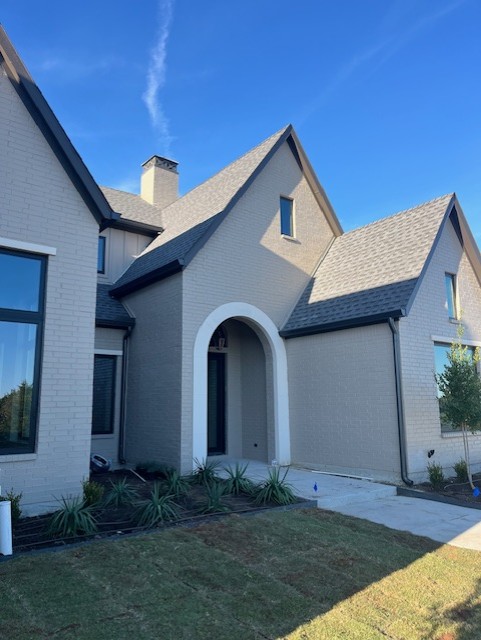
The Turtle Creek Grade Changes Where the Water Has to Go
Most of North Texas is flat enough that a downspout extension and a splash block finish the job. Highland Park is not. The land falls toward Turtle Creek, and plenty of lots here carry six, eight, or more feet of change between the street side and the back of the property. Water leaving a leader on the high side of a house does not stay put. It picks a path, and that path becomes a rut through a bed, a washout behind a wall, or a permanently wet corner.
The right answer on a sloping lot is almost always a buried discharge line rather than a surface extension. We take the leader below grade, run solid pipe with continuous fall to a pop-up emitter or a daylight outlet at the low end of the property, and keep the water off the terraces, steps, and hardscape in between. Solid pipe matters. Corrugated flex silts up in clay, holds standing water, and eventually becomes a buried problem you cannot diagnose without digging. Depth matters too, since a line run shallow across a terrace gets clipped the first time a border is reset.
The uphill elevations have the opposite issue. Grade from the property above sheds toward your low corner already, and adding a few hundred gallons of roof volume to that same corner during a spring storm is how water ends up against a foundation. Blackland Prairie clay swells when it takes on water and shrinks hard in drought, and the low corner of a sloping lot is exactly where that cycle does the most structural damage. Moving roof water to the low end of the lot is cheap next to what pier work costs.
What Roof Water Does to Terraces, Steps, and Mortar Joints
On a Highland Park lot that steps down in stone, roof water rarely lands on soil. It lands on a terrace, crosses a mortared tread, and runs over the cap of a retaining wall on its way to the low corner. Mortar joints are the weak line in that path. Water standing in a joint through a January freeze expands, opens a hairline, and the next storm drives more water into the gap. Two or three winters of that and the joint has turned to sand.
Behind the wall is the part nobody sees until it moves. A retaining wall is holding back saturated fill, and roof volume delivered to the top of that fill loads it well past what it was built to carry. The wall leans, the cap opens, and the bed behind it stays wet long after the rain has stopped. A quote should say where every leader lets go of its water, because on a terraced lot that is a hardscape decision as much as a drainage one.
The answer is to route around the stone rather than across it, with a buried line taken under a terrace and daylighted below the lowest wall. Where a stair is too solid to get a line under, we move the leader to the end of the elevation and accept a longer run above grade rather than discharging into the middle of the hardscape. Light stone shows the difference fast. Constant wetting leaves a dark track and a mineral bloom across a limestone step within a season or two, and once the bloom is into the stone it does not wash off.
Why Conductor Heads Are Function Before They Are Ornament
A conductor head, sometimes called a leader box, is the flared collection box you see partway down an elevation where an upper downspout ties into a lower run. On the multi-plane roofs common in Highland Park, an upper dormer or a third-floor plane usually has to discharge into a lower system, and sending a full-velocity leader straight into a lower trough will push water over the front lip in any serious rain. The conductor head catches that flow, kills its velocity, and meters it into the leader below.
They are also the detail people notice from the sidewalk. Fabricated copper heads can be left plain or shaped to suit the period of the house, and on a front elevation they read as architecture rather than as plumbing. We build them to the specific transition instead of pulling a stock box off a shelf, because the inlet position and the outlet size have to match what the plane above actually sheds. Overflow relief matters too. A head with no relief slot backs water up into the run above instead of spilling it harmlessly at the box.
What Is Behind the Gutter on a 1920s Highland Park House
Before anything gets hung, we look at what it is getting hung on. Original eaves on these Highland Park blocks were built with real lumber, often with a molded fascia, exposed rafter tails, or a boxed cornice that was never intended to take a modern hidden hanger driven through the face. Ninety-odd years of a trough holding standing water against that board leaves soft wood at the outlet locations and at every spot where a spike went in and slowly worked its way loose.
Some of these houses never had a hung gutter at all. They have built-in box gutters formed into the cornice and originally lined with soldered metal. When that liner fails, water does not spill outside the house. It runs into the wall assembly, and that is why box gutter failures show up as an interior ceiling stain long before anyone thinks to look at the roof edge.
Re-lining a built-in gutter means stripping the old metal, correcting the slope inside the trough, and installing a new liner, and it is different work from hanging a run. Where the original system is tired but structurally sound, it is often better to repair the original rather than replace it and lose the period detail. Relining is also the one job on a cornice where the roofer and the metal work have to be sequenced together, since the liner runs up under the roofing at the back edge.
Live Oak and Pecan Along Beverly, Lakeside, and Armstrong
The canopy over the older Highland Park streets is as heavy as anything in the metroplex. Live oaks that have been in the ground since these blocks were laid out arch completely over the roof, and mature pecans add a second debris layer that behaves nothing like leaves. Pecan drops small hard twigs, husks, and shell fragments through the fall, and that material does not mat on the surface where you can see it. It sinks, travels to the outlet, and packs into a plug that a surface screen will not stop.
Two things follow from that. Half-round sheds sediment better than K-style because there is no flat bottom for grit to settle into, but it is also more open to whatever falls in, so screening still earns its keep under a pecan. And you cannot put an aluminum or galvanized screen on a copper gutter. Dissimilar metals with rainwater running between them set up galvanic corrosion, and the less noble metal gives up first. On a copper system the screen, hangers, fasteners, and flashing all have to be copper or stainless.
Choosing the right guard material is a compatibility question on these houses before it is a preference question, and no screen makes a gutter maintenance-free. What it does is turn a full clear-out into a surface sweep. Where the trees are heavy enough that screening alone will not keep up, we put the house on a scheduled clear-out, which on these blocks means two visits a year at a minimum: one in late fall once the pecans have finished dropping, and one in early spring after the live oak drop.
What This Costs on a Highland Park Home
Homes here land at the upper end of the metro range, and not because of the address. It is the work: two and three stories, several roof planes, steep pitch, restricted access on tight setbacks, mature landscape to protect, and premium material with soldered joints. Here is the honest spread.
- Seamless aluminum, formed on the drive, $4.50 to $12 per foot fitted. Sensible on rear elevations, service wings, and detached structures the street never sees.
- Steel, roughly $9 to $20 per linear foot, for heavy-duty runs and larger accessory structures.
- Copper, $25 to $40 per linear foot, with conductor heads and soldered seams priced with the elevation they sit on.
- A full aluminum system, priced off the measured run rather than a house-size average. Much of the Highland Park stock dates to the 1920s and 1930s and still carries undersized original troughs on original fascia, so a quote here reflects what the existing spec forces us to correct as much as how many feet come off the reel.
- Cleaning, set by run length, working height, and canopy load. A two-story front elevation under mature pecan and cedar elm takes considerably longer than a service wing with clear ladder footing beside it.
- Guards, quoted by system type and by the metal they have to sit on. A screen going over copper has to be compatible with copper, and a screen on original half-round is a different mount from one on modern K-style.
Those are ranges rather than quotes, and a mixed-material approach is common and sensible. A good number of Highland Park homeowners run copper half-round across the front and the visible side elevations and aluminum around the back, which puts the money where the house shows it. Every installation carries a 5-year workmanship warranty and a 20-year manufacturer warranty on the materials, and the estimate costs nothing. Access moves the number more than owners expect, and a walled lot with a tight side yard stages slower than a bigger house with an open one.
Questions We Get in Highland Park
Does copper need any maintenance once it is up?
Nothing beyond keeping it clear. There is no coating to renew. New copper goes from bright to a warm brown and eventually to a green patina over many years, and that process is the finish rather than a defect. The one thing worth planning for is that new copper sheds a little oxide in its first rains, which can leave a faint stain on light limestone or stucco directly beneath a leader. Placing the discharge clear of a light-colored wall handles it. Light limestone and pale stucco are the surfaces that show it, and both are common on these elevations.
Can you match new copper to the copper already on my roof or bay window?
Usually yes, though new copper will read brighter until it weathers in. If the existing metal is decades old and fully patinated, the new work will look obviously new for a while and then close the gap. We will show you both against the house before anything is ordered. Sun exposure changes the pace as well, so a south-facing elevation darkens ahead of a shaded north wall on the same house.
There is a stain on my upstairs ceiling but the roof was replaced two years ago. What is that?
On a house of this era it is frequently a built-in gutter, not the roof. A failed box gutter liner puts water inside the cornice and wall rather than over the edge, so the symptom appears indoors while the roof surface looks perfect. That one is worth looking at quickly. Built-in cornice gutters are still in service on plenty of these blocks, so it is worth ruling out before anyone opens a ceiling.
Will a new gutter fit under a slate or tile roof edge?
It has to be set to the plane, not to the fascia. On a steep tile or slate roof, water leaves the edge with real momentum, and a trough hung too low or too far out will let it shoot straight past. We set hanger height and projection off the roof plane and coordinate with your roofer where the drip edge and any flashing meet the gutter line. On the steepest roofs we also keep the outer lip a little below the line of the plane, so a sheet leaving a valley clears the front edge instead of jumping it.
Do I need to get exterior material or color approved before you start?
Some properties here do require exterior material and color approval before work starts, so it is worth confirming before we order anything. Where a submission is required, we will provide manufacturer spec sheets, finish samples, and a physical metal sample so you are not describing it from memory, and we schedule the work around the approval window rather than pushing a start date.
How much longer does copper take than aluminum?
Longer, and you should plan for it. Aluminum runs are formed continuously on site and a typical house is a one-day job. Copper involves fabricated corners, soldered joints, and conductor heads built to the transition, so it is measured, fabricated, and installed in stages. The result is a system with permanent joints instead of sealed ones. Plan on a fabrication window rather than a single visit. On a large house the crew will be back more than once before the last leader is hung.
Is half-round worse than K-style in a hard rain?
Only if it is sized as though the two were interchangeable. Matched properly, a correctly sized half-round with round leaders drains cleanly and clogs less often, because there is no flat trough bottom for sediment to build a dam on. The mistake is dropping a 5-inch half-round onto a roof that needed a 6-inch K-style. The other version of that mistake is leaving a 3-inch round leader on a 6-inch half-round, which throttles the whole run at the outlet.
My retaining wall is leaning and the bed behind it stays wet. Could that be the gutters?
Worth ruling in or out before anyone rebuilds the wall. Look at where the leaders above it end. If one lets go within a few feet of the top, that fill is taking roof volume every storm and the wall is holding back water it was never sized for. The bed staying wet days after the rain has stopped is the tell.
Rerouting that discharge below the wall costs a fraction of the masonry, so we check it as a matter of course on a walled lot.
The Park Cities and the Dallas Neighborhoods Around Them
Highland Park is bordered by University Park to the north and by the city of Dallas on the other three sides, which makes for short routes and easy scheduling. We do the same restoration-grade work next door in University Park, where the housing stock is close cousins to this one but the lots are tighter and the rebuild turnover is higher. Further north, beyond Northwest Highway, we handle gutter installation in North Dallas, and west of the Tollway we cover Northwest Dallas. Work in the surrounding Dallas neighborhoods runs on the same crews, and the same is true everywhere we work in Dallas County.
Have Us Look at the House
If you have a period elevation that deserves the right profile, a box gutter you suspect is leaking, or water finding its way down the slope to the wrong corner of the lot, call Creative Gutter at 214-324-4674. We will walk the grade, look behind the fascia, and give you a written range with real options rather than one number. Family-owned and working across DFW since 1984.
Contact us today to schedule a FREE on-site consultation for gutter installation or repair for your home or business in Dallas, Collin and Rockwall Counties.
214-324-4674