

Gutter Company in Denton County
Gutter Company Serving Denton County, Texas
Creative Gutter has worked as a gutter company in Denton County since 1984, and the job here is shaped by water arriving from two directions: what falls on the roof, and what blows in off Lewisville Lake and Grapevine Lake. Shoreline neighborhoods in Highland Village, Hackberry, and Lakewood Village take wind-driven rain at an angle no gutter catches passively. Hanger spacing, downspout placement, and drip edge detail all change because of it.




Open water is the fact that separates this county from the rest of DFW
Lewisville Lake and Grapevine Lake put miles of open shoreline inside Denton County, and open water means uninterrupted fetch. Wind that has crossed a mile or two of lake reaches a roof edge with nothing to break it up. It drives rain sideways into the trough and back behind the fascia instead of down into the outlet. On north and west elevations of shoreline homes we regularly find staining on the fascia board directly behind a gutter that is technically working.
The correction is rarely a bigger gutter on its own. It is drip edge that laps correctly into the back of the trough, hidden hangers screwed into the fascia at 24 inches on center and tightened to about 18 inches on the runs that take the worst of the wind, and outlets positioned so the run is never trying to carry water uphill into a headwind. Spike-and-ferrule gutters, which you still see on older lake-area homes, work loose faster near the water than anywhere else in the metroplex because the wind load cycles the front lip constantly.
Debris behaves differently near the lakes too. Cottonwood and willow grow along the shoreline, and their seed fluff mats into a felt layer that holds water rather than washing through. That mat is what turns a lakeside gutter into a planter box. If your home sits within a few hundred yards of open water, plan on three cleaning visits a year rather than the two we treat as the floor, or move the decision toward gutter guards earlier than a comparable inland house would need to.
What gutter work costs in Denton County
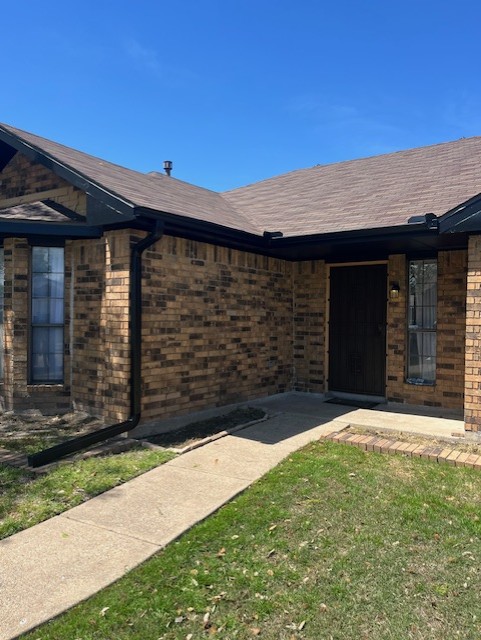
Pricing across the metroplex is consistent for us, and Denton County is no exception. Seamless aluminum is quoted at $4.50 to $12 per linear foot once it is hung. Steel, which we use on commercial buildings and heavy-duty residential applications, runs roughly $9 to $20 per linear foot. Copper is a premium specification at $25 to $40 per linear foot. The spread inside each range comes down to linear footage, roof height, and how hard the access is.
Whether guards go on at the same visit is the biggest single swing in a Denton County estimate. Screening a run while the crew, the ladders, and the coil are already on that elevation costs far less than bringing all of it back out in two years, so we quote the system with screens and without and let you compare the two lines. The two-story homes that dominate Flower Mound, Castle Hills, Lantana, and the Frisco side of the county carry more footage, taller ladder work, and more corners than a lake-area ranch. Cleaning follows the same logic, priced against reach and against how far the debris has packed down.
Those are ranges, not quotes. A roof cannot be priced from a street view image, and we do not try. Every estimate is free, and every one of them is measured on-site. Our work carries a 5-year workmanship warranty and a 20-year manufacturer warranty on materials.
How we size a Denton County roof
Most of the county’s housing stock falls into two buckets, and they do not take the same system. Homes built from the late 1990s onward, the majority of what stands here, carry taller elevations, steeper pitches, and larger uninterrupted roof planes. A 5-inch K-style gutter with a 2×3 downspout was never designed for that volume. We specify 6-inch K-style with 3×4 downspouts on those homes, and the 3×4 alone moves roughly twice the water of a 2×3.
The older stock, mostly 1970s and 1980s ranch homes in Lewisville, Corinth, and Lake Dallas, is a different problem. Long low roof planes shed slowly and 5-inch is often adequate. What fails on those houses is the fascia, not the gutter size.
Thirty-plus years of a spiked gutter working in and out of soft wood leaves nothing for a new hanger to bite into, so a proper job includes replacing the fascia board before hanging anything. We form every run from a single coil on-site, and that is why seamless gutters cut to length in your driveway matter on a house with a 60-foot back elevation. No mid-run seams means no joints along the length of the run to reopen when the wood underneath moves.
Roof geometry matters more than square footage. Two valleys converging above a single 10-foot gutter run will overwhelm a 5-inch trough during a spring cell no matter how clean it is. In those spots we either upsize that specific run, add a second outlet, or install a valley diverter above it. Sizing for peak intensity is the correct engineering answer in North Texas, because our roughly 37 to 40 inches a year does not arrive evenly. It arrives in bursts.
What a seamless gutter buys you on a lake-facing elevation
Seamless means there are no joints along the length of the run. Corners, outlets and end caps are still sealed, so anyone describing a system with no joints at all is describing something that does not exist. What seamless removes is the joint that fails first, the mid-run lap, and on a Denton County house with a 70-foot elevation facing open water that one detail decides how long the gutter stays watertight.
We roll every seamless run on-site from a single coil, cut to your elevation rather than to a stock length off a shelf. On the lake side of the county we also move that coil from the standard .027 aluminum to .032 on elevations taking sustained wind, because heavier stock holds its shape when the front lip is being worked all winter. Inland, in Corinth or Providence Village, .027 is the correct specification and the upgrade is not worth buying.
Seamless does not rescue a bad hanging job. If the pitch is wrong or the fascia is soft, a continuous gutter fails in the same places a jointed one does, only later. That is why fascia condition and the hanger schedule are quoted alongside the metal, and why seamless fabrication appears on a Denton County estimate as one line among several rather than as the whole product.
Questions Denton County homeowners ask
Does living near Lewisville Lake actually change what I need?
Yes, in two specific ways. Sustained wind off open water drives rain behind the gutter line, so drip edge integration and hanger spacing matter more than they would inland. And shoreline vegetation, particularly cottonwood, produces fine seed debris that mats instead of flushing. Both push toward tighter fastening and a more frequent cleaning schedule.
My HOA has to approve the color. Can you work with that?
Yes. Some associations in Denton County’s master-planned communities require written color approval before installation. We provide the manufacturer color and spec sheet for you to submit, and we hold the install date until you are cleared. We do not guess at what your association allows, and we do not order coil before you have an answer.
My house is only eight years old. Why are the gutters overflowing?
Usually because the builder installed 5-inch trough with 2×3 downspouts on a roof that generates more volume than that combination can carry. It is the most common defect we find in 2010s construction. Moving to 6-inch with 3×4 downspouts, or adding outlets to the runs that fail, solves it without replacing anything that is not undersized.
Do I need gutter guards in a new subdivision?
Usually not yet. If your trees were planted at build-out and are still under about fifteen years old, they are not producing enough debris to justify the cost. Homes in Double Oak, older Flower Mound, and established Corinth neighborhoods are a different story. Your house lands on one side of that line or the other, and a walk around it settles that.
Where should the water go once it leaves the downspout?
Away from the slab, and farther than most people think. The shrink-swell clays under most of North Texas take on water and expand, then contract as they dry, and repeatedly soaking one corner of a foundation is how you get differential movement. On smaller lots we run extensions to a discharge point at the property line or the curb. On acreage in Bartonville and Double Oak we bury the line and daylight it at a low spot.
Distance is the part people underestimate. Four feet from the wall is the bare minimum, six feet is the working target, and ten feet is what we recommend wherever the clay under that sand is active. A splash block stopping two feet out is the case we design away from, because it returns every storm to the same square yard of ground.
Our lot backs onto cottonwoods. Are guards or a cleaning schedule the better buy?
Both, and in that order of honesty: guards reduce the work here, they do not end it. Cottonwood fluff is fine enough to sit on micro-mesh rather than pass through, so the mesh wants brushing off after the spring release even though nothing reached the trough. What you gain is that the fluff stays on a surface you can clear from a ladder in minutes instead of packing into a gutter you have to scoop out by hand.
One run overflows and the rest are fine. Can you just add an outlet?
Often, yes, and it is the cheaper answer. A single run that fails while its neighbors behave is usually a concentration problem rather than a sizing problem, which means a valley or a dormer is dumping into a short section. Adding a second outlet on that elevation, or upsizing that one gutter to 6-inch, fixes it without touching the other 180 feet of the house.
Can you match a copper or half-round look on a custom home?
Yes. We install half-round profiles, copper systems, and conductor heads on high-end work, and we fabricate seamless runs on-site regardless of profile. If you want to see the full range of gutter styles, materials, and profiles before you decide, that page walks through the options.
Do you do commercial buildings, or just houses?
Both. Most of our work as a gutter company in Denton County is residential, but the I-35E and SH 121 corridors through the county carry a lot of retail, office, and light industrial, and we handle commercial gutter installation, box gutter work, and heavy-gauge steel systems on those buildings.
Master-planned communities and architectural review
Denton County has one of the densest concentrations of 2000s-and-later master-planned development in the metroplex. Castle Hills, Lantana, Providence Village, and large sections of Flower Mound and Frisco were all platted with active architectural standards. In practice that means color and profile are not always the homeowner’s free choice. Some associations in these communities require written approval of gutter color before installation, and a few specify that downspouts match the trim or the brick rather than the gutter.
We handle that the same way every time. Before we order coil, we pull the color and provide the manufacturer spec sheet so you can submit it to your association, and we hold the schedule until you have an answer. It costs a week sometimes. It costs a great deal more to hang 210 feet of the wrong color and take it back down. If you are not sure whether your neighborhood has a standard, tell us and we will write the estimate with the approval step built into the timeline.
The other thing worth knowing about these newer neighborhoods: your trees are probably too young to justify guards. Builder landscaping in a 2005 subdivision is only now producing meaningful leaf volume, and in a 2018 subdivision it produces almost none. Paying by the foot to screen a roof that drops nothing is money better put into correct sizing and downspout extensions that carry water away from the slab. On most of those houses guards do not pay off yet, and we say so.
Acreage, barns, and the southwest corner of the county
Southwest Denton County still runs to large lots, horse property, and custom homes set well back from the road. Bartonville, Double Oak, and the country between them have a different set of problems than a tract subdivision does. Outbuildings and barns are usually metal roofed, and metal sheds water fast and cold, which means the gutter sees the whole event at once rather than spread out. On those structures we generally go to 6-inch, and on long unbroken eaves we add a second downspout rather than trusting one end to carry 80 feet of run.
Discharge is the other half of the job out here. Large lots often mean the natural grade falls toward the house rather than away from it, and there is no storm inlet at the curb to aim at. We run buried discharge lines to daylight at a low point on the property, or to a pop-up emitter well clear of the slab.
This matters everywhere in North Texas, and it matters here in a way people get wrong. Most of this county is Eastern Cross Timbers sand over a clay subsoil, not deep Blackland prairie clay. The sand drains, so the surface looks forgiving, but the clay underneath still swells when it takes on water and shrinks hard in a drought. Water dumped at the foundation is the single biggest driver of slab movement in this region.
Post oak canopy is heavy through Double Oak and parts of Bartonville. Post oak leaves are large, thick and leathery, three to five inches across or more, and they do not sift through a screen. They mat on top of it and sit there, which is why the screen under a post oak has to be heavy enough gauge to carry that weight without deforming. The fine debris on these properties comes in spring, when the same trees drop catkins, and catkins are small enough to work through a coarse slot. Those are two separate problems on one roof.
The Denton County debris calendar
Four kinds of tree cover feed Denton County gutters and none of them drop at the same time. Cottonwood and willow along the shoreline release seed fluff in late spring, and it mats into felt rather than flushing through. Cedar elm sends down papery seed wafers in September into October, then its leaves from October into December. Post oak, heavy through Double Oak and Bartonville, drops large leathery leaves that sit on top of a screen instead of passing through it.
Live oak runs opposite to all of it. It is evergreen, sheds last year’s leaves from late February into April, and drops catkins fine enough to slip through a coarse slot right before hail season opens in March. Pecan trails everything with husks and twigs. Two to three cleanings a year covers most of the county, four under heavy pecan, and three is the realistic floor within a few hundred yards of open water.
When should you schedule the work?
North Texas gives you two wet seasons: the heavy one from March through June, and a second, shorter one in the fall. The March through June window is also hail season, and DFW sits squarely in the hail belt. Aluminum dents. If your gutters took a hit this spring, the dents themselves are cosmetic, but the flattened trough bottom and the pulled hangers are not, and those are worth an inspection.
The best time to install is late summer or midwinter, when we are not competing with storm callbacks and you are not trying to beat a front. The best time to clean is late fall after the oaks have finished dropping, plus a second pass in spring for seed and catkin load if you are near water or under canopy. If a storm has already opened a seam or torn a run loose, do not wait for the calendar. We handle storm damage on an emergency basis across Denton County.
Gutter service across Denton County, city by city
Every place below is a live service area, not a list of names. The notes are what our crews plan for when a job comes in from that address.
Gutter installation in Lewisville covers about as wide a range of housing as any city in the county. Old Town blocks near Main hold small mid-century homes with original fascia and undersized 4-inch and 5-inch gutters, while the subdivisions east toward Castle Hills are 2000s two-story brick that need 6-inch. The I-35E corridor through town is dense retail and light industrial, where the work shifts to internal drains, box gutters, and long steel runs.
In Flower Mound you get the county’s toughest combination: large two-story homes from the 1990s and 2000s, sitting between two lakes, under genuine Cross Timbers post oak. Steep pitches and multiple valleys concentrate water into short runs, and the tree canopy fills what the sizing does not solve. This is one of the few parts of Denton County where we recommend guards on a majority of the homes we quote.
The Colony sits with Lewisville Lake wrapping most of its western and northern edge, so wind exposure is high across the whole city. The older core off Main is 1970s and 1980s single-story stock with short eaves and aging fascia. Newer construction toward the SH 121 side is taller and steeper. Two different specifications inside one city limit.
Homes in Highland Village back directly onto the Lewisville Lake shoreline in places, with larger custom elevations and mature trees on established lots. Complex rooflines here throw a lot of water into a few concentrated corners. We spend more time on outlet placement in Highland Village than almost anywhere else in the county.
Lake Dallas is a small town on the lake’s west shore, grouped with Hickory Creek and Corinth in the Lake Cities, with a housing stock that started as cottages and small post-war homes and has been added onto for decades. Short eaves, tight lot lines, and original fascia are the norm. Most jobs here start with carpentry before a single foot of gutter goes up.
Castle Hills is master-planned from the ground up, with consistent architecture, steep pitches, and multiple roof planes per house. The trees are young, so debris volume is low and guards are usually premature. What these homes do need is 6-inch trough and 3×4 downspouts, because the roof area feeding each run is larger than the elevation makes it look.
Out at Lantana, the terrain rolls and the homes carry stone and stucco elevations with deep overhangs and dormers. Dormers create short isolated runs that overflow first in a hard rain. Architectural review is active in most of the neighborhoods here, so we build the color approval step into the schedule as a matter of course.
Bartonville is large-lot and semi-rural, with custom homes, long driveways, and barns or equipment buildings on many properties. Metal roofs on the outbuildings dump fast, so those get upsized trough and extra outlets. Discharge almost always has to be routed to daylight rather than to a curb.
The lots in Double Oak are wooded, and the name is not decorative. Heavy post oak canopy over custom homes means large leathery leaves that mat across the top of a screen, plus a spring catkin drop fine enough to slip through a coarse one. A heavy-gauge screen and a real cleaning schedule both earn their keep here, and neither one on its own is enough.
Providence Village is newer master-planned construction north of the lake, laid out on open ground. There is very little canopy and a lot of wind, which is close to the opposite of the Double Oak problem. Sizing and secure hanger spacing carry the whole job. Guards can wait five or ten years.
Hackberry sits right on Lewisville Lake near The Colony, and lakeside exposure defines the work. Wind-driven rain gets behind poorly detailed gutters here more than anywhere. We check the drip edge on every Hackberry inspection before we look at anything else.
The same holds at Oak Point and along the
Little Elm
shoreline, where lots sit close to open water and the roof edge takes sustained wind load rather than the occasional gust. Fastener choice matters more than product choice on those houses, and a spike that has worked a quarter inch loose will let the whole front lip flutter.
Lakewood Village is a small lakeside town on the east side of Lewisville Lake with custom homes on larger lots and long fetch across the water. Long unbroken eaves on these houses need two outlets, not one, and the run should slope to both ends rather than to a single low corner.
Corinth runs along I-35E between Denton and Lake Dallas and is mostly 1990s and 2000s subdivision stock that has now aged into its first replacement cycle. Trees planted at build-out are mature, so leaf load has climbed while the original 5-inch systems stayed the same size. That mismatch is the most common reason we get called to Corinth.
The Denton County side of Frisco is newer, larger, and steeper than most of what surrounds it. Frisco straddles the Collin and Denton county line, and the Denton County portion falls to us here. Big two-story elevations with wide roof planes and few mature trees mean the whole answer is capacity: 6-inch trough, 3×4 downspouts, and extensions that get the water past the flowerbed.
Where else we work from here
Denton County borders three of our other core service counties, and crews cross those lines every day. To the east, our Collin County service area covers the US 75 and Dallas North Tollway growth corridor. To the southwest, gutter work throughout Tarrant County includes Grapevine and the northeast Tarrant cities that sit right across the lake from Flower Mound. To the south, Dallas County is where our shop is.
If you need to understand the service itself before you pick a city, the installation and repair overview covers process and materials, and targeted repair work covers what we can fix without replacing a whole system.
Talk to a Denton County crew
Creative Gutter is family-owned and has been installing seamless gutter in this county since 1984. We measure on-site, form the runs in your driveway, and back the work with a 5-year workmanship warranty and a 20-year manufacturer warranty on materials. Call 214-324-4674 and tell us your city and roof height, and we will get an estimator to the property. There is no charge for the estimate and no obligation attached to it.
Contact us today to schedule a FREE on-site consultation for gutter installation or repair for your home or business in Dallas, Collin and Rockwall Counties.
214-324-4674