

Gutter Installation In Lantana, TX
Gutter Installation in Lantana TX for Steep, Multi-Plane Rooflines
If you’re searching for professional gutter installation in Lantana, TX, you’ve come to the right place. At Creative Gutter, we proudly serve homeowners and businesses across Lantana and surrounding areas with dependable gutter services designed to protect your property and enhance curb appeal. Whether you need a completely new gutter system, repairs to your existing gutters, or leaf protection solutions, our team is ready to help. Contact us today at 214-324-4674 to schedule a free on-site consultation.




A Local Lantana Gutter Company You Can Trust
Lantana was built out largely in the 2000s and 2010s, which means two-story brick and stone elevations, steep pitches, and rooflines that break into several planes rather than running straight. Two things follow from that, and both of them shape what gutter installation in Lantana involves. Water arrives at the inside corners in concentrated bursts instead of spreading evenly along the eave, and the gutter line is a visible architectural element that neighbors and architectural review committees both notice.
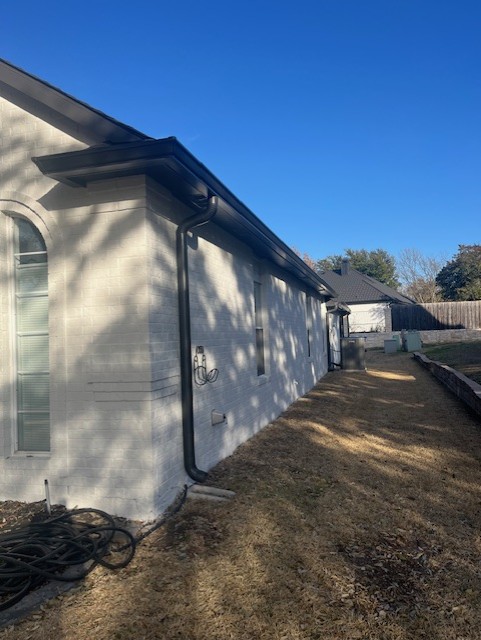
Valleys Deliver Water Faster Than a Straight Eave Ever Will
This is the most useful thing to understand about a roof in Lantana. A straight run of eave collects rain across its whole length, so a forty-foot gutter receives water more or less evenly along forty feet. A valley does the opposite. Two roof planes funnel everything they catch into one channel, and that channel discharges into roughly three feet of gutter at the inside corner. The same storm a straight eave handles comfortably will overwhelm that corner.
Steep pitch makes it worse. Water leaving a valley on an 8:12 or 10:12 plane is moving fast and carries real horizontal momentum by the time it reaches the eave. It does not drop neatly into the trough. It arcs outward, and on the worst geometries it clears the front lip entirely, and that is why homeowners find a trench cut into the mulch beneath a corner that has a perfectly functional gutter above it. On the steepest elevations that arc clears the front lip by several inches, which is exactly what a diverter is for.
The fixes are specific rather than general. A valley diverter at the inside corner keeps the discharge in the trough. An outlet placed at or near the valley discharge point carries that water away immediately instead of asking it to travel the length of the run first. And a 6-inch trough with a 3×4 downspout gives the corner the cross-section to absorb a burst. Those three details resolve most of the overflow complaints we get from Lantana homeowners in this part of Denton County.
The Water You Cannot See: Roof-to-Wall Junctions
Complex rooflines produce a lot of places where a roof plane dies into a two-story wall, and that junction is where the most expensive problems start. It is also invisible from the ground. If there is no kickout flashing where the lower roof edge meets the wall, water running down that intersection does not turn into the gutter. It continues straight down the wall and gets behind the brick, stone, or stucco.
You will not see water. What eventually shows up is efflorescence on the brick, a soft or stained patch of sheathing, or interior damage on the wall below. On the two-story elevations common in Lantana this can run quietly for years. When we replace a system on a house with this geometry, checking the kickouts is part of the job, and if one is missing we say so rather than hanging a new gutter over an existing fault.
The same logic applies where an upper-story downspout discharges onto a lower roof. Dumping a full downspout onto shingles in one spot erodes granules and drives water toward whatever is downhill of it, frequently a valley already carrying more than its share. The correct detail is a splash guard or diverter at the landing point, or in some cases carrying that upper downspout past the lower roof entirely. It comes up wherever a plan steps a bedroom wing down off the main roof mass, which is most of them.
Color, Profile, and Getting Through Architectural Review
These elevations are consistent by design, and a gutter in the wrong color draws the eye down an entire street. Aluminum comes in a wide range of baked-on finishes, and the real decision is whether the gutter should disappear into the fascia and trim or pick up a tone from the brick and stone. On most homes here, matching the trim is the safer choice, because it keeps the horizontal line quiet rather than drawing a stripe across the front of the house.
We bring physical color chips to the estimate instead of a printed chart. Finishes read differently in daylight against brick than they do on paper, and a color that looks right in a garage can read noticeably warm or cool on a west-facing wall in the afternoon. Downspouts get the same consideration, and they are often specified to match the wall they run against rather than the gutter they hang from, so they visually recede.
Some HOAs in Lantana require exterior color approval before work begins. Ask us for whatever the committee wants in the packet and we will put it together, then schedule around the approval window rather than starting and hoping it clears. If you want to look at gutter styles and color options before you submit anything, it is worth doing that first so you only have to ask once.
Where the Downspouts Go on a Symmetrical Front Elevation
On a complex roof, hydraulics and appearance pull in opposite directions. The engineering answer is more outlets placed closer to where the water lands. The visual answer on a formal two-story front is as few downspouts as possible, tucked at the corners where the eye does not catch them. Reconciling those two is a real part of the design conversation on this housing stock.
Usually there is room to compromise. Shifting an outlet a few feet to land on a mortar line or behind a column, running a downspout down the return of a projecting element rather than across a flat expanse of brick, or splitting a long front run so each half drains toward a corner will satisfy both requirements at once. On a front elevation the return beside a projecting entry is usually the easiest place to hide one.
Where a front elevation genuinely cannot take another downspout, the answer is a larger trough with a 3×4 outlet at each corner instead of a 2×3, which buys the capacity without adding a visible element. On higher-end stone elevations a conductor head is worth considering, since it handles volume and reads as an intentional detail rather than an intrusion.
Where the water goes after it leaves the downspout is the other half of that decision, and lot width limits the choices. Lots in Lantana are generous by suburban standards but they are not acreage, so running an extension sideways toward a neighbor is rarely acceptable and rarely useful anyway. That normally means carrying discharge toward the front or the rear of the property, either above grade or through a buried line to a pop-up emitter in the lawn. Most lots here offer a front route and a rear route and very little else, so that choice gets made early.
The reason it is worth the trouble is the ground. Lantana sits in the Eastern Cross Timbers belt, where sand at the surface covers a clay subsoil that still swells as it takes on water and shrinks in drought, and a downspout that dumps at a slab corner every storm drives that cycle harder than anything else on the property. Extending the discharge past the bed line is inexpensive next to what foundation work costs, and on a lot this size the route is usually obvious once someone looks at how the ground falls.
Two Roofs Draining Into One Side Yard
The side yards on a Lantana street are the narrowest ground on the lot and they take the most water per square foot of anywhere on the property. Your roof plane falls toward that strip and so does the one next door, and if each house puts a downspout at its rear corner, four planes of runoff are crossing eight or ten feet of turf. The soil there never gets a full week to dry between spring storms. It is usually where a fence post goes soft first.
Routing is the whole answer, and the strip does not give you many options. A side yard with a gate at each end has nowhere for a surface extension to sit without being kicked or mown, so the practical solution is solid pipe run under the strip to the front or the rear, where the ground opens up and the water can spread. A cleanout at the head of the line keeps it serviceable. What is worth avoiding is aiming a downspout at a property line and hoping.
There is a wind effect in that gap as well. A narrow channel between two tall brick elevations speeds the air moving through it, and a storm blowing along the channel drives rain up under the drip edge on both houses at the same time. That is one reason we set the trough tight to the drip edge on the side elevations and not only across the front.
Sizing for Lantana’s 2000s and 2010s Roof Geometry
Housing built in this era generally warrants 6-inch K-style rather than the 5-inch that suits an older single-story ranch, and the reasons are pitch and plane size. Steeper roofs deliver water to the eave faster. Larger uninterrupted planes deliver more of it per foot of gutter. A 5-inch trough is not undersized in the abstract, it is undersized for this particular geometry.
Downspouts follow the same reasoning. A 3×4 downspout moves roughly twice the water of a 2×3, and on a house where several planes converge on two or three outlets, that difference is what keeps the trough from backing up at the peak of a spring storm. We size to the intensity of a North Texas downpour rather than to the annual rainfall total, because the annual number is not what causes an overflow. If you want the detail on how an install day runs, from measurement through the final water test, that is set out separately.
Two install details on a steep roof matter as much as the size you pick. Hanger spacing has to tighten on any section carrying a valley load, because that stretch of trough holds more water and more weight than the rest of the run and is where a sag begins. The gutter also has to sit correctly against the drip edge, since wind-driven rain on a steep plane can travel back along the underside of the shingle and behind the fascia wherever there is a gap. Neither is a product decision, and both are common findings when an original builder system comes down.
The Trees Are Only Now Becoming a Factor
When the Lantana neighborhoods were new, guards were premature. The landscape trees were small, the debris load was negligible, and the money was better spent on correct sizing. That has changed. Fifteen to twenty years of growth has put genuine crown over some of these roofs, and homeowners who never had to think about their gutters are now finding a packed outlet by December. The runs under the earliest plantings are the ones showing it first.
The load is not uniform across the house, which is the useful part. A back elevation under a maturing red oak or cedar elm may need screening while the front still has clear sky above it. We look at each run individually and recommend screening only the elevations that earn it, with the price following the guard type and the footage you actually choose to cover. Partial screening keeps the cost sensible and gives up nothing, because the clear elevations were never the ones filling. Once you know which runs to screen, the install itself takes a morning and does not require lifting a single shingle course.
The species mix here is also different from the wooded towns a few miles east, and that changes which guard makes sense. Builder and homeowner planting in Lantana leans toward live oak, red oak, crape myrtle, and ornamental pear rather than stands of native post oak. A lot of what those trees drop is small: seed capsules, flower litter, and fine leaf material that passes straight through a coarse screen and settles quietly at the outlet. If you are screening a run in this neighborhood, mesh aperture matters more than it would under a heavy native canopy where the debris is mostly large leaf.
Hail, Dents, and a Gutter Line Everyone Can See
North Texas sits in the hail belt and the season runs roughly March through June. Aluminum dents. On a street of consistent elevations, a dimpled gutter face reads immediately from the curb in a way it would not on a varied streetscape, so cosmetic hail damage matters more here than its effect on water-carrying capacity would suggest. A street here reads as one elevation repeated, so a single dented run stands out against the whole block.
The functional damage from those storms is usually somewhere else anyway. Wind separates runs at the miters, tears downspouts off their straps, and drives shingle granules into the trough where they settle at the outlet as a dense paste. After a significant storm it is worth walking the perimeter an hour later. Water standing in the trough means a packed outlet, and a gutter line that no longer reads straight from the driveway has lost hangers. We handle storm damage repairs and can generally reach Lantana and this corner of the county quickly.
What a System Costs on This Housing Stock
Most homes in Lantana are two-story with multiple roof planes, which puts them in the upper half of the metro range. Seamless aluminum is priced at $4.50 to $12 a foot of run. A complete system on one of these houses is measured on the ground rather than off a plan, because the same square footage can hide an extra hundred feet of eave once the returns, jogs, and porch roofs are walked out. That measured run, and the material chosen to carry it, are where the number comes from. A smaller single-story with two long straight runs sits well below a house of similar size spread across a dozen roof planes.
- Steel runs $9 to $20 per linear foot and is normally a heavy-duty or commercial specification rather than a residential one.
- Copper is $25 to $40 per linear foot, and on a stone entry elevation with a conductor head it is a legitimate architectural choice rather than an upsell.
- Cleaning is quoted off height, access, and the number of corners where debris packs in first, since a two-story with several valleys feeding into it takes longer than a single-story with two straight runs.
- Guards are priced per foot by system type, and on this housing stock they are usually best applied selectively rather than across the whole house.
Inside corners are the variable that moves a quote here more than square footage does. Every valley means a miter, often a diverter, and frequently an additional outlet, so two houses with the same floor area can price differently on roof geometry alone. These are ranges rather than quotes. A full replacement carries a 5-year workmanship warranty and a 20-year manufacturer warranty on materials, and the estimate itself is free.
Questions From Lantana Homeowners
Water pours over one specific corner every storm. Is my gutter too small?
Possibly, but the more common cause is a valley discharging into that corner faster than the trough can accept it. A diverter at the valley plus an outlet placed near it usually solves it, and a 6-inch section at that corner finishes the job. It is rarely a whole-house capacity problem. We see it most often at the corner nearest the front door on a two-story, because that is where two planes usually meet.
Do I need HOA approval before gutter installation in Lantana can start?
Some HOAs in the area require exterior color approval before work begins. We will provide the manufacturer spec sheet and a physical color sample so you can submit it, and we schedule around the approval rather than starting and hoping it clears.
Can you match the color my neighbors have?
Usually yes. Bring us a cut piece of existing gutter if you have one, or we will pull a sample at the estimate and match it against the chip range. Matching the trim color is a more common request here than matching the brick.
My house is fifteen years old. Do I need guards yet?
Look at the crown, not the calendar. If a maturing tree now sits over a specific roof plane, screen that run. If the trees are still clear of the roof, put the money into correct sizing and revisit guards in a few years when the canopy has closed in.
The side yard between me and my neighbor stays wet for a week. Whose downspout is that?
Frequently both of them. Walk the strip an hour after a storm and note every outlet discharging into it, yours and theirs, then look at which end of the strip the ground falls toward. You do not need an agreement to fix your half. A buried line taking your two rear outlets to the front or the back removes most of the volume, and if the larger share is coming from next door, a short conversation is cheaper than a wall. We look at this on most quotes where the houses sit close.
Is 5-inch gutter enough on a steep two-story?
Usually not on this housing stock. Steep pitches and large planes deliver water to the eave faster than a 5-inch trough absorbs it, and inside corners concentrate it further. Six-inch with 3×4 downspouts is the normal specification for roofs built in this era.
Do you have to lift shingles to install?
No. Hidden hangers fasten to the fascia and clip into the front lip of the gutter, so the roof is never disturbed. If your roof is newer that is worth confirming with any contractor you are considering, because some accessory products do go under the first shingle course.
How long does a replacement take?
Most homes here are a one-day job even with complicated geometry, because every run is fabricated on site to the exact length of the elevation rather than assembled from stock sections joined in the middle. A larger elevation with several valleys can run into a second morning.
Where Else We Work Around Lantana
This corner of southern Denton County is a short route for our crews. The acreage lots up in Argyle sit immediately north, and Bartonville lies just southwest of us with a completely different property type. Beyond it we cover Double Oak and Flower Mound, and west toward the county line we handle Justin. All of it is served by the same team doing gutter work throughout Denton County, family-owned and in business across DFW since 1984.
Schedule a Free Look at Your Roofline
If one corner overflows every storm, or you are planning a replacement and want the color settled before you go to your association, call Creative Gutter at 214-324-4674. We will measure the elevations, look at where the valleys actually discharge, hold color chips against your brick in daylight, and give you a written range with no pressure attached.
Contact us today to schedule a FREE on-site consultation for gutter installation or repair for your home or business in Dallas, Collin and Rockwall Counties.
214-324-4674