

Seamless Gutters in Dallas, TX
Seamless Gutters in Dallas and North Texas
Seamless gutters are formed from a continuous coil of metal at your property and cut to the exact length of each stretch of roofline. Nothing is spliced together along the run, which removes the joints where older gutter systems most often leak. Since 1984, Creative Gutter has installed seamless gutters in several sizes and profiles on homes across Dallas and North Texas, and we also offer copper for homes that call for it.
The idea is simple, but the results depend on the details: the width of the gutter relative to the roof, how many downspouts serve each run, the thickness of the metal, and how the few remaining joints are handled. Two quotes for the same Dallas house can differ on every one of those points, so it helps to understand them before you compare numbers.
How Seamless Gutters Are Formed On Site
The process starts with a roll of flat, pre-finished metal coil and a forming machine that travels to the job. As the coil feeds through a series of rollers, it’s bent in stages into the finished gutter shape, with the back wall, the floor, the face and the rolled front lip all made in one pass. The gutter keeps coming out of the machine until it reaches the measured length of the run, and only then is it cut.
Because each piece is made to measure, a 57-foot rear eave gets a single 57-foot gutter, and the 14-foot run over the garage gets a 14-foot one. There’s no stock length to work around and very little waste. Runs are carried to the house, lifted into place and hung with a slight pitch toward the downspouts.
We form residential aluminum gutters this way. The coil comes in a wide selection of factory colors, so the finished gutters go up in the color you choose, and no painting is needed afterward.
Seamless vs. Sectional Gutters
Sectional gutter is sold in short stock lengths that are joined end to end with connectors or overlaps. A typical house ends up with a joint wherever one stock length meets the next, plus the corners and end caps. Each of those joints relies on sealant, and sealant ages. North Texas summers regularly pass 100 degrees, the metal grows and shrinks with every temperature swing, and that daily movement works hardest on the places where two pieces meet.
A continuous run has nothing in the middle to open up. It also hangs straighter, since there are no connectors to sag or step out of line, and the uninterrupted face gives a cleaner look from the street. Debris moves along a smooth interior more easily than it does past the lips and ridges at sectional joints, where twigs and leaves tend to catch and start a clog.
Sectional systems do have one advantage, which is that a handy homeowner can buy and hang them without special equipment. Seamless work requires the forming machine and the experience to run it, so it’s installed professionally. For most homeowners the lower leak risk over the life of the system outweighs the difference in upfront cost.
Where a Seamless System Still Has Joints
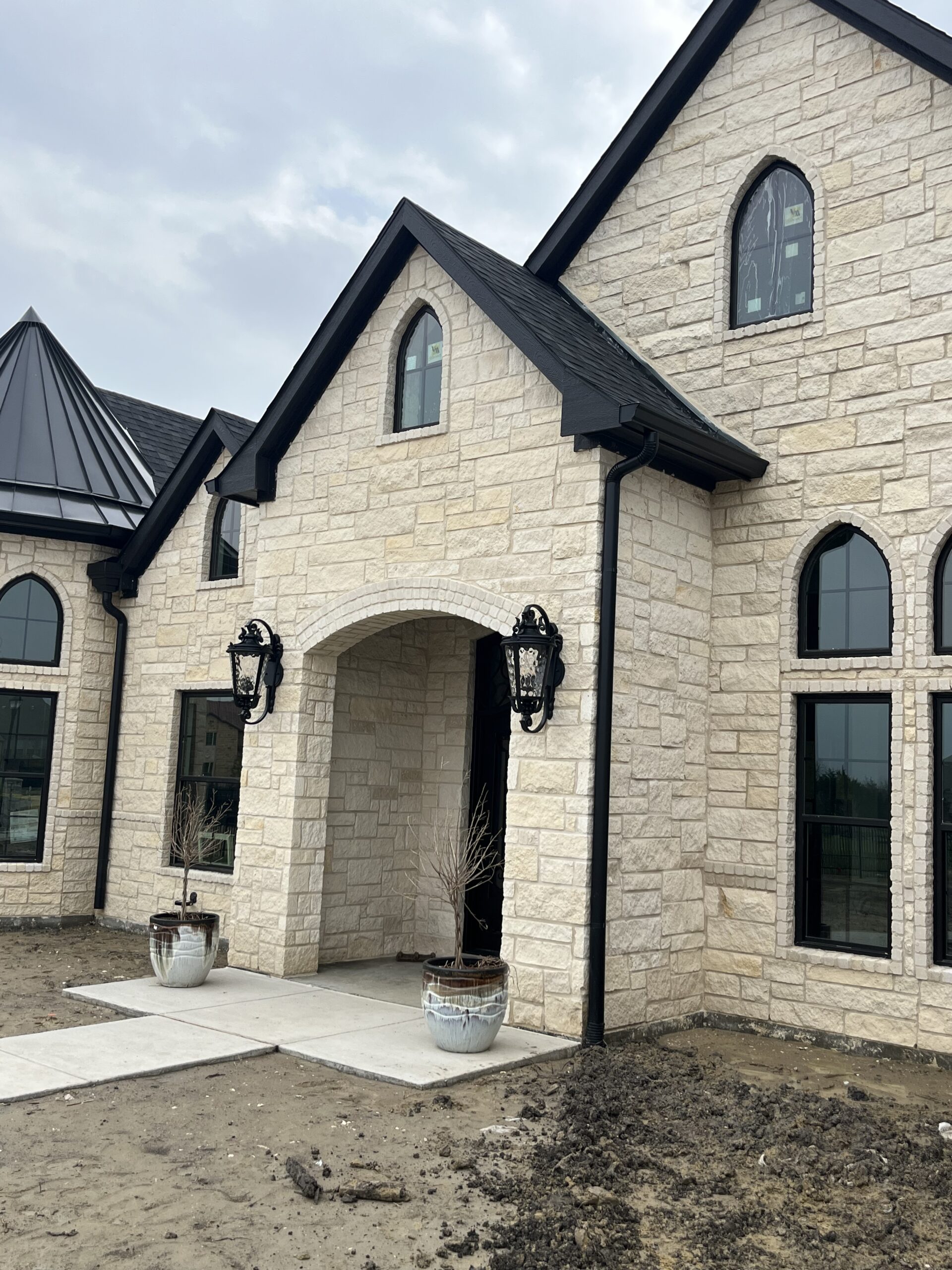
The name describes the runs, not the entire system. Joints remain in three places: at corners, where two runs meet at a miter; at end caps, which close off the end of each run; and at outlets, where an opening in the gutter floor drops water into the downspout. Every one of them is sealed, and every one is a place where a leak could eventually appear.
That’s a far smaller list than a sectional system carries, and the locations are predictable. When a drip does show up years later, it’s almost always at a corner or an end cap, it’s easy to find, and resealing it is a small repair. Corners see the most stress because two long runs expand toward each other there, so the quality of the miter work has a lot to do with how long a system stays dry.
Seamless Aluminum Gutters and Copper Options
Aluminum is the standard gutter material on Dallas homes for practical reasons. It doesn’t rust, it’s light, it takes a durable factory finish, and it’s the most economical material that can be formed on site. For the large majority of houses it’s the right answer, and the choices that matter are the size, the thickness of the metal and the color.
Copper is the premium option. It needs very little maintenance, it’s long-lasting, and it changes appearance over time, moving from bright metal through brown tones to a green patina. Homeowners choose it for architectural character on custom homes, historic styles and houses with other copper details such as bay roofs or dormers. It costs several times what aluminum does, so it’s a decision about appearance as much as function.
One rule applies whenever both metals are present on a house. Aluminum should never be placed against copper, because contact between the two in the presence of water causes the aluminum to corrode. A copper gutter gets copper downspouts, copper-compatible hangers and fasteners, and no aluminum flashing or drip edge resting in it.
Aluminum Thickness and Factory Color Finishes
Aluminum coil is sold in more than one thickness, and the difference shows up over time. Heavier aluminum keeps a straight line across a long elevation, stands up to hail better, and doesn’t ripple in July heat the way a thin coil can. Thin metal is also easier to bend out of shape with a ladder, which is a common source of dents along the front lip. If you’re comparing quotes, ask each company which thickness it’s pricing, because two quotes for “aluminum” aren’t always for the same product.
Color is applied before the metal is ever shaped. Enamel baked onto the coil at the mill holds its color under Texas sun for many years and resists chalking down onto the brick underneath. Because the finish is part of the coil, the color is even from one end of a run to the other, with no brush marks or missed spots. We offer many color options, so there’s usually one that suits the existing trim.
K-Style and Half-Round Gutter Profiles
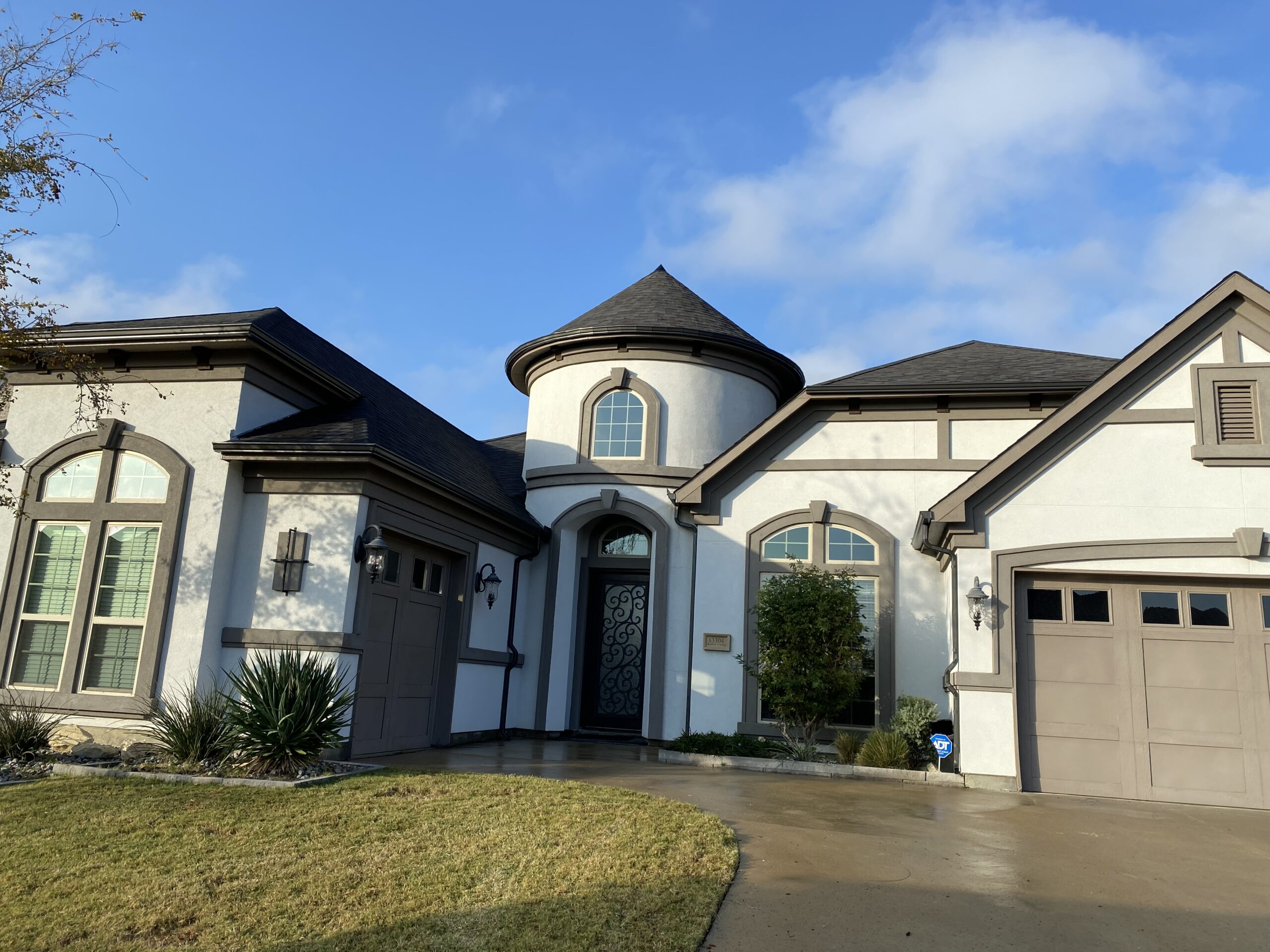
K-style is the profile on most houses. Its flat back sits flush against the fascia, and the shaped front resembles crown molding, which suits the trim on the majority of homes built in recent decades. The shape also carries more water than a half-round of the same nominal width, so it’s the practical choice where capacity is the priority.
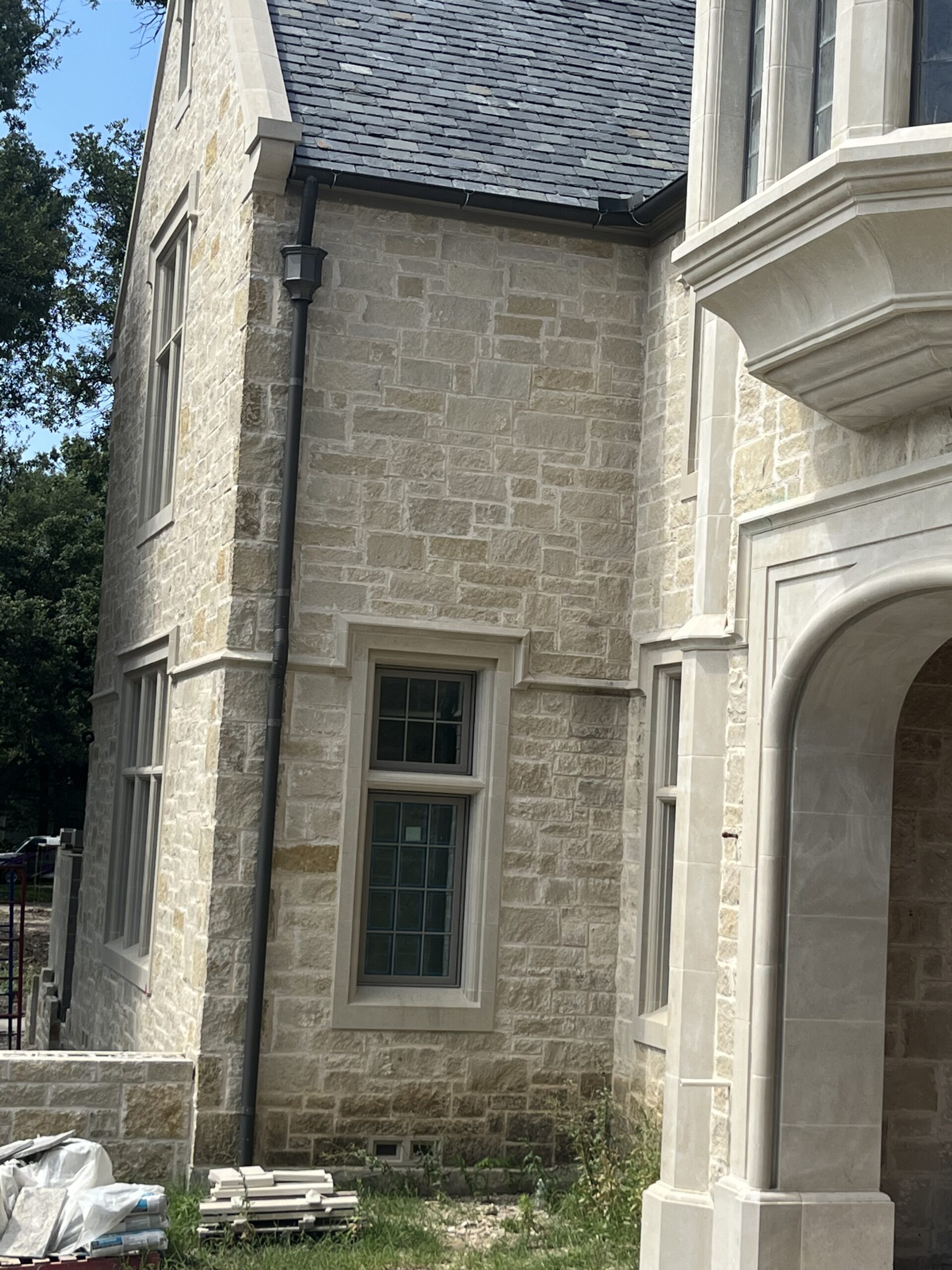
Half-round is a simple semicircular trough, usually paired with round downspouts. It suits older and architectural homes, and it’s the traditional profile for copper. The smooth curved interior sheds debris well. It’s offered in aluminum and in copper.
Choosing between them is mostly a matter of matching the house. Our page on gutter profiles and sizes goes further into how the shapes compare and which homes each one suits.
Choosing a 5-Inch, 6-Inch or 7-Inch Gutter Width
Width determines how much water a gutter can carry before it spills over the front. A 5-inch K-style handles modest roof areas and simple rooflines well. A 6-inch K-style holds roughly 40 percent more water, and that extra capacity matters on large roof planes, on steep roofs where water arrives fast, and below valleys where two slopes concentrate their runoff into a few feet of gutter.
Dallas-area rainfall is the reason sizing deserves attention. The region gets roughly 37 to 40 inches of rain a year, and that total doesn’t arrive in even installments. A storm can deliver inches of rain in under an hour, and a gutter sized for average rainfall will overflow in those bursts. Newer homes can have larger and steeper roof areas than older ones, which is one reason 6-inch has become a common recommendation.
For very large roofs, or for spots where a big upper roof empties onto a lower one, a 7-inch or oversized K-style is available. It’s more gutter than most houses need, but where it is needed, nothing smaller will keep up.
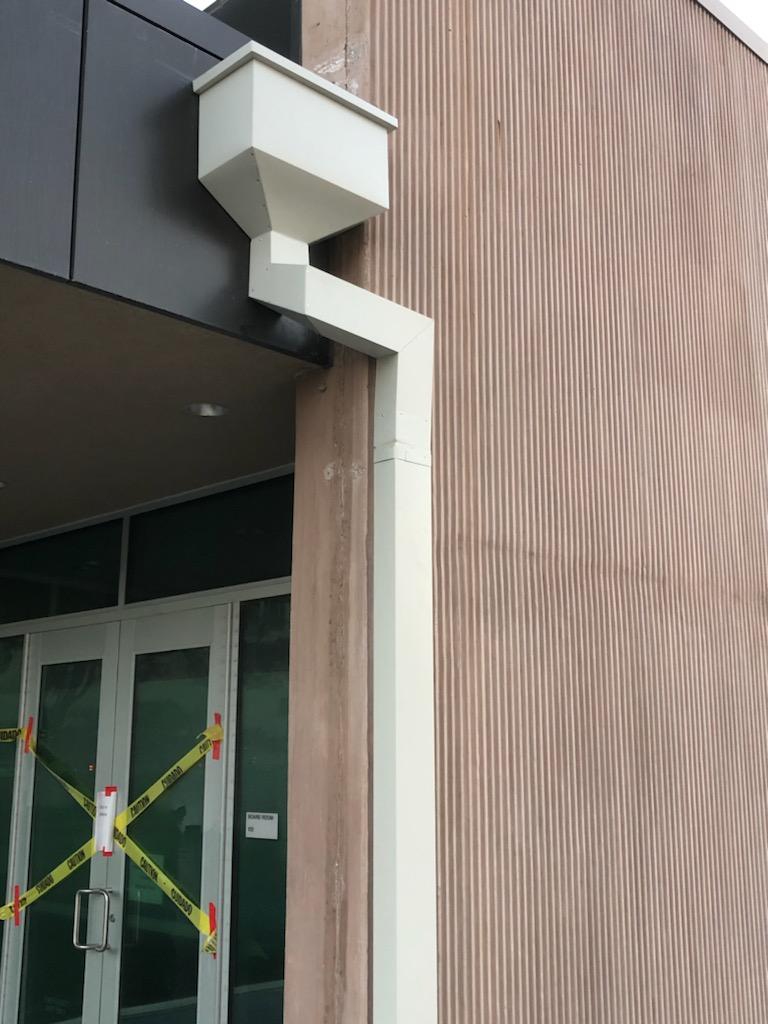
Downspouts for Seamless Gutters: 2×3, 3×4 and Round
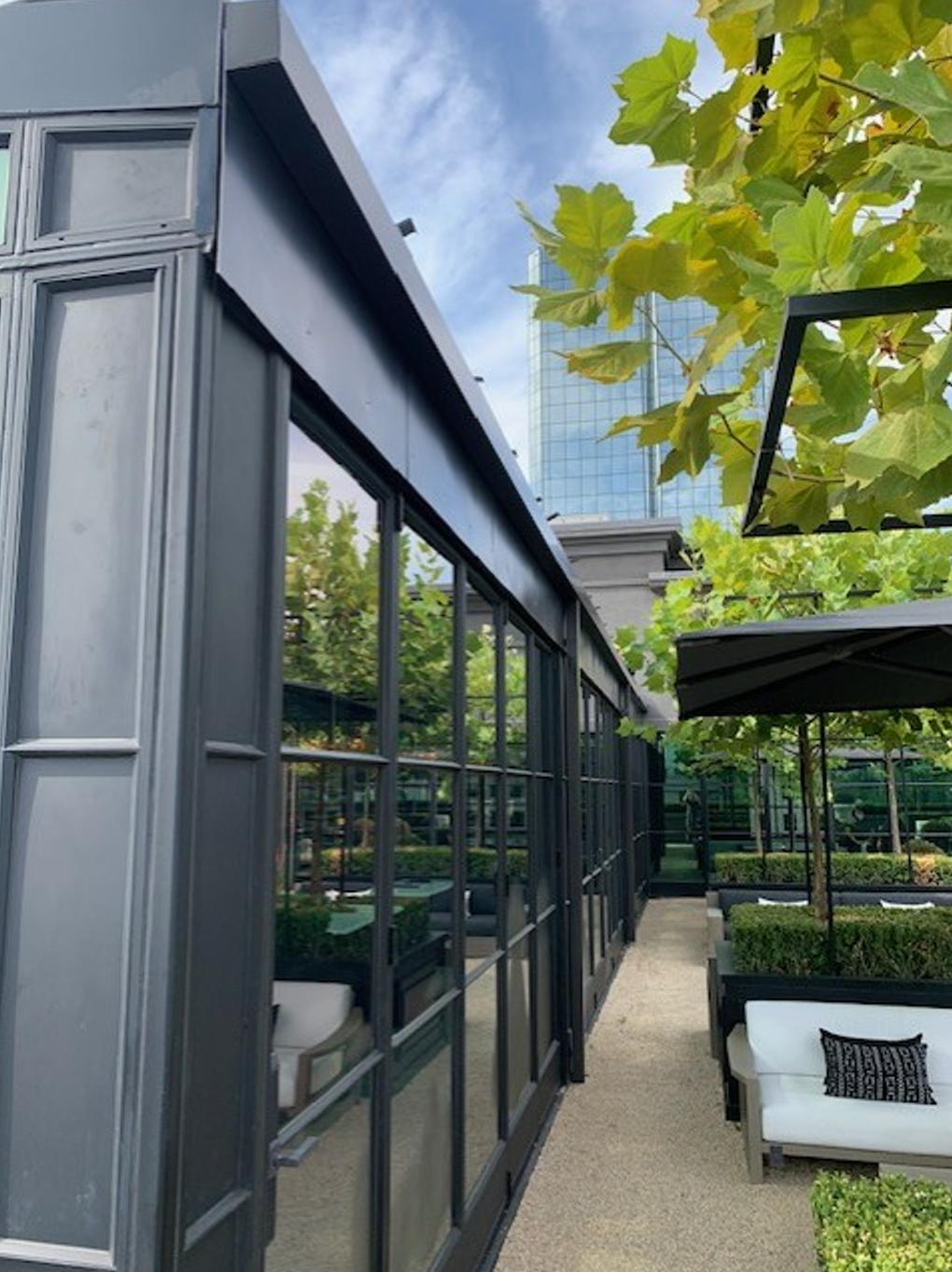
A gutter can only drain as fast as its downspouts allow. The two standard rectangular sizes are 2×3 and 3×4, and the larger one moves about twice as much water. It also clears debris that would jam in a 2×3, which makes it less prone to clogs at the elbows. Pairing a 6-inch gutter with 2×3 downspouts wastes much of the capacity you paid for.
Round smooth downspouts, in aluminum or copper, go with half-round systems and suit homes where the downspouts are a visible part of the design. Whatever the shape, the count and the locations matter as much as the size. Long runs often need an outlet at each end, and valleys call for a downspout nearby so the concentrated flow has a short path out.
Where the water lands is part of the plan too. North Texas clay soil expands when it takes on water and contracts as it dries, and repeated soaking at the slab edge isn’t good for a foundation. What we install to carry discharge runs above ground, sending water onto soil that slopes away from the house. If your property needs the discharge carried further, mention it when we come out for the estimate.
Seamless Gutter Installation in Dallas: What to Expect
Estimates are free, and the quote you receive is written and itemized from real measurements of your home. Before an installation quote becomes final, we visit the property. That visit confirms the measurements, settles the elbow and miter configuration each corner and downspout will need, and shows whether offsets are required to bring a downspout around a ledge or a change in the wall. We also look at how the ground falls and where the water needs to go.
On the day of the work, existing gutters are taken down, new runs are formed to length, hung and pitched toward their outlets, and corners, end caps and downspouts are fitted. The property is left clean. Most seamless gutter installation jobs on a house are finished in 2 to 4 hours, with a full day, and occasionally a second one, reserved for very large homes.
Timing aside, the quality of the result comes from the planning. Our main gutter installation page covers the wider process for Dallas homes, including how pitch, hangers and downspout placement are decided.
Seamless Gutter Cost: Per-Foot Price Ranges
Pricing is by the linear foot, and each figure here is a range or a starting price, since height, corners and access differ on every house. In aluminum K-style, 5-inch runs $7 to $14 per foot and 6-inch runs $8 to $16 per foot. Oversized K-style, 7-inch and up, is $20 to $28 per foot. Aluminum half-round is $13 to $25 per foot.
Copper K-style is $40 to $55 per foot, and copper half-round is $45 to $60 per foot. Downspouts are quoted on their own lines: 2×3 aluminum from $7 per foot, 3×4 aluminum from $8, round smooth aluminum from $14 and round smooth copper from $45. Gutter work has a $500 minimum charge and downspout work has a $250 minimum.
To estimate footage, a home of about 1,500 square feet generally takes 150 to 200 linear feet of gutter and downspout together. At 2,500 square feet the figure is usually 200 to 300 feet, and at 3,500 square feet and above it’s 350 feet or more. Within any range, the price moves with the number of stories and the number of corners. If you’d like guards added, Expanded Steel (Roll Lock) screen starts at $5 per foot and micro-mesh starts at $10 per foot.
Repairing a Seamless Run Instead of Replacing It
A continuous gutter that’s in good condition is worth repairing. The usual faults are a corner or end cap that has started to drip, a run that has lost its pitch and holds water, hangers that have loosened, or a downspout that has come away from the wall. Each of those can be corrected without disturbing the rest of the system, and each of those repairs starts from a $250 minimum charge. Where the fix is maintenance work, meaning a sealed seam, a re-pitched run, added hangers or a re-secured gutter, our 2-year warranty applies.
Damage to the run itself is a different matter. A seamless piece can’t be patched back to its original state once it’s been creased by a fallen limb or crushed by a ladder. In that case the damaged length is cut out and replaced, or the whole run is formed again to the same length, while the undamaged runs stay where they are. When we look at a problem, we inspect it, identify the cause and tell you what correcting it involves.
Commercial Buildings Use Sectional Gutter, Not Seamless
On-site forming is a residential method. Commercial gutter is a heavier, larger product, and it comes in 10-foot or 20-foot sections that are joined on the building. Box gutters and large downspouts on offices, warehouses, retail centers and apartment buildings are built this way because the sizes involved are beyond what a residential forming machine produces.
The joints on a commercial system are planned and sealed as part of the installation, and the system’s larger dimensions give it the capacity those roofs require. Box gutter is priced at $20 to $30 per foot, commercial downspouts start at $20 per foot with a $300 minimum, and commercial installation carries a minimum charge from $750.
Warranty on a Seamless Gutter System in Dallas
A new installation is covered two ways. Creative Gutter provides a 5-year workmanship warranty. The manufacturer provides a 20-year warranty on the materials.
Choosing a Seamless Gutter Company in Dallas
When you compare companies, look past the per-foot number. Ask what thickness of aluminum is being quoted, what size downspouts are included, how many downspouts are planned, and whether the quote is itemized. A low price built on thin coil, 2×3 downspouts and too few outlets isn’t the same product as a properly sized system, even though both are described the same way on paper.
Creative Gutter is family owned and operated, has worked from Dallas since 1984, and is fully insured. We’ve installed thousands of systems around North Texas, and customers have given us 4.9 stars across 140+ reviews on Google. Our shop is at 1515 Fuller Dr, and we have the equipment, experience and crew capacity to take a project from the first measurement to the finished system.
If you’re searching for a seamless gutter company near me, look for one that will show up, measure properly and explain the options. That’s the kind of company we’ve worked to be for more than 40 years, with competitive pricing and straightforward advice on what your house does and doesn’t need.
Seamless Rain Gutter Questions from Dallas Homeowners
Are seamless gutters completely free of seams?
The runs are. Joints still exist at corners, end caps and downspout outlets, since those are places where separate parts have to meet. Compared with a sectional system, that’s a small number of joints in known locations.
How much does seamless gutter installation cost?
Aluminum K-style is $7 to $14 per foot for 5-inch and $8 to $16 per foot for 6-inch, with a $500 minimum on gutter work. Downspouts are added separately from $7 or $8 per foot depending on size. Your exact price comes from a measured, itemized quote.
How long do seamless rain gutters take to install?
Plan on 2 to 4 hours for a typical home. Only the largest houses stretch the work to a full day or, once in a while, two.
Are seamless gutters worth the extra cost over sectional?
For most homeowners, yes. Fewer joints mean fewer leaks and less resealing over the years, the runs stay straighter, and the appearance is cleaner.
Can seamless gutters be made in copper?
Our on-site forming is for aluminum, which is what most seamless gutters in Dallas are made from. Copper gutters are also available in K-style and half-round, and we’ll go over how a copper system is fabricated and joined for your home at the estimate. Copper just can’t be combined with aluminum parts anywhere the two metals would touch.
Should I get 5-inch or 6-inch gutters?
A 6-inch K-style carries roughly 40 percent more water than a 5-inch. Large roofs, steep pitches and runs below valleys generally call for 6-inch with 3×4 downspouts, while smaller and simpler roofs can do well with 5-inch.
Do seamless gutters still need cleaning?
They do. We suggest cleaning 1 to 3 times a year, and the right number depends on the tree cover over your roof, the type of trees and the storms you’ve had. Gutter guards reduce the frequency but don’t eliminate it.
Can a damaged seamless run be repaired?
Leaks at corners and end caps, lost pitch and loose hangers are all repairable. A run that’s been creased or crushed needs new gutter, either a replacement section or a whole new run, without touching the other runs.
Who installs seamless rain gutters near me in the Dallas area?
Creative Gutter works throughout Dallas, Collin, Denton, Rockwall and Tarrant counties. If you’re inside that area, we can come out, measure and give you a free written quote.
Get a Free Estimate on Seamless Gutters in Dallas
If you’re ready to replace leaking sectional gutters, or you’re putting gutters on a home for the first time, contact Creative Gutter for a free estimate on seamless aluminum gutters, with copper available for homes that call for it. Call 214-324-4674 to request your estimate and receive an itemized quote based on real measurements. We provide seamless gutter installation for homeowners across Dallas, Collin, Denton, Rockwall and Tarrant counties.
Contact us today to schedule a FREE on-site consultation for gutter installation or repair for your home or business in Dallas, Collin, Rockwall, Denton and Tarrant Counties.
214-324-4674