pixel image

Gutter Installation In Dallas, TX

Gutter Installation in Dallas TX: One City, Every Kind of Roof

Dallas is not one gutter market. A 1926 Tudor in the M Streets, a 1958 ranch in Lake Highlands, and a low-slope brick warehouse in Deep Ellum need three different drainage systems, and about the only thing they share is the Blackland Prairie clay sitting under all of them. Creative Gutter has been doing gutter installation in Dallas out of a shop on Fuller Drive on the east side of the city since 1984.

The City Sorts Itself by Roof, Not by ZIP Code

When a contractor quotes the same package across Dallas, they are guessing. The correct spec follows the era the house was built in and the roof geometry that came with it, and Dallas contains essentially every era at once. Here is how the city breaks down from a gutter standpoint.

  • 1920s and 1930s Tudor, craftsman, and prairie. Lakewood, the M Streets, Munger Place, Swiss Avenue, the older Oak Cliff neighborhoods. Original fascia, steep multi-plane roofs, undersized period troughs, and built-in box gutters on some of the stock.
  • 1950s and 1960s ranch. Lake Highlands, much of Preston Hollow, Casa Linda, Wynnewood. Long low roof planes, shallow pitch, deep overhangs, wide carports. Usually 5-inch is adequate if the pitch and hangers are right.
  • 1970s through 1990s brick two-story. Taller elevations, more valleys, more inside corners. This is where 6-inch starts to be worth specifying.
  • 2010s and newer builds and full rebuilds. Steeper pitch, large uninterrupted planes, tall walls. 6-inch K-style with 3×4 downspouts is close to a default, along with extra outlets rather than one leader per side.
  • Commercial and low-slope. Downtown, Deep Ellum, the Design District, the warehouse corridors along the rail lines. A different trade entirely, covered further down.

Roof plane area and pitch determine size, not the length of the eave. The eave length only tells us how much material to run. If you want the general picture of how we handle installs and repairs before getting into your specific house, start there.

Why Professional Gutter Installation is Essential

Our Gutter Installation Services in Dallas

At Creative Gutter, we offer comprehensive gutter installation services tailored to both residential and commercial properties. Every installation begins with a detailed consultation where we evaluate your roofline, drainage needs, and property layout. From there, our team designs a custom solution that ensures efficient water management and long-lasting performance.

Our expert technicians perform rain gutter installation using premium materials such as seamless gutters, aluminum gutters, and copper gutters. Each material offers its own advantages depending on the style of the property and the level of durability desired. Aluminum gutters are lightweight and resistant to rust, copper gutters provide a distinctive architectural appearance, and seamless gutters reduce the number of joints where leaks can occur.

For homeowners, seamless gutters offer a clean aesthetic while minimizing the potential for leaks and ongoing maintenance. Because they are custom fabricated to fit the home, they create a streamlined appearance while improving performance. Commercial properties, on the other hand, often benefit from more robust gutter systems that are designed to handle higher volumes of water from larger roof surfaces.

Whether you’re upgrading your home’s exterior or equipping a commercial building with a reliable drainage system, our professionals handle every project with care and attention to detail. Gutter installation in Dallas, TX, isn’t just about functionality. It is also about enhancing curb appeal, protecting landscaping, and reducing long-term maintenance requirements for the property owner.
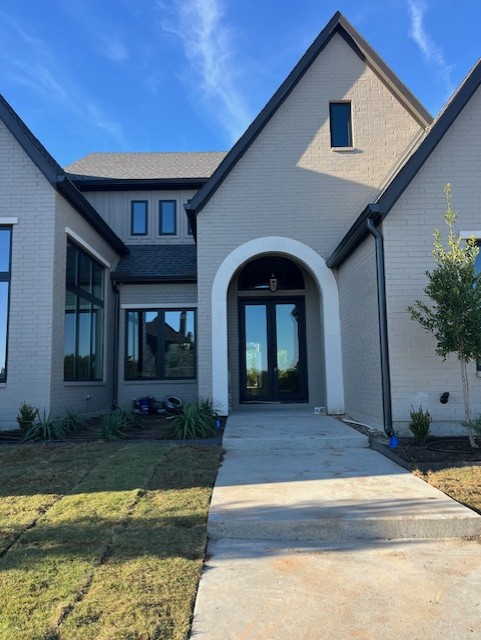
Professional Gutter Installation in Dallas Texas

Lakewood, the M Streets, and Munger Place: 1920s Roofs, Original Wood

On these blocks the gutter is rarely the first problem. The fascia is. Original east Dallas eaves were built from real lumber, often with a molded profile or a boxed cornice, and eighty or ninety years of a trough holding standing water against that board leaves soft wood at every outlet and at every spike hole. Hang new metal on that and it will come down.

So we probe the board first, replace what has gone, and re-hang with hidden hangers driven into solid wood. A fair number of these houses were never built with a hung gutter at all. They have built-in box gutters formed into the cornice and lined with soldered metal, and when the liner fails the water goes into the wall assembly rather than over the edge. That is why a homeowner in Munger Place calls about a ceiling stain after a brand new roof and cannot understand it. Box gutters on older brick and frame houses are their own repair, not a variation on hanging a run.

Profile matters here too. A steep Tudor elevation frequently wants half-round rather than K-style Ogee, and copper is a reasonable specification on a house with that much detail. Sizing does not carry over between the two: a half-round has less cross-section than a K-style of the same nominal width, so a straight swap loses capacity you may not be able to spare.

Lake Highlands, Preston Hollow, and the Ranch Roof Problem

The 1950s and 1960s ranch is the most common house in the north and northeast quadrants of the city, and it fails in a specific, unglamorous way. Long low roof planes with shallow pitch do not accelerate water. It sheets slowly across a wide surface and arrives at the gutter as a broad, steady flow rather than a concentrated rush. That is easier on capacity, and that is why 5-inch K-style is usually adequate here.

What ranch roofs punish instead is pitch and support. A 45-foot run with almost no fall toward the outlet holds water at the low spots, and standing water is heavy. On original spike-and-ferrule hangers in sixty-year-old fascia, that weight is what slowly pulls the run away from the house until you can see daylight between the gutter and the board from the driveway. Adding hangers on tighter centers and re-setting the pitch fixes more Lake Highlands houses than a full replacement ever will.

Two ranch-specific details worth naming. Deep overhangs mean the gutter sits well out from the wall, so a downspout has to travel back to the house before it drops, and that offset is a common leak point when it was done casually. And carports and covered patios, which nearly every house of this era has, get skipped in most estimates even though they dump straight onto a walkway. The canopy in this part of the city is heavy, so screening options are a real conversation on a ranch, not an upsell.

Which Dallas Neighborhoods Actually Need Guards

We will talk homeowners out of guards regularly, and the deciding factor is what is growing over the roof rather than what part of town you live in. The established east and north neighborhoods, Lakewood, the White Rock area, Casa Linda, Preston Hollow, much of Lake Highlands, sit under mature live oak, red oak, pecan, and cedar elm. Those are heavy-debris streets and screening pays for itself quickly.

Newer construction and infill with young landscape trees usually does not need guards yet. What those houses more often have is a capacity problem, and a guard does not add capacity. It can slightly reduce it. Sizing comes first, always. Where guards do go on, the type matters: fine stainless micro-mesh over a solid frame sheds a wet oak leaf mat, while cheap drop-in foam and loose plastic mesh pack solid under the same conditions.

The other point is that no guard makes a gutter maintenance-free. It converts a full clear-out into a periodic surface sweep. Under mixed live oak and pecan, two visits a year is the floor and three is closer to right, once in late fall after the pecans finish, once in late winter before the spring storms start, and one in between wherever the crown sits directly over the roof.

Under All of It: Blackland Prairie Clay

Dallas sits on expansive clay that swells when it takes on water and shrinks hard during a dry August. Every foundation in the city rides that cycle, and the single largest thing a homeowner controls about it is where roof water lands. A house with 2,000 square feet of roof sheds a large volume in a one-inch rain, and if that volume is released at the corner of the slab, you have engineered a wet spot right where you least want one.

The rainfall pattern makes it worse. North Texas gets roughly 37 to 40 inches a year, but it does not arrive evenly. It comes in intense bursts during spring storms from March through June and again in a wet stretch in fall, with long dry periods in between. That is a soak-and-shrink cycle rather than steady moisture, and it is exactly the pattern clay responds to most.

Which means the discharge point is not an accessory to the gutter, it is the point of the gutter. Carry the water well clear of the slab, either with above-grade extensions on an open lot or with buried solid pipe to a pop-up emitter where the yard is tight or terraced. Use solid pipe rather than corrugated flex, because flex silts up in clay soil and eventually holds water underground. And roof water should never be tied into a sanitary line. If you want the full picture of what a rain gutter system includes from roof edge to discharge, that covers it end to end.

Commercial Gutters Downtown, in Deep Ellum, and Along the Warehouse Corridors

Commercial drainage in Dallas is a different trade with different failure modes, and a lot of it sits on buildings that are eighty to a hundred years old. Deep Ellum, the Design District, and the corridors along the rail lines are full of brick warehouse stock with low-slope roofs draining through parapet scuppers and internal leaders, and downtown adds height and access constraints on top of that.

The things that change on a commercial job are worth understanding before you get a bid.

  • Material and gauge. Aluminum is fine on light commercial, but larger buildings and anything with real span usually calls for heavier-gauge steel, which handles impact, ladder traffic, and long unsupported runs better.
  • Volume. A commercial roof plane can be many times the size of a house roof. That means oversized troughs or box gutters, larger leaders, and more outlets, because a single undersized downspout on a big plane will back a whole system up in a five-minute burst.
  • Scuppers and conductor heads. Where a parapet discharges through a through-wall scupper, the water hits a conductor head and drops into a leader. Sizing that head and its overflow relief correctly is the difference between a controlled discharge and a sheet of water down a brick facade.
  • Box gutters. Older commercial buildings frequently have built-in gutters behind the parapet. These are rebuildable, and rebuilding is generally far cheaper than reworking a roof edge.
  • Discharge and site drainage. On a lot with paved parking and little permeable ground, discharge has to be routed deliberately or it simply pools where tenants walk.
  • Scheduling. Occupied buildings mean staging around tenants, parking, and business hours. We plan that into the job rather than discovering it on day one.

We do this work on retail strips, offices, churches, schools, warehouses, and mixed-use buildings across the city. If you manage a property and are dealing with overflow at a scupper or a leader that never kept up, low-slope and commercial systems are handled by the same company, not subcontracted out.

Pecans Over an East Dallas Roof

Our shop sits on Fuller Drive, which puts us under the same canopy as the streets around White Rock and Casa Linda, and in that part of Dallas the pecan sets the schedule. It trails everything else. The cedar elm has finished, the oaks are done, and the pecan is still dropping husks, twigs and small branches into December and past it.

Husks are the problem rather than leaves. They are bulky and stiff, and two or three of them will bridge an outlet and hold back everything arriving behind. That is why a house under heavy pecan moves to four cleaning visits a year rather than the two to three that covers most of Dallas, and why the last visit of the year should be late rather than convenient.

It also argues for downspout size over trough size. A 3×4 leader passes a husk that a 2×3 catches, and on a 1950s Dallas ranch with 5-inch gutter that is otherwise sound, changing the leaders and leaving the trough alone is frequently the whole job. We will tell you when that is the case rather than quoting a system you do not need.

Dallas Gutter Questions We Get Most

My roof was replaced and now the gutters overflow. What changed?

Usually the drip edge or the way the new roofing sits relative to the gutter lip, so water is now shooting past the trough instead of into it. Sometimes granule wash from a new roof has packed an outlet. Neither requires a new gutter system, but both need to be looked at rather than lived with.

I have a 1950s ranch. Do I really need 6-inch gutters?

Usually not. A shallow low-pitch ranch roof sheets water slowly and 5-inch handles it. What your house probably needs is correct pitch toward the outlet and more hangers, because sixty-year-old spikes in softened fascia are the actual failure. Fixing that costs less than a bigger profile and solves more of the problem.

Would you do the garage off the alley too?

If you want us to. Detached garages off an alley are common through the older parts of Dallas and they are usually the roof nobody ever guttered, which shows up as a trench along the drip line and a soft bottom plate. Short runs on a garage are inexpensive metal, and you can take that part or leave it.

Can you do gutters on a downtown or Deep Ellum building with no rear access?

Yes, though access shapes the plan and the schedule. Tight urban sites, occupied tenants, and limited staging are normal for us. We look at the site before quoting rather than pricing off a drawing.

Is there any point to gutters on a house with big overhangs?

There is, and it is about the foundation rather than the siding. A deep eave keeps water off the wall but still drops it in a line around the house, right into clay that swells and shrinks. Controlling where that water is released is the entire argument for a properly drained system.

How often should I have gutters cleaned in Lakewood or near White Rock?

Two to three times a year under that canopy. Late fall after the pecans and cedar elms are done, again in late winter ahead of the spring storms, and a third pass on the runs sitting directly under a crown. Newer neighborhoods with young trees can usually hold to two.

Can you repair just the section that is failing?

Often yes. Separated corner miters, a sagging middle, a leader that pulled off, and a section that ponds after rain are all fixable in place. Replacement makes sense when the profile is simply too small for the roof, when the fascia has been rebuilt, or when hail has gone through enough of the system that patching costs more than starting over.

Do you install copper and half-round, or only standard K-style?

Both, and box gutters as well. K-style aluminum is what most Dallas houses get. Half-round, copper, and fabricated conductor heads go on period homes and high-end rebuilds, and we solder rather than seal those joints.

Is a repair worth it on a system that is thirty years old?

Often, if the metal is sound and the fascia still holds a screw. Age by itself is not a reason to replace aluminum. What decides it is how many separate things have failed at once, and a call that ends in a re-hang and two new leaders is a perfectly normal outcome for us.

What Gutter Work Costs in Dallas

Because the housing stock varies so much, the range across the city is wide, and where your house lands depends on linear footage, roof height, complexity, and access more than anything else.

  • Seamless aluminum, $4.50 to $12 per linear foot installed. This covers the majority of residential work in the city.
  • Steel, roughly $9 to $20 per linear foot, standard on heavy-duty and commercial applications.
  • Copper, $25 to $40 per linear foot, common on period homes in Lakewood and Swiss Avenue and on high-end rebuilds.
  • Gutter size is the first thing that moves a whole-house number. A 5-inch K-style run costs less per foot than a 6-inch one, because there is less coil in it, fewer outlets to cut, and lighter metal to hang.
  • Where 6-inch is warranted, meaning steep pitches, large planes, and heavy tree load, the system costs more up front and is still the cheaper decision over its life, because an undersized trough overflows during exactly the storms that do damage.
  • Cleaning prices off what is actually sitting in the trough. A compacted season of granule wash takes far longer to clear than a light leaf load, and a second story adds ladder time to either one.
  • Guards are sold by the linear foot, and the total depends as much on how many runs you cover as on the product itself. We fit them run by run rather than by default.

Commercial work is quoted on the building rather than off a per-foot table, because gauge, volume, scupper details, and access drive it. All of these are ranges rather than quotes. A house with no side-yard access, a steep back elevation, or fascia that needs rebuilding before anything can be hung will cost more to stage than an open corner lot. Every installation carries a 5-year workmanship warranty and a 20-year manufacturer warranty on materials, and estimates are free.

Hail Season and What to Check After a Storm

Dallas sits in the hail belt, and the season runs roughly March through June. Hail dents the visible fronts of aluminum gutters. That much is cosmetic, but it also strips shingle granules that wash into the trough and set up as a paste at the outlet. The wind that comes with those cells does more structural damage than the hail: it gets under a loose gutter lip and peels a run off the fascia, and it tears leaders off their straps.

The post-storm check takes five minutes. An hour after the rain stops, look for water still standing in the trough, which means a packed outlet. Look at the gutter line from the street and see whether it still reads straight, because a run that has dropped at one end has lost hangers. Check the back of the house and any detached garage, which is where damage sits unnoticed for a season. We take after-storm repair calls across the city and the visit starts by sorting out whether it is a re-hang, a replacement, or an insurance conversation.

Where We Work Across Dallas and the Cities Next Door

We cover the whole city, from Oak Cliff and the Bishop Arts area to Lake Highlands, Preston Hollow, and the neighborhoods around White Rock Lake, and we work the surrounding communities on the same routes. That includes the Park Cities, where we do restoration-grade work in Highland Park and University Park. North along Central Expressway we cover Richardson, and east of the city we handle gutter installation in Garland and Mesquite. Everything ties back to the rest of Dallas County, plus Collin, Denton, Rockwall, and Tarrant.

Tell Us What Your House Is Doing

Overflowing at one corner, sagging away from the fascia, staining a ceiling with no roof leak in sight, or dumping straight onto the slab. Whichever version of Dallas you live in, call Creative Gutter at 214-324-4674 and we will come look at the roof planes, the fascia, and the discharge. You get a written range and an honest recommendation, including when the answer is a repair rather than a replacement. Family-owned, working the whole metroplex since 1984.