

Gutter Installation In University Park, TX
University Park Gutter Installation for Original Homes, Rebuilds, and New Builds
University Park runs on a rebuild cycle, and you can read it off a single block. There is a 1930s cottage still on its original fascia, a house that went down to the studs three years ago, and a lot two doors along with forms up for a new foundation. Those are three different gutter jobs, and gutter installation in University Park has to be quoted that way. The lots are narrow enough that where the water goes after it leaves the downspout matters as much as the gutter you hang on the house.




Three Houses on the Same Block, Three Different Jobs
Most cities we work in are one thing. University Park is three at once, and the mistake we see most often is a contractor pricing all three the same way. The original 1920s through 1940s stock is small-footprint by modern standards, sits on ninety-year-old wood, and frequently still carries a 4-inch or 5-inch trough that was adequate for the roof above it and is now buried under sixty years of canopy growth that did not exist when it was hung.
The renovated middle group is the trickiest. A house that was expanded and re-roofed at some point in the last twenty years usually has a roof plane that grew while the gutter did not. A rear addition adds square footage and a new valley, that valley concentrates flow into one inside corner, and the original 5-inch run on the side elevation gets asked to carry water it was never sized for. Nothing is broken. The math just changed underneath it.
The new builds are the opposite problem. Steep pitch, tall elevations, large uninterrupted planes, and often a builder-standard gutter package chosen for cost rather than for the roof drawn above it. On those we specify 6-inch K-style or oversized half-round with 3×4 downspouts, extra outlets rather than one heroic leader per side, and hidden hangers on tighter centers because a full 6-inch trough is heavy before you add anything to it.
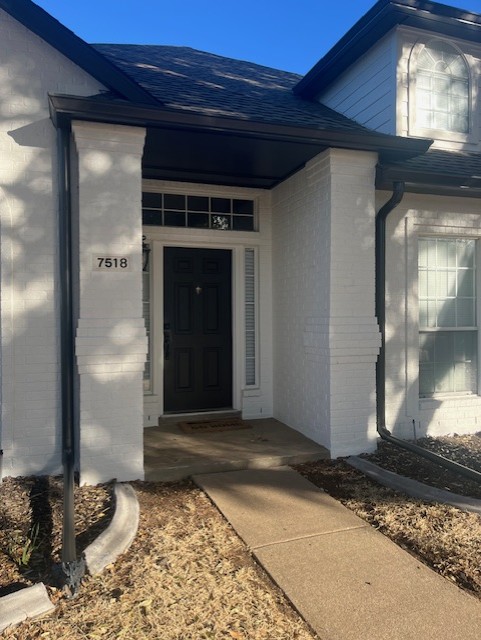
Original Homes: Undersized Troughs on Ninety-Year-Old Fascia
Start an original University Park house at the eave board rather than at the trough. Old-growth lumber holds a fastener beautifully right up until it has been kept damp, and a gutter that ponded through a few winters keeps one narrow strip of that board damp all year round. The failure is local, not general: the board a foot away can be perfectly sound.
So we push a screwdriver in behind every outlet and behind any miter that has been dripping. Where it sinks, the wood has lost its grip on a screw and anything hung on it will be back on the grass inside two seasons. That is a carpentry line on the estimate, and it comes before any decision about profile or size.
The sequence, then, is fascia first: replace what needs replacing and re-hang with hidden hangers into solid wood on centers appropriate to the load. Some of these houses have built-in box gutters formed into the cornice, and a failed liner there shows up as an interior ceiling stain rather than as water over the edge, and that is why it often gets misdiagnosed as a roof leak.
The other original-home decision is profile. A period elevation often wants half-round rather than K-style, and where the roof plane is small but the canopy above it is enormous, we frequently size up anyway. On these houses debris load rather than roof area is the limiting factor. Understanding what taking the whole system off and starting over involves is worth doing before you commit, because on original stock the answer is not always replacement.
Fifty Feet of Lot and Two Slabs: The Side-Yard Problem
This is the condition that makes University Park different from almost everywhere else we work, and it barely gets discussed. The houses here occupy most of the lot width. On many properties the side setback is a narrow strip with your slab on one side and the neighbor’s on the other, almost no fall along its length, and a downspout discharging into it from each direction. Two roofs, one channel, nowhere for it to go.
What happens next is predictable. The strip stays saturated after every storm, the clay under both slabs takes on water and swells, then dries out and shrinks in August, and both houses pay for it. Surface extensions do not solve this because there is nowhere on the surface to extend to. Sending it toward the neighbor is not a solution either, it is just their problem now.
The workable answer is to consolidate. We tie the side-yard leaders into a single buried solid-pipe line with continuous fall and run it either forward to a pop-up in the front yard or back to the alley, whichever direction the grade favors. Solid pipe rather than corrugated flex, because flex silts up in clay and turns into a buried reservoir. On a tight lot, buried leader lines and extensions are not an add-on. They are the part of the system that determines whether the gutter did any good.
Getting the Gutter Spec Into a Rebuild Before the Scaffolding Comes Down
If you are building new or taking a house to the studs, the gutter conversation should happen at the framing and roofing stage, not after the landscaper has finished. Several decisions get expensive to reverse once the site is closed up.
- Blocking behind the fascia. Tall elevations and 6-inch troughs need solid backing to screw into. Adding it during framing costs almost nothing. Adding it later means pulling trim off a finished house.
- Leader chases and sleeves. If the discharge is going below grade, the sleeves under the driveway, the walk, and any hardscape have to be in before the concrete is poured. This is the single most common regret on a finished rebuild.
- Roof-to-wall details. Kick-out flashing where a roof plane dies into a wall above a gutter is a roofing detail, but it is the reason a lot of new houses get water behind the brick. It has to be right before the gutter goes on, and we will flag it if it is not.
- Material and finish decisions. Copper, half-round, conductor heads, and finish coordination with any standing seam accents are spec-stage choices. Deciding at the end usually means aluminum by default.
- Sequencing. Gutters go on after roofing and after the fascia is finished and painted, but before final grade and irrigation. Out of order and something gets torn out and redone.
We are used to working alongside a general contractor on a University Park rebuild, coming out to look at framing, then returning once the roof is on. Every run is formed from a single length of coil on site, so a 48-foot elevation gets one continuous 48-foot gutter with no mid-run joint to open up in year three.
Alleys, Garage Apartments, and Everything Behind the House
Park Cities blocks are served by rear alleys, and a large share of University Park properties have a detached garage, frequently with quarters above it. Those structures get forgotten in almost every estimate we are asked to look at as a second opinion. They have small roofs, but small roofs with real valleys, and they usually sit right on the paved approach, which means whatever comes off them lands on concrete and sheets straight back toward the structure or into the alley.
Two practical notes. A detached garage with living space above needs the same discharge discipline as the main house, because its slab sits in the same clay. And the alley is useful to us: crews can stage from behind the property, which makes rear-elevation work faster and keeps ladders and coil off a narrow front setback and out of the street. If you are having the main house done, doing the garage on the same visit costs far less than bringing a crew back for it.
Canopy: What a Live Oak and a Pecan Do to a Gutter
The established University Park blocks around Snider Plaza and the older park-adjacent streets sit under some of the heaviest canopy in Dallas County, and the two dominant trees behave completely differently. Live oak is evergreen in habit but drops its old leaves in late winter and early spring, right before the heaviest rain months, along with catkins that mat into a dense wet layer. That is the drop most homeowners forget about, and it is the worst-timed one.
Pecan is the other half. It sheds small hard twigs, husks, and shell fragments through the fall, and that material does not sit on the surface where a screen can catch it. It sinks to the bottom of the trough, migrates to the outlet, and packs into a plug.
How Often These Blocks Need Clearing
Put those two calendars side by side and the answer for these blocks is two visits at an absolute minimum, three where a lot carries both trees, and four on the handful of properties sitting under a full pecan crown. One in late December after the pecan has finished. One in April once the live oak catkins are down. Anything beyond those two fills the gap between them.
Standing a ladder against a three-story elevation in December is nobody’s idea of a good Saturday, so most owners here put the property on a set cleaning rotation and stop thinking about it. Where a screen is the better answer on a particular run, fitting guards takes half a day on a gutter that is already sound.
Third Floors, Dormers, and the Run Nobody Can Reach
The rebuilds have changed the geometry of these University Park blocks. A new University Park house frequently carries two and a half or three floors of elevation on the same narrow lot the cottage before it sat on, with dormers, a steep pitch, and a gutter line better than twenty feet off the ground above a side yard that may be only five or six feet wide. That combination is easy to design and genuinely awkward to service.
The practical problem is the ladder. A high run over a side yard that narrow leaves nowhere to foot a ladder at a safe angle, and on a University Park lot the ground on either side of it belongs to somebody else. Anything at that height and in that position is not a Saturday job for the owner and it is not a quick visit for anybody else either, so the cost of clearing it is set by access rather than by how much is in the trough, which is why University Park cleaning quotes vary so much from house to house.
That changes what is worth buying at install. On the reachable University Park elevations, a service schedule is cheaper than screening. On a third-floor dormer run over a side setback, the screen pays for itself because it converts the visit from a full clear-out into a look, and because getting the specification right the first time is worth far more when nobody is going back up there casually. Outlet placement matters for the same reason: a drop every thirty to forty feet keeps water travel short so a high run is not relying on one opening.
Sequencing is the other lever. On a rebuild the gutters should go on while the site is still open and staging is available, not after the drive is poured and the landscape is in. The same run that takes an hour off scaffolding takes most of a morning once the only approach left on a University Park lot is a narrow gate and a neighbor’s fence.
Hail, Wind, and What to Check After a Storm
Hail season across North Texas runs roughly March through June, and it does two things to a gutter. It dimples the visible fronts of aluminum, cosmetic on its own, and it strips shingle granules that wash into the trough and settle into a paste at the outlet. On a tall University Park elevation you will not see either from the ground until water starts coming over the front.
What you can see from the ground on a house this tall is limited, so start with the two things that do show. Granule paste washed out of the bottom of a downspout onto the drive tells you the roof took a beating and that the outlet feeding that drop is carrying the same material. A leader hanging free of its strap is the other, and on these lots it is nearly always the alley elevation, where nobody walks and nobody looks.
Everything above that needs either a ladder or a set of eyes at a second-floor window looking down the length of the trough. We take urgent post-storm calls, and the first thing we settle on site is whether you are looking at a hardware fix we can do that morning or something an adjuster should see before anyone touches it.
Questions University Park Homeowners Ask
How do you service a gutter three floors up over a side yard that narrow?
Carefully, and with the access worked out before the day rather than on it. On many University Park lots the answer is staging from the alley or from the front rather than the side yard, and on some elevations it means the run should have been screened at install so a visit is an inspection instead of a clear-out. We will tell you at the estimate which runs on your University Park house fall into that category.
Does a tall rebuild cost more to gutter?
Access does more to the number than material does. The metal on a tall elevation costs what it costs anywhere, but the setups take longer, some of them cannot be done off the ground at all, and a narrow lot limits where equipment goes. That is why estimates here sit in the upper half of what a whole-home system runs rather than at the bottom of it.
The house next door is being rebuilt. Will that affect my gutters or drainage?
It can affect drainage. A rebuild often changes the grade of the adjoining side yard and adds roof area discharging near the property line. If your side yard has started holding water since construction next door, that is worth looking at, and the fix is usually a consolidated buried line on your side rather than an argument over the fence.
My gutters are only four years old and they overflow at one corner.
Almost always a valley concentrating two roof planes into a single inside corner with a 5-inch trough and a 2×3 downspout below it. A 3×4 leader moves roughly twice the water of a 2×3, and adding an outlet at that corner usually fixes it without touching the rest of the house.
Should I do copper, or is that only worth it on the front?
Plenty of homeowners here do exactly that: copper half-round on the elevations the street sees, aluminum on the back and on the garage. It is a reasonable use of money and it looks correct. We will lay out both and you can decide where the line goes.
Can you fit gutter installation in University Park around a construction schedule?
Yes, and we prefer to. We like to come out at framing to talk about blocking and sleeves, then come back after roofing and painted fascia to install. Coordinating with your builder is normal for us on residential work across the metro.
Do you need to get into my backyard, and what about the pool or landscaping?
We do need rear access, and on tight lots that usually means staging from the alley rather than dragging material through a side gate. Tell us about beds, irrigation heads, pool equipment, and anything else worth protecting when we come to estimate, and we will plan the staging around it.
How often should gutters be cleaned in University Park versus a newer suburb?
Two to three times a year on these blocks, against two in a 2000s subdivision with young landscape trees. The difference is entirely canopy. A ninety-year-old live oak arching over a roof produces a debris load that a fifteen-year-old red oak simply does not.
Do you need approval for gutter color or material before starting?
That depends on your specific property and project. If any exterior submission is required, we will supply manufacturer spec sheets, a finish sample, and a physical metal sample, and we will schedule around the approval rather than starting and hoping.
What Gutter Work Costs in University Park
Cost here tracks the same metro ranges as everywhere else we work, but the property mix pushes most jobs toward the top of them. Two and three stories, several planes, steep pitch, tight setbacks that limit ladder placement, mature landscape to protect, and buried discharge on top of the gutter itself.
- Seamless aluminum, $4.50 to $12 per linear foot installed, which covers most rear elevations, garages, and rental properties.
- Steel, roughly $9 to $20 per linear foot for heavy-duty applications.
- Copper, $25 to $40 per linear foot, common on front elevations and carried around the whole house on higher-end rebuilds.
- Full aluminum system, $600 to $2,750 installed for a whole home, with the two-story and multi-plane elevations that dominate these blocks sitting at the upper end of it.
- Cleaning, quoted on debris volume as much as on footage, and under this canopy a fall pass once the cedar elm has finished is a heavier visit than a spring one.
- Guards, priced by specification, since a fine mesh for live oak catkins and a heavy-gauge screen for leaf are not the same product.
When you book matters nearly as much as what you book. Hail season runs March through June, and the fortnight after a cell crosses this part of Dallas County is when every crew in the metro is committed and lead times stretch out. The same job ordered in a quiet stretch of late summer or midwinter gets a calmer schedule and a crew that is not working around three other addresses on the same street. If you already know the system is at the end of its life, getting on the calendar ahead of the spring window keeps the work on your timetable rather than the weather’s.
Those are ranges and not quotes. Buried discharge lines are priced separately because the run length, the depth, and whether anything has to be sleeved under existing hardscape vary enormously lot to lot. Estimates are free, and if the honest recommendation is fascia repair and a re-hang rather than a new system, that is what you will get. Everything we install carries a 5-year workmanship warranty and a 20-year manufacturer warranty on the materials.
Where Else We Work Around University Park
University Park is surrounded by the city of Dallas and shares a boundary with its sister city, so routes here are short. We do the same restoration-grade work in Highland Park, where the estate stock is older and the ground falls toward Turtle Creek. Heading north we cover North Dallas, and west of the Tollway we handle gutter installation in Northwest Dallas. Work throughout the city of Dallas runs on the same crews out of our Fuller Drive shop, and Dallas County homeowners have been calling us for this since 1984.
Book a Walk-Through
Bring us out before the drawings are final if you are building, or the morning after the side yard held water if you are not. Call Creative Gutter at 214-324-4674. We measure the planes, probe the eave board, and trace where every leader currently puts its water, then leave you a written range with the drainage priced as its own line rather than folded into a per-foot number. There is no charge for the visit and no pressure to buy the largest version of the job.
Contact us today to schedule a FREE on-site consultation for gutter installation or repair for your home or business in Dallas, Collin and Rockwall Counties.
214-324-4674