

Gutter Installation In Richardson, TX
Gutter Installation in Richardson TX for Homes Whose Trees Outgrew Their Gutters
Most of Richardson was built between the mid-1950s and the early 1970s, and many of those houses still carry the original 5-inch gutter on the original fascia. That gutter was correctly sized for the roof it was hung on. The trees are what changed. Sixty years of post oak, pecan, and cedar elm over Canyon Creek, Richardson Heights, and the Duck Creek corridor now feeds far more debris into that trough than it was built to carry. That is why gutter installation in Richardson is more often a capacity decision than a repair.




Your Gutters Were Right in 1968. The Trees Settled the Argument.
When these blocks went up, the lots were open ground. A new Richardson ranch had a low, simple roof, a young shade tree staked in the front yard, and almost nothing hanging over the eave. A 5-inch K-style gutter fed by 2×3 downspouts handled that house easily, and for the first two or three decades it did exactly what it was designed to do. Nobody was wrong.
The roof has not changed since. Same pitch, same square footage, and in plenty of cases the same physical run of aluminum with the same spikes through the same holes. What changed is above it. Six decades of growth turned those staked saplings into full crowns that reach past the roofline and drop leaf litter, twigs, catkins, and seed straight into a trough with a fixed capacity.
That distinction changes what you should buy. A homeowner who believes the gutter is broken pays for a repair and gets the same overflow the following spring. A homeowner who understands the gutter is simply undersized for current conditions pays for capacity instead, and capacity is the thing that actually stops water from coming over the front lip.
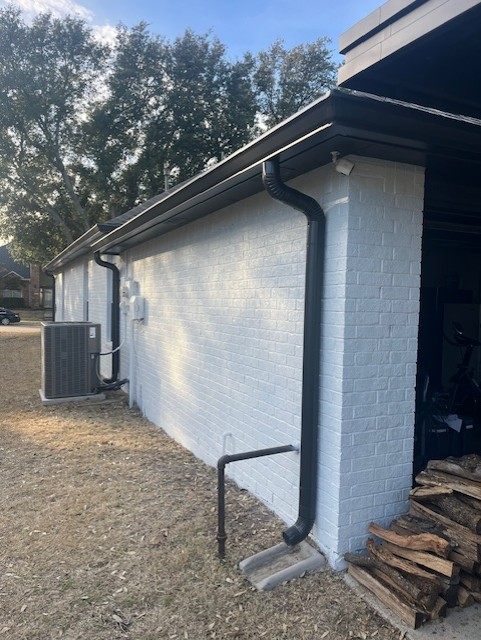
Is It Failing, or Is It Just Too Small?
There is a practical way to tell the difference from the ground, and it takes about ten minutes on a Saturday. Undersized systems fail in a specific, repeatable pattern, while broken systems fail randomly. Walk the perimeter of the house an hour after a good rain and look for these.
- Overflow at the same inside corner every single storm, including the week after a cleaning. Debris moves around. Geometry does not.
- Standing water in the trough an hour after the rain stops. That is an outlet restriction, and on a 2×3 downspout under heavy canopy it is usually a wet leaf slug packed into the drop.
- A dark stain line running down the fascia below the front lip, which means water has been going over the edge for long enough to leave a record.
- A downspout that runs hard, gurgles, then quits partway through a storm while water keeps coming off the roof.
- A visible dip between hangers when you sight down the run from the driveway. A loaded 5-inch trough full of wet oak leaf is heavy, and old fascia gives up before the aluminum does.
- An erosion trench or washed-out bed directly under the eave, which tells you the overflow has been happening for years and landing in the same place.
If you are seeing three or more of those on the same elevation, cleaning it again is not going to solve anything. It buys a few weeks. The trough is being asked to move more water and more solid material than its cross-section allows, and no amount of maintenance changes cross-section.
Moving a Richardson Ranch From 5-Inch to 6-Inch
A single-story ranch has a roof shape that works against it in one specific way. The planes are long and low, which means one continuous run can be sixty feet or more with a single downspout at one end. Water entering at the far end has a long way to travel through a shallow trough, and anything sitting in that trough slows it down further. Length is a capacity problem the same way debris is.
When we upsize one of these houses, the trough is only part of it. Here is what changes on the job.
- 6-inch K-style on the elevations carrying canopy or long single runs, which gives noticeably more cross-section and, just as important, accepts a larger outlet.
- 3×4 downspouts replacing 2×3. A 3×4 moves roughly twice the water and is far harder to plug with a wet leaf mat or a slug of shingle granules after hail.
- A second drop added to long runs so one opening is not draining an entire side of the house. That is the most common single improvement on these floor plans.
- Hangers on tighter centers, because a full 6-inch trough weighs considerably more than a full 5-inch one and the fascia has already proven what it will tolerate.
- Pitch reset toward the outlets, since decades of settling and re-hanging usually leave a run holding water somewhere in the middle.
Every run is rolled from coil in your driveway as one continuous length, so a 58-foot elevation gets a 58-foot gutter with no mid-run seam to open up in year three. Homeowners sometimes worry that a 6-inch profile will look heavy on a low ranch. In practice the face height difference is modest, and on a long horizontal elevation it reads as a cleaner line, not a bulkier one. Anyone comparing bids should read what actually goes into a rain gutter system before assuming two quotes describe the same work.
The fascia has to carry it before any of that matters
A bigger trough is heavier, which puts the fifty-year-old board behind it squarely in the middle of this decision. These houses were built with dimensional wood fascia, and the original gutters were hung on spikes driven through the front of the trough into that board. Every time a drooping run got re-hung over the decades, somebody drove a fresh spike an inch from the old hole. What is left is a line of enlarged holes in wood that has also spent years behind a trough holding standing water.
So we get on the ladder and press on the board before we quote a size, not after the old gutter is on the lawn. Soft sections get replaced rather than covered. We also look for drip edge along the roof line, because a fair number of Richardson roofs from this era went on without it, and without drip edge the water at the back of the gutter wicks behind the trough into the fascia instead of falling into it. Correcting that while the gutter is off costs very little. Correcting it afterward means taking the new run back down.
Canopy Load in Canyon Creek, Richardson Heights, and Duck Creek
Tree load in this city is not evenly distributed, and the difference between streets is dramatic. The older sections around Richardson Heights, the Canyon Creek area, and the lots that follow the Duck Creek corridor carry the kind of continuous canopy where two neighboring crowns meet over the street. Those roofs are under debris nearly year-round rather than for six weeks in November.
The drop comes in waves here, and the spring wave is the one homeowners forget. Live oaks shed last year’s leaves in late February through April as new growth pushes, and they drop catkins on top of that, which lands the debris in the trough right before the March-through-June storm season. Cedar elm and red oak then come down in volume from late October into December. A single annual cleaning under that canopy is a system that spends half the year restricted.
This is the part of Richardson where screening the gutter genuinely earns its cost, and we would rather screen the two or three elevations sitting under a crown than wrap the whole house. Elevations with open sky above them were never the problem. For the rest, three visits a year, in early spring, in mid-fall, and again after the last leaves are down, is the recommendation, and we can put the house on a set rotation so it does not depend on anyone remembering in December.
Pop-Tops and Rear Additions on a 1960s Ranch
Plenty of Richardson ranches are no longer the house that was built. A second story went on over part of the plan, or a primary suite was pushed out the back, and the roof grew with it. The gutter almost never did, and on a Richardson ranch that is where the overflow starts. What was a single low plane draining evenly along one run is now two planes, and the upper one discharges onto the lower roof or straight into a trough that was sized in 1968 for a third of the water.
A cascade is the specific problem. Where an added upper plane sheds onto a lower roof, all of that water lands in a strip a few feet wide and then travels down the lower plane to the same short length of gutter. That section is carrying two roofs through one opening. It overflows in every hard rain while the run twenty feet away barely fills, and it is the most common complaint we hear on a remodeled Richardson ranch. No amount of cleaning changes it, because nothing is blocked.
The fix is an outlet under the cascade rather than a bigger gutter around the whole house, and on these Richardson plans that usually means adding a drop so no point in the run is more than thirty to forty feet from one. A Richardson addition often brings a new inside corner with it, which is a second concentration point on the same elevation. Both want their own opening, and both want the run under them stepped up in size while the ladders are there.
There is a carpentry angle too. An addition built decades after the original rarely lands its fascia in the same plane as the old board, so an existing run pushed up against the new work sits proud at the joint and holds water at the step. Anyone quoting a house that has been added onto should be looking at that transition before pricing a single foot of trough.
Flat Lots, Short Setbacks, and Where the Water Ends Up
Richardson lots are generally flat and the side yards on these mid-century plans are narrow. That combination puts a downspout discharging a few feet from a slab that has been sitting on Blackland Prairie clay for over half a century. Clay swells when it takes on water and shrinks hard in an August drought, and cycling that soil wet and dry against one corner of a foundation is the single biggest driver of slab movement in North Texas.
The other thing that happens over fifty-five years is that the original grade settles. Soil that was sloped away from the house when the sod went down has slumped, and on plenty of these lots the ground now falls gently back toward the slab. A downspout that was adequate in 1970 is now delivering water to a low spot against the foundation.
The fix is unglamorous and cheap relative to what it prevents. Get the discharge point well past the slab edge, either with above-grade extensions or a buried line running to a pop-up emitter out in the yard. On a corner where hardscape or a narrow side yard makes that awkward, we work out the routing on site. Moving the water away from the foundation costs a fraction of what pier work costs, and it is the part of the job that protects the most expensive thing you own.
Commercial and Office Buildings Along the Telecom Corridor
The stretch of Richardson along US 75 is dense with office, flex, and light industrial buildings, and that stock has almost nothing in common with the ranch houses a few blocks east. Low-slope roofs, long parapet runs, roof drains and overflow scuppers, and a great deal more water arriving at fewer collection points. The failure mode is different too. A residential overflow damages landscaping, while a commercial overflow lands on an entry, a walkway, or a loading area.
On these buildings we work in heavier-gauge material, typically steel where impact resistance and span matter, with oversized downspouts and conductor heads where the volume justifies them. Older masonry buildings sometimes have built-in box gutters behind a parapet, one of the gutter styles and metals we fabricate and a different repair discipline from hanging a K-style run, not something to hand to a residential crew. Property managers can reach us for commercial gutter work and we schedule around tenant hours when the work sits over an occupied entrance.
What Gutter Work Costs on a Richardson Home
One thing worth knowing before you compare bids on a ranch. A single-story house has more eave per square foot of living space than a two-story house of the same size, because the whole floor plan is spread across one level. A 2,000 square foot Richardson ranch can carry more linear footage of gutter than a 2,400 square foot two-story elsewhere in the county, so the per-foot rate matters more here than the house size suggests.
Seamless aluminum works out to $4.50 to $12 a foot on the run. Apply that rate to the eave you actually have and you have the honest shape of a whole-house number, with the larger wing-and-corner ranch plans and anything carrying a second story sitting toward the top of it.
The line homeowners forget is what happens once the water leaves the downspout. On a flat Richardson lot, extensions carried out to a working distance, a solid buried line run to daylight, or a tie-in at the alley are separate work from the gutter itself. That is also the part actually protecting the slab, so it is worth pricing deliberately rather than discovering it after the new runs are up.
- Heavy-duty and commercial steel prices at about $9 to $20 per linear foot.
- Copper, on higher-end elevations and with conductor heads: $25 to $40 per linear foot.
- Cleaning: quoted per visit against run length and how the ladder has to be set, which on a low ranch roof usually makes it the simplest job on this list.
- Guards and leaf screens: screening is sold by the foot, and a long ranch eave is more foot than most homeowners estimate, so covered length matters as much as the product does.
- Fascia repair, when the board has gone soft behind the old gutter, is quoted separately after we look at it.
Those are ranges, not quotes. Access, roof height, the number of inside corners, and whether the fascia needs work before anything gets hung all move the number. Estimates are free, and if the right answer is two new hangers and a downspout rather than a new system, that is what we will tell you. Every installation carries a 5-year workmanship warranty and a 20-year manufacturer warranty on materials.
Questions Richardson Homeowners Ask Us
My gutters are original to the house. Can I just add guards and skip the rest?
Usually not, and here is why. A guard keeps debris out of a trough, but it does not add cross-section, and on an already undersized run it can slightly reduce effective capacity. If the 5-inch system is overflowing under canopy, guards on top of it are money spent on the wrong half of the problem. Size first, screen second.
Why does only the back of my house overflow?
Almost always because that elevation has the longest uninterrupted run, the biggest tree over it, or both, and it is draining through a single downspout at one end. Adding an outlet in the middle of that run is often the entire fix, and it costs a great deal less than re-gutting the house.
Will a 6-inch gutter look out of place on a low ranch?
It reads as a slightly deeper shadow line at the eave, nothing more. On these long horizontal elevations most homeowners tell us it looks more intentional than the original. If you want to see profiles side by side before deciding, we bring physical samples of both profiles to the estimate and hold them up to the eave.
Does gutter installation in Richardson usually mean replacing the fascia too?
Only where the board has gone soft or where the old spike holes have opened up enough that a screw will not hold. We check with a probe and a hand, not a guess, and we tell you before the work starts rather than discovering it as a change order.
Hail dimpled the fronts of my gutters. Is that structural?
Cosmetic on its own. What matters more from the same storm is whether the downspouts got flattened and whether the outlets are packed with shingle granules, a paste that sets up hard. We will document the condition of the runs, fronts, and drops so you have something concrete for your insurer, but we do not make coverage decisions for you.
How often should gutters be cleaned in Canyon Creek?
Three a year under that canopy. Once in early spring before the heavy rain months, once in mid-fall, and once more after the cedar elms and red oaks finish dropping in December. Newer or more open lots elsewhere in the city sit at two, which is the fewest we would put any house on.
Can you get to a storm-damaged run quickly?
Yes. A run that has separated at one end or a downspout torn off its straps needs attention before the next cell moves through, and we treat that as work that cannot wait for a scheduled slot.
We pushed the back of the house out. Do the gutters have to change?
Almost always on that elevation, and rarely anywhere else. The addition adds roof area and usually a valley, and the original run is now taking water it was never sized for. What that generally buys is a stepped-up trough on the affected side, an extra outlet under the new concentration point, and hangers on tighter centers to carry the load. The front of a Richardson ranch can usually stay exactly as it is.
Should the gutters go on before or after a room addition?
Wait until the framing is closed in, the roof is on and the new fascia is up. Hanging gutter and then watching a builder tear a section off to run trim is money spent twice. If you know an addition is coming, tell us at the estimate and we will price the elevations that are staying and leave the rest for a second visit.
Nearby Cities We Cover on the Same Routes
Richardson straddles the Dallas and Collin County line, and the neighborhoods around it turn up in our schedule every week. Plano gutter installation sits directly north of here, and the older stock immediately east in Garland looks a great deal like the Duck Creek side of Richardson. Further out we work Sachse’s newer subdivisions and the streets around Murphy, where the housing is much younger and the sizing conversation runs the other direction.
South down Central Expressway, North Dallas shares the same mid-century ranch stock and the same overgrown canopy.
One more thing about the address itself. The Dallas and Collin line runs through Richardson rather than around it. Most of the city is Dallas County, and the northern third, above the line, sits in Collin County. Canyon Creek is on the Dallas side, though Plano ISD serves part of it, which confuses plenty of people. Either way the same conversation runs through the crews we keep running across Dallas County or through our Collin County service area depending on the address. The specification does not change at the line.
Find Out What Your Roof Needs
If your gutters are original and the trees above them are not, the measurement is worth doing. Call Creative Gutter at 214-324-4674 and we will come out, sight the runs, press on the fascia, count the drops, and give you a written range with no charge attached to it. We have been fabricating gutters on-site across Dallas, Collin, Denton, Rockwall, and Tarrant counties since 1984, and we would rather tell you the truth about a repair you can count in hangers and sealant than sell you a system you do not need.
Contact us today to schedule a FREE on-site consultation for gutter installation or repair for your home or business in Dallas, Collin and Rockwall Counties.
214-324-4674