

Gutter Installation, Repair and Replacement in Plano, TX
Gutter Installation, Repair and Replacement in Plano, TX
A gutter system put on a Plano house in 1978 has now been hanging there for close to fifty years. The city’s own heritage survey has started assessing structures built between 1970 and 1975, because they’re crossing the half-century mark and qualifying for that kind of attention. Nobody surveys gutters, so the aluminum on those same houses has quietly gone from new to original to overdue without anyone calling a meeting about it. That cohort, the 1970s and 1980s homes through east and central Plano, is where most of our work in this city lands.




Fifty Years Is a Long Time for One Length of Aluminum
Aluminum itself holds up well. It doesn’t rust, and a baked-on finish keeps its color for decades. What ages is everything around it: the sealant at the miters, the fasteners in the fascia, the wood those fasteners are driven into, and the pitch of the run, which flattens by fractions every year as the hangers work loose.
The other thing that ages is the assumption behind the original sizing. A builder in 1978 put five-inch K-style on the whole street because that’s what went on every street, and on a house with a simple hip roof and a bare front yard it was the right call. Forty-odd years later the trees planted with that house are full grown, the roof has been replaced once or twice with heavier shingle, and the same trough is being asked to do more work with more debris in it.
Original spike-and-ferrule hanging is the third thing. It relies on a single nail driven through the front face of the gutter into the fascia, and every seasonal expansion cycle backs that nail out a little further. On a house of this era you can often stand in the street and count the spikes that have walked out along the front elevation.
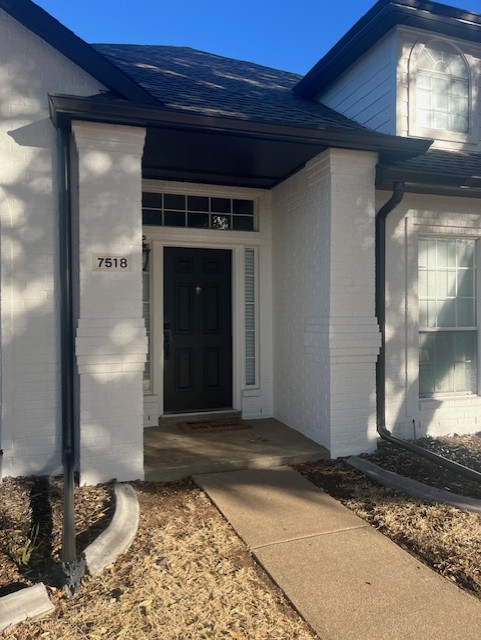
East and Central Plano Read Differently From the Far West Side
Plano is not one housing market and the gutter conversation changes as you cross it. Roughly speaking, the bulk of the city’s housing went up between 1970 and 2000. East and central Plano, the older half, is 1970s and 1980s. Far west Plano, out toward the Dallas North Tollway and Arbor Hills, is 1990s and 2000s and a decade or two behind on all of this.
Around the Downtown Historic District and Haggard Park the stock is older again, with buildings on the red brick streets going back to the 1890s and the Courtyard Theatre dating to 1938. Those are profile-matching jobs, where half-round on brackets often looks right and a modern K-style face doesn’t.
West of Preston Road the houses are newer, mostly 1990s and 2000s, and the original gutter out there is younger but was often undersized from day one for the amount of roof feeding it. Different age, same overflow.
The practical point is that a quote built off a Plano address alone tells you nothing. We measure the roof in front of us.
Reading the Signs That the Original System Is Finished
There is a difference between a system that needs a repair and one that has reached the end of its service, and it’s worth knowing which you’re looking at before anyone quotes you.
Points toward repair: one run sagging, one corner weeping, one downspout that has come off the wall, water standing in a short stretch after rain. Points toward replacement: fasteners pulling along multiple elevations, fascia soft behind more than one run, seams opening on sectional gutter in several places at once, or a trough that overflows during ordinary rain even when it’s completely clear.
That last one settles the question on its own. A clean gutter that still spills water isn’t dirty, it’s small. No amount of maintenance fixes a capacity problem, and we would rather tell you that on the estimate than sell you a cleaning schedule that never solves it.
Taking a 1978 System Off and Putting Up What the Roof Needs
Replacement on this stock is mostly a fascia job with gutter attached. The old run comes down along with the hangers and every spike still driven through the board, and those spikes leave a line of holes that has to be dealt with before new hardware goes anywhere near it. Where the board is soft, it gets replaced first. That’s not an add-on, it’s the only sequence that works.
The new gutter is formed on site from a coil on the truck, so a fifty-foot elevation gets one continuous piece with no joint along its length. Sectional gutter has a seam every ten feet and every seam is a future leak, which matters in a climate that swings a hundred degrees across the year and works the metal accordingly. Corners, end caps and outlets are the only joints left, and those get sealed properly.
Hidden hangers replace the old spikes, screwed through the back of the trough into the fascia, spaced tighter on long runs and on steeper pitches, where more water arrives at the trough in less time. We set the outlet positions off the roof again. Reusing the old holes is how a badly placed drop gets inherited by the next system. Where the water concentrates on a 1978 roof with a 2015 shingle on it is not always where the original builder put the drop.
Widths, Profiles and the Metals Worth Paying For
Five-inch K-style remains right for a single-story Plano home with a simple roof and modest canopy. Six-inch is what we put on two-story elevations, on steeper pitches, on rooflines with long valleys, and on houses now sitting under forty-year canopy. It carries a lot more water and pairs with a bigger downspout, which is often the part that was actually undersized in the first place.
Seven-inch and oversized profiles are specialty sizes for large custom homes and commercial roofs. Half-round is the historically correct look on the older downtown stock and it sheds debris better than K-style, since there are no interior corners for grit to settle in. Box gutter is built into the roof structure and shows up on commercial and low-slope buildings across the city.
Aluminum is the default and the gauge is worth asking about. Heavier stock holds its shape across a long run, resists hail denting and doesn’t oil-can in July. Copper is the other end of the range, formed in K-style and half-round, chosen for how it looks as much as how long it lasts.
There’s more on gauges, finishes and profiles on our gutter styles and materials page, including what we’ll hang on a house and what we won’t.
Sizing rain gutters on this stock is nearly always a step up and not a like-for-like swap. If the original five-inch spills on a clean trough, what replaces it wants to be six with a three-by-four leader under it, and that decision adds nothing to the labor, because the tear-off and the ladder work are the same either way.
Sugarberry, Cedar Elm and What Actually Lands in the Trough
What decides a Plano cleaning schedule is the species mix overhead, not how much of the city is shaded. Sugarberry leads here, then cedar elm, then American elm, and nearly all of it was planted rather than left standing, so the age of the canopy tracks the age of the subdivision almost exactly. A 1979 street has a 1979 canopy over it, now full size and dropping into a trough that was sized for a bare lot.
All three of those leading species are small-debris producers, which is the awkward kind. Cedar elm drops seed in fall, September into October, fine enough to sift through a coarse screen and settle into a compacted layer at the bottom of the trough. American elm throws its samara in late winter, so the debris calendar has two ends to it rather than one. Sugarberry contributes leaf and small fruit through the season.
There is no version of this job below those figures where the drive out doesn’t cost more than what goes on the house. On a mature street in east Plano, twice a year is the sensible interval, and the fall visit is worth booking for after the cedar elm has finished rather than the first cool weekend in October.
We clear by hand, flush the runs, confirm every drop passes water, and take the debris away with us. Our gutter maintenance page sets out what a scheduled visit covers.
Screen and Mesh Under a Planted Canopy
Guards are worth money on a street where the canopy has closed over the roof and hard to justify where it has not. Since Plano’s canopy is planted and predictable, this is one of the easier calls to make from the driveway.
Expanded steel screen, the Roll Lock product, is the leaf screen we fit, from $5 per linear foot, and it keeps leaves and larger debris out of the trough. On a street dominated by elm and sugarberry it won’t stop the seed. Better you hear that standing in the driveway in June than work it out for yourself in October.
Micro-mesh is the step up, from $10 per linear foot in stainless or aluminum. The weave holds back seed, shingle grit and the fine material that makes elm such a nuisance. Leaf Blaster, Hydroflow and Flow Shield are names you’ve likely come across.
Neither ends cleaning. Both reduce it and both prevent the packed clog that puts water over the front edge during a storm. We do not install hinged or heavier-gauge guard systems. Our gutter guard installation page shows how each one fastens and what it costs fitted.
Leaders, Elbows and Where the Runoff Ends Up
Downspouts are the half of the system nobody looks at, and on 1970s and 1980s houses they’re commonly the constraint. A big trough draining into a small leader fills and spills. Two-by-three is the standard rectangular size and works on short runs and small roofs. Three-by-four moves roughly twice as much and belongs on six-inch gutter or on any long run going to a single drop. Round smooth leaders are the finished option, in aluminum and in copper.
Then there is the ground. Plano sits on Blackland Prairie clay, which swells as it takes water and shrinks back in drought. That cycle is the main driver of foundation movement across Collin County, and a downspout discharging at the slab edge concentrates an entire roof’s runoff into the worst possible spot. On the older lots, where mature root systems are already competing for soil moisture close to the house, it’s worse still.
Above-ground extensions carry that discharge out past the foundation to where the grade can take it, starting at a $250 minimum. What we fit runs on the surface, which keeps it visible and easy to clear. Lengths, elbows and where they discharge are covered on our downspout extensions page.
Repairs That Buy a Sound System More Years
Where the metal is decent and the fascia is solid, repair is the right answer and it’s a fraction of the cost of replacement. Every item starts at a $250 minimum charge and covers re-securing a sagging run, re-pitching a run that holds water, resealing a corner miter, sealing a seam or joint leak, replacing hidden hangers, replacing an end cap, and reattaching a downspout.
Re-pitching deserves a particular mention on this stock, because a run that has flattened out over four decades holds water, and standing water adds weight that flattens it further. Catching it while the fascia is still sound is the difference between an afternoon’s work and a full elevation. Our gutter repair page sets out the whole list, and our gutter replacement page covers the point at which repairs stop being worth the money.
Parapet Roofs Along Legacy and US 75
The office and retail belt through Legacy, Willow Bend and the older commercial along US 75 and Preston Road is almost all low-slope roof behind a parapet, and that changes what we hang. There’s no fascia and no front edge for water to run off, so the roof sheds rain inward through drains and outward through scuppers cut in the wall. Our half of it is the sheet metal on the wall face: the head under each scupper, the conductor carrying that water to grade, and any box gutter built into the roof structure.
Capacity on those buildings gets worked out for a downpour and never for an average, the overflow route has to end somewhere other than inside the building, and the ladder work happens around tenants and trading hours. Apartment and townhome portfolios run the same way, and consistency across a set of near-identical buildings is where a property manager actually saves money.
What Plano Homeowners Are Looking At
Gutter work carries a $500 minimum charge and downspout work a $250 minimum. Above those, the number follows footage, size, material and access. Here’s where the common residential choices start.
| What the metal itself runs | Per linear foot |
|---|---|
| Aluminum 5-inch K-style, seamless | $7 to $14 |
| Aluminum 6-inch K-style, seamless | $8 to $16 |
| Aluminum 7-inch or oversized K-style | $20 to $28 |
| 3×4 aluminum downspout | from $8 |
| Micro-mesh guard, stainless and aluminum | from $10 |
Copper, half-round and box profiles are priced separately, and the full range is on our gutter styles and materials page.
Guards sit outside that: expanded steel screen from $5 per linear foot, micro-mesh from $10. Above-ground extensions start at $250. Cleaning and every individual repair item start at $250. What lifts a Plano quote from the bottom of a range toward the top is a second story, fascia that needs replacing, a high count of corners and drops, and runs that sit above mature beds where a ladder can’t be footed cleanly.
On the commercial side the floor is $750 for installation, with commercial downspouts from $20 per linear foot behind a $300 minimum of their own.
A worked example, so the ranges mean something. Take a 2,600 square foot two-story in east Plano, about 260 feet of six-inch aluminum with four 3×4 drops, no fascia to put right and no guards going on: at $8 to $16 a foot for the trough, the gutter line lands somewhere around $2,100 to $4,200, with the downspout line and the extensions on top of it. That’s an example to give the table a shape, not a quote for your house, and the only figure that counts is the one we write down in your driveway.
Every figure here is a starting price or a range with a minimum behind it. None of them is a final number, and we do not pretend otherwise before measuring.
From the First Phone Call to the Water Test
We come out and measure. The two things that move a price most are the state of the fascia and the number of drops the roof needs, and both of those take a ladder. We walk the perimeter with you, look at where water is going now and where it should go instead, and leave you with a written number split out by gutter, downspout and anything else the house turns out to need.
On installation day the old system comes off first, fascia gets attended to, the new gutter is formed in the driveway and hung to pitch, and the leaders and extensions go on last. Nothing leaves the property until every drop has been proved. Single-story homes are usually one day. Two-story houses and fascia work run longer, and you hear that beforehand, not at four in the afternoon. Our gutter installation page follows the same sequence in more detail.
The Cover Behind a Plano Install
Five years of workmanship warranty from us, twenty years of manufacturer warranty on the materials. Worth knowing which is which: ours covers the hanging, the pitch, the sealing and the fastening, and the manufacturer’s covers the metal and the finish baked onto it. A run that sags is our problem. A finish that chalks is theirs, and either way we’re the ones who come out and look at it.
Collin County Towns We Cover From Here
Plano sits in the middle of our northern routes. We’re in Allen and Frisco constantly, south into Garland off the President George Bush Turnpike, and out to Richardson, Murphy, Wylie and McKinney on the same days. Our service area covers Dallas, Collin, Denton, Rockwall and Tarrant counties.
Plano Gutter Questions We Hear Most
My house is from 1980 and the gutters are original. How much longer do they have?
It depends far more on the fascia and the fasteners than on the metal. Aluminum from 1980 can still be sound. The spikes holding it up almost certainly aren’t, and the corner seals will have gone brittle. We look at all three before saying anything.
Is it worth upgrading from five-inch to six-inch when I replace?
Often, on this housing stock. The trees that went in with the house are mature now and the roof has usually been rebuilt heavier since, so the trough is doing more than it was sized for. If the current system overflows when clean, that’s your answer.
What do I do about the seed that gets through my screens every fall?
That is cedar elm, and expanded steel screen won’t hold it. Micro-mesh will. It starts at $10 per linear foot, and on an elm-heavy street it’s the product that actually solves the complaint.
Can you match half-round gutter on an older house near downtown?
Yes. We form half-round in aluminum and in copper and hang it on visible brackets, which is the correct look on the pre-war stock around the historic district.
Do you work with HOAs and property management companies?
Regularly. With a large multi-family share in this city, portfolio work is a normal part of what we do, and consistency across similar buildings is where it pays.
The gutter is clean and it still pours over the front. Why?
Capacity. Either the trough is too small for the roof feeding it, the downspout can’t drain it fast enough, or a valley is unloading into a stretch with no drop nearby. Cleaning will never fix any of those.
Will you replace the rotten fascia or do I need a carpenter first?
We handle it. Fascia has to be sound before gutter can hang on it, so it is part of the job and it happens before the new metal goes up.
Can you take the water further from the foundation?
Above-ground extensions, from a $250 minimum. On Collin County clay they’re the least expensive worthwhile thing on the whole job. Our own extensions run above grade.
Get a Number Measured Off Your Own Roof
If your Plano house is from the seventies or eighties and nobody has been up there in years, the useful next step is a ladder and a tape measure, at no charge. We’ll tell you plainly whether you are looking at a repair, a partial replacement or the whole perimeter. Creative Gutter is family-owned, working out of East Dallas since 1984 across Dallas, Collin, Denton, Rockwall and Tarrant counties. Call 214-324-4674 or request a quote and we’ll come and measure it.
Contact us today to schedule a FREE on-site consultation for gutter installation or repair for your home or business in Dallas, Collin and Rockwall Counties.
214-324-4674