

Gutter Installation in Addison, TX
Gutter Installation in Addison, TX
Most roofs in Addison belong to somebody’s balance sheet, not somebody’s home. The town is four and a half square miles of offices, hotels, restaurants and apartments, and the practical consequence for a gutter contractor is that most of the roof here has no fascia board under it at all. What Addison has instead is parapet roofs, box gutter, leaders hanging off scupper collection, and portfolios where one fault repeats across six buildings because one crew built them all in one year.




Low-Slope Roofs, Parapets and Where Water Leaves the Building
A low-slope roof behind a parapet has no front edge for water to run off, so it gets rid of rain in one of three ways: internal drains through the roof deck, scuppers cut through the parapet wall, or a built-in box gutter behind the parapet line. Whichever it is, there’s a secondary overflow path as well, because a roof that ponds is carrying weight it was never designed to hold.
Our part of that system is everything on the outside of the building. Where a scupper discharges into a conductor head, we form and hang the head and the leader that carries the water down the wall to grade. Where the building has box gutter, that is our work end to end. Where the roof runs on internal drains, we handle whatever exterior collection and leader work exists alongside them.
The failure most Addison building owners actually see isn’t the roof membrane. It’s a leader that has come off its straps, a conductor head packed with leaf litter from the landscaping, or a box gutter whose seam has opened. That last one sends water into a wall cavity, and it keeps doing it every storm until somebody gets up there, which is why the complaint reaches you from a tenant before it reaches you from a roofer.
Box Gutter on Belt Line and Older Addison Buildings
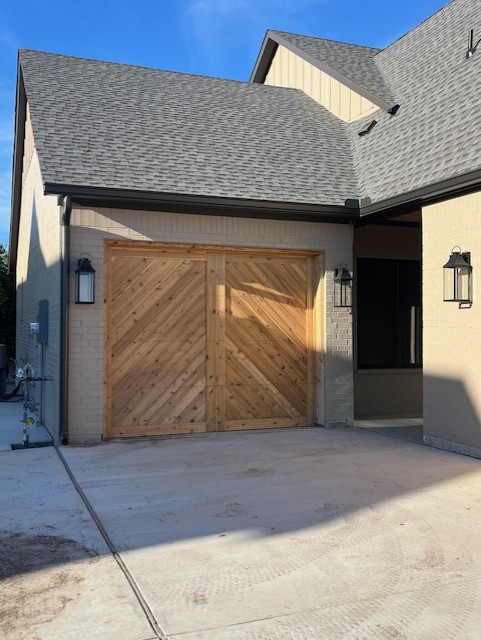
Box gutter is built into the roof structure, not hung off a fascia, and you find it on commercial buildings, on flat and low-slope roofs, and on the older stock along the Belt Line corridor. It carries a great deal of water, which is the point, and it’s unforgiving when it fails, because a hung gutter that lets go spills outside the building while a box gutter that lets go spills inside it.
We build and replace box gutter at $20 to $30 per linear foot. On a house that sits behind the $500 gutter minimum; on a commercial building the floor is $750. The construction detail on box gutter sits on our gutter styles and materials page.
The judgment on an existing box gutter is whether the trouble is a seam and a slope problem or whether the liner has reached the end of its service. We will tell you which, and we’ll tell you when the honest answer is a repair and not a rebuild.
Multifamily Around Addison Circle and Vitruvian Park
Addison Circle and Vitruvian Park are where the residential density actually lives, and the roof inventory there is nothing like a subdivision. The buildings mix flat sections behind parapets with pitched sections carrying conventional K-style, sometimes on the same structure.
That mix is what makes multifamily bidding different. A single building can need box gutter on one section, six-inch K-style on another, and leaders sized for a burst on the wall between them. Courtyards concentrate water into short runs. Breezeways and stair towers create drops with nowhere obvious for discharge to go.
Heavy irrigated landscaping is the other multifamily reality here. Live oak, cedar elm and red oak have been planted densely across these properties, and they load troughs and conductor heads on buildings where nobody notices until a resident reports a waterfall over a walkway.
Scheduled Maintenance Across a Portfolio
Reactive gutter work on a managed property costs more than planned work, and it costs it at the worst moment, usually during a storm with a tenant on the phone. The alternative is a schedule, and for most Addison properties that means two visits a year, with the second one placed late enough that the fall drop has finished.
A maintenance visit covers clearing troughs and box gutter, clearing conductor heads and scupper collection, running the leaders to confirm they’re actually passing water, checking straps and hangers, and reporting on anything that is heading toward a failure. What that visit covers in detail is on our gutter maintenance page. The minimums are straightforward: $500 on gutter work, $250 on downspout work, repair calls, cleaning and cleanouts.
For an owner with several properties in this town, the useful part is the report. Knowing that three of your six buildings have straps backing out lets you schedule one crew visit instead of three emergency calls. We’ll walk a portfolio and give you that list before you commit to anything.
Gutter Warranty That Survives a Change of Owner
Five years on our labor, twenty years from the manufacturer on the metal. On a managed building that distinction earns its keep, because the person signing the work order in year one is hardly ever the person hunting for the paperwork in year four. The warranty follows the building, not the contact name on the file. We’ve been doing this since 1984, over forty years, from a shop on Fuller Drive in East Dallas, and the same family still runs the company.
Keeping a Restaurant, Hotel or Office Open While We Work
Addison’s residents voted alcohol sales in back in 1976 specifically to bring in restaurants and hotels, and it worked, which is why the Belt Line corridor is what it is. That produces a practical constraint on every job: the building stays open while we’re on it.
We plan around that, and we don’t ask you to plan around us. Work over an entry or a patio gets staged early or late. Dumpster corrals, drive-through lanes, valet stands and loading docks get scheduled around, never blocked. On office property along the Dallas North Tollway that usually means arriving before the parking garage fills. On restaurant row it means being finished before the lunch shift sets up.
Debris control matters more on a commercial site than a residential one. Old metal, fasteners and trough contents come down under control and go straight into the truck, because a fastener in a customer’s tire is a bigger problem than the gutter ever was.
Commercial Leaders, Discharge and Grade
Commercial downspout starts at $20 per linear foot with a $300 minimum, and on a multi-story building that leader is doing serious work. It has to move the volume a large roof delivers in a cloudburst, it has to be strapped to survive the wall it is on, and it has to release the water somewhere sensible.
Addison sits on Blackland Prairie clay, the deep expansive kind that swells with water and shrinks in drought. That movement moves slabs, and it moves paving. A leader discharging at the base of a wall soaks the one place you don’t want soaked, and on a commercial site it also produces the slick spot on a walkway that turns into an incident report.
Above-ground extensions move that discharge out to a curb, a swale or the site drainage, from a $250 minimum. Our own work stays above grade. On a built-out site that is usually the sensible call anyway, because anything under the paving is invisible until it fails and awkward to reach once it has. Where a property needs the water taken somewhere it cannot go on the surface, tell us at the walk and we’ll work out the right approach. On a built-out 4.4 square mile town with paving and utilities everywhere underneath, the day you want to find one is the day you’re breaking up a parking lot to do it.
Gutter Repair on Addison Commercial and Multifamily Runs
Each repair item starts at a $250 minimum charge, and the list reads the same on a Belt Line office as on a townhome: a sagging run pulled back to line, a flat stretch re-pitched so it drains, a corner miter cut out and resealed, a leaking seam or joint closed, tired hidden hangers swapped, a split end cap changed, and a leader strapped back to the wall it walked away from.
Knowing when to stop repairing is an accounting decision on a managed building. One item on one elevation is a repair and should stay one. When that same item comes back on three buildings in a portfolio inside a year, the original specification has reached the end of its service across the whole group, and a staged replacement on the affected elevations costs less than another two years of call-outs and tenant complaints.
Capacity That Was Undersized on the Day It Was Built
The most common structural fault we find on commercial and multifamily property is a system that never had enough capacity for the roof above it. Five-inch trough and small leaders went on because that was the standard specification for the build, not because anyone calculated what a 20,000 square foot roof plane delivers in a ten-minute downpour.
Those systems can be spotless and perfectly sealed and still put water over the edge every storm. Six-inch K-style moves what five-inch can’t and pairs with a three-by-four downspout. Seven-inch and oversized trough is the specialty size for large roofs and unusual concentrations, and box gutter carries more again.
Sizing on a commercial building is calculated for the burst, not the average. When we quote a replacement we tell you what the existing system moves and what the roof above it actually delivers, and the gap between those two numbers is usually the whole explanation for the complaint you’ve been fielding.
Gutter Screens and Guards on Runs You Cannot Reach Twice a Year
A gutter screen pays for itself fastest on the lengths that are awkward to service, and a commercial property has plenty of those: a run above a covered entry, a courtyard elevation with no vehicle access, a section that needs a lift every single time anyone goes up.
We carry two. Expanded steel screen, sold as Roll Lock, is from $5 per linear foot, and it holds leaf, twig and the coarse litter that blows off a landscaped island. Micro-mesh in stainless and aluminum is from $10 per linear foot, and the weave is tight enough to keep shingle grit and fine seed out as well, which is what the dense irrigated planting around these buildings actually delivers. Leaf Blaster, Hydroflow and Flow Shield are the brand names in that category. Those two products are the whole list, and hinged or heavier-gauge covers are not something we sell.
No screen retires the annual walk, and on managed property that’s useful, because it keeps an inspection on the calendar. What a screen removes is the packed clog that puts water over a walkway during a storm. The gutter guards page has the rest of it.
Commercial and Multifamily Pricing in Addison
Commercial installation starts at a $750 minimum. Commercial downspout runs from $20 per linear foot with a $300 minimum. Everything below is a starting price or a range, because building height, access and roof geometry set the rest.
| Starting figures on commercial and multifamily work | Per linear foot |
|---|---|
| Box gutter, residential or commercial | $20 to $30 |
| Aluminum 6-inch K-style, seamless | $8 to $16 |
| Aluminum 7-inch or oversized K-style | $20 to $28 |
| 3×4 aluminum downspout | from $8 |
| Micro-mesh guard, stainless and aluminum | from $10 |
Residential five-inch aluminum, half-round and copper are priced separately, and the full range is on our gutter styles and materials page.
Cleaning, maintenance, downspout cleanout and each repair item start at a $250 minimum charge. Above-ground extensions sit on the downspout minimum. For a portfolio we price per building and give you the whole set in one document, so you can stage the work across a budget year instead of approving it one emergency at a time.
Residential Gutter Work on the Smaller Side of Addison
Addison does have single-family homes and owner-occupied townhomes, and the work on them is straightforward retail gutter work: seamless five-inch or six-inch aluminum K-style, formed on the truck in one continuous length per elevation, hung on hidden hangers into sound fascia. Aluminum half-round and copper are available for elevations where the profile matters, and the full range sits on our gutter styles and materials page.
Aluminum 5-inch K-style runs $7 to $14 per linear foot and 6-inch $8 to $16. Aluminum half-round is $13 to $25, copper K-style $40 to $55 and copper half-round $45 to $60. To put a rough number on it: 1,500 square feet of house generally means 150 to 200 feet of gutter and downspout, 2,500 square feet means 200 to 300 feet, and anything past 3,500 square feet runs 350 feet or more.
The one Addison-specific point on the residential side is the same canopy that loads the commercial buildings. These streets are heavily planted and irrigated, not left in native prairie, so leaf load runs higher than the lot sizes suggest and gutter cleaning twice a year is the sensible baseline.
Aluminum, Copper and Ogee Profile on an Addison Elevation
Aluminum does the large majority of the work, commercial and residential alike. It doesn’t rust, it takes a baked-on finish that holds its color through the sun, it hangs light, and it forms seamlessly on site. K-style, which older specifications and some manufacturers still call Ogee, is the profile on nearly every pitched section in this town. On commercial runs the gauge is the specification worth attending to, because a long trough in thin stock oil-cans in the heat and flexes at the lip until fasteners walk.
Copper is installed for appearance as much as service life, in K-style and half-round, and it belongs on buildings where the entrance is the argument. It weathers from bright metal through brown to green patina and outlasts the roof it serves.
Galvanized steel is the one material we turn down, and we put the reason in writing when a specification calls for it. Every cut edge, every screw hole and every seam on a steel trough is a place the coating stops, and that’s where the rust begins. Addison summers followed by wet springs find those spots quickly. Aluminum moves an identical volume of water and has nothing to corrode.
How We Bid Gutter Work on an Addison Building
We walk it. There’s no way to price commercial or multifamily drainage from an aerial image, because the things that move the number are roof geometry, the state of the existing collection, wall height, and how the crew can safely reach each elevation. On a portfolio we walk every property before quoting any of them.
You get a written scope broken out by building and by elevation, separating trough, leaders, collection and anything the walk turns up, so an owner or a board can see exactly what is being approved. Where a building needs less than we expected, the number goes down and we say why.
Scheduling is agreed before we mobilize, including access hours, keys or gate codes, staging, and which tenants need notice. On occupied multifamily we give residents notice through you, and nobody turns up unannounced under their windows.
Where Else We Work Near Addison
Addison sits inside Dallas County, hemmed in by the Tollway, I-635 and Midway Road, and we work the surrounding towns on the same routes. That includes Farmers Branch, Carrollton and Richardson, along with North Dallas and the rest of Dallas County.
Questions From Addison Property Managers
Can you service several buildings under one agreement?
Yes. We walk each property, price it individually, and deliver the set as one document so you can stage the work across a budget year. Cleaning and maintenance start at a $250 minimum per building.
Our roof drains internally. Is there anything for you to do?
Often, yes. Exterior collection, conductor heads, leaders and any box gutter section are our work, and those are usually where the visible failure is. We’ll tell you honestly if the answer is that your building has nothing for us on it.
Water is coming down inside a wall after every storm. Where do we start?
With a walk of the roof edge and the collection above that wall. An open box gutter seam, a blocked scupper or a leader that has separated at a joint all produce that symptom, and they’re three different repairs.
Can the work happen without closing the restaurant or the office?
Yes, and that’s normal here. We stage around opening hours, entries, patios and loading. Tell us the hours you need protected and we will build the schedule around them.
How often should a commercial property be on a cleaning schedule?
Twice a year for most Addison buildings, given how densely these sites are planted. Buildings with heavy tree cover over the roof edge or with hard-to-reach runs are worth looking at more often.
Do you handle HOA and condo association work?
Yes, including the townhome and mid-rise associations common in this town. We’re used to boards that need a written scope in hand before they can vote, and a number given over the phone won’t do it.
What does it cost to replace box gutter?
Box gutter runs $20 to $30 per linear foot, residential or commercial, on a $500 gutter minimum. What moves it inside that range is access, height and how much of the existing structure has to be dealt with first.
Will you quote galvanized steel if our specification asks for it?
No. It rusts at every cut edge and seam in this climate. We’ll explain the substitution in writing so it can go back to whoever wrote the spec.
Who holds the warranty if the property changes hands?
The building does. Five years on our workmanship, twenty years from the manufacturer on materials, regardless of who is managing it when a claim comes up.
Book a Roof Edge Walk on Your Addison Property
Send the address, or send the whole list of them, and we’ll walk the roof edge and come back with a written scope broken out building by building. The walk is free and the number that comes off it is measured, never guessed at over the phone. Creative Gutter is family-owned, working out of East Dallas since 1984, covering Dallas, Collin, Denton, Rockwall and Tarrant counties, and we take commercial, multifamily and residential gutter installation in Addison alike. Call 214-324-4674 or request a quote to get on the schedule.
Contact us today to schedule a FREE on-site consultation for gutter installation or repair for your home or business in Dallas, Collin and Rockwall Counties.
214-324-4674