

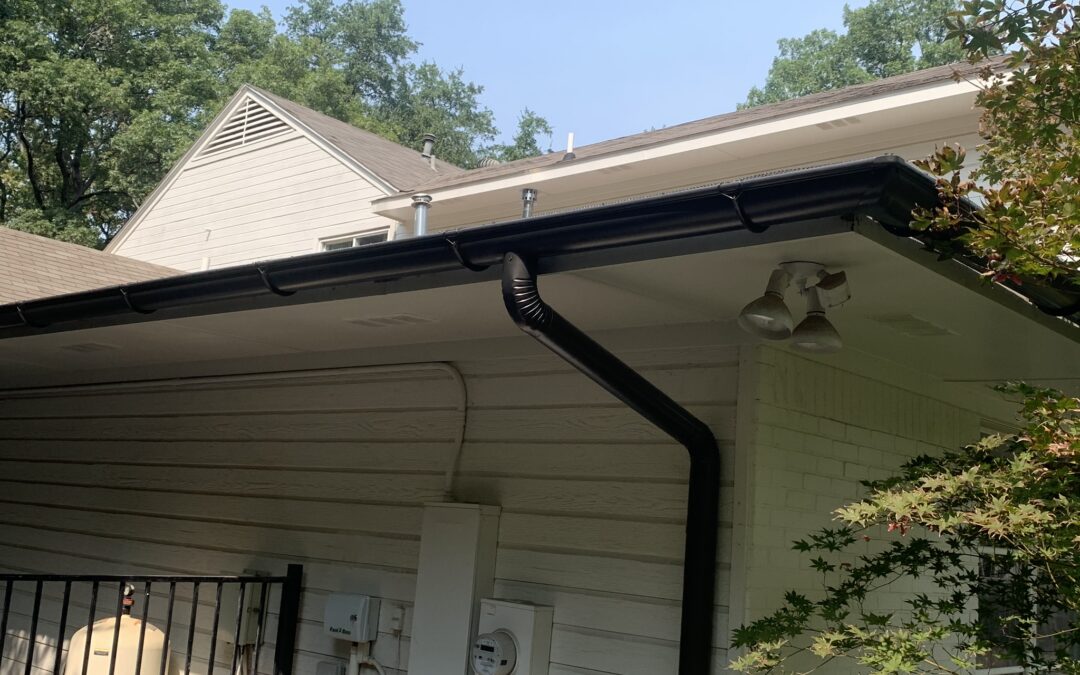
A gutter can only drain as fast as its downspouts let it. You can install the widest seamless gutter available, and it’ll still overflow if the water has nowhere to go once it reaches the end of the run. That’s why the number, size and placement of your downspouts deserve as much thought as the gutters themselves.
There isn’t one number that fits every house. The right downspout count depends on the length of each gutter run, the amount of roof draining into it, and where the water can be released safely once it’s on the ground. Getting all three right is what keeps water moving off the roof and away from the house.
The Basic Rule for Downspout Spacing
A common rule of thumb is one downspout for every 30 to 40 feet of gutter. A 35-foot run along the back of a house would get one downspout, usually at one end. A 70-foot run along the front would get at least two, and often one at each end so the gutter pitches toward both corners from the middle.
That rule is a starting point, not the whole answer. A run that collects water from a large upper roof plane, or one that sits below a valley, may need a downspout sooner than the spacing rule suggests. A short run under a small porch roof may need nothing more than a single outlet at its low end.
How Gutter Pitch Works With Downspout Location
Gutters are hung with a slight slope toward their outlets so water doesn’t sit in the trough. A common guideline is about a quarter inch of fall for every 10 feet of run. On a long gutter with a downspout at only one end, that slope adds up, and the outlet end can end up hanging well below the roof edge. Adding a second downspout lets the run slope both ways from the middle, so neither end has to drop as far and the water has a shorter trip to an outlet.
2×3 vs. 3×4 Downspouts: Which Size Do You Need?
You’ll find most residential downspouts in two rectangular sizes. A 2×3 downspout is the standard partner for a 5-inch gutter. A 3×4 downspout is larger and moves roughly twice the water of a 2×3, which is why it’s usually paired with 6-inch gutters or used anywhere a single outlet has to handle a lot of roof.
Upgrading to 3×4 downspouts can solve an overflow problem without changing the gutter itself. If a run fills during heavy rain but stays clean and properly pitched, the outlet may simply be too small for the water arriving at it. Larger downspouts also clog less easily, since leaves and roof grit have more room to pass through the elbows.
Round smooth downspouts are another option, and they’re mostly used on homes with half-round gutters. They’re available in aluminum and in copper, and they give the system a more traditional look.
Where Downspouts Should Go on Your Home
Good downspout placement gets water off the roof quickly, moves it away from the house and keeps it out of the way of how you use your yard. A few guidelines help:
- Put downspouts at the low ends of runs and near corners where two roof planes send water into the same gutter.
- Keep discharge away from walkways, driveways and patios, where it can create slick spots or wear down concrete edges.
- Avoid releasing water into areas where the ground slopes back toward the foundation.
- Think about the view from the street. A downspout tucked against an inside corner is often less noticeable than one in the middle of a wall.
Every elbow and offset in a downspout slows the water a little and gives debris a place to catch. A clean layout uses as few bends as the house allows. At the estimate, we look at where the ground falls and where the water needs to go, then plan the bends for each downspout before we write the quote.
Getting Downspout Water Away From the Foundation
The clay soil common across North Texas swells when wet and shrinks as it dries. A downspout that empties straight down at the base of a wall soaks the same patch of ground beside the slab every time it rains, and that cycle repeats for as long as the downspout stays where it is.
The fix is usually simple, and it doesn’t have to be expensive. Splash blocks and above-ground extensions carry water out from the wall and release it where the ground falls away from the house. Our page on downspout extensions in Dallas covers the options, and this earlier post explains how downspout extensions help protect your foundation in more detail.
What we install runs above ground. It stays visible and easy to clear, while a line below grade can silt up where nobody can see it, and shifting clay can work its joints out of alignment. If your lot is one where the discharge genuinely needs to be taken further, raise it when we measure and we’ll work through it with you.
Signs Your House Needs More Downspouts
You don’t need to climb a ladder to spot most downspout problems. Watch your gutters during a steady rain and look for these signs:
- Water spilling over the front edge of the gutter partway along a run while the downspout at the end looks like it’s barely working.
- Overflow at the same corner or valley every storm.
- A gutter that stays full for a long time after the rain stops.
- Erosion lines, bare soil or washed-out mulch under one section of the roofline.
- Water gushing out of a downspout seam or elbow, which can point to a clog below it.
It’s worth ruling out clogs first. A downspout packed with leaves and roof grit behaves exactly like a downspout that’s too small. Downspout cleanouts and unclogging start at a $250 minimum charge, and reattaching a loose or separated downspout starts at the same minimum.
Downspout Installation in Mesquite, Sachse and Rockwall County
We install gutters and downspouts throughout eastern Dallas County. If you’re planning gutter installation in Mesquite or adding downspouts to an existing system in Sachse or Sunnyvale, the spacing, sizing and discharge questions above are the ones we’ll work through with you on site.
The same goes for homes east of there. We serve homeowners in Fate, Mobile City, Union Valley and Sandy Shores, where the layout questions don’t change: how many outlets each run needs and where the water can safely land. You can see everything we offer in that area on our Rockwall County gutter company page.
What Downspouts Cost
Downspouts are priced by the foot. Current starting prices are:
- 2×3 aluminum downspouts: from $7 per foot.
- 3×4 aluminum downspouts: from $8 per foot.
- Round smooth aluminum downspouts: from $14 per foot.
- Round smooth copper downspouts: from $45 per foot.
- Above-ground downspout extensions: from a $250 minimum charge.
The $250 minimum covers downspout work in general, and new gutter work carries a $500 minimum. Estimates are always free, and your quote is written and itemized so you can see exactly how many downspouts are planned and where.
Common Questions About Downspouts
How many downspouts does a house need?
A typical guideline is one downspout for every 30 to 40 feet of gutter, with extra downspouts where large roof areas or valleys send concentrated water into one run. Most homes end up with several. Larger two-story homes and roofs with several valleys usually need a few more.
Is it better to have more downspouts or bigger gutters?
It depends on the cause of the overflow. If water backs up because the outlet can’t keep up, more or larger downspouts usually help. If water overshoots the gutter on a steep roof, a wider gutter is the better fix. Many homes benefit from a little of both.
Should downspouts be 2×3 or 3×4?
2×3 downspouts suit most 5-inch gutter systems on modest roofs. 3×4 downspouts are the better choice with 6-inch gutters, under large roof planes, and anywhere clogging keeps coming back.
Where should downspouts drain?
Downspouts should release water onto ground that slopes away from the house, clear of walkways and driveways. Splash blocks or above-ground extensions help carry the water out from the foundation.
Can you add a downspout to an existing gutter?
In many cases, yes. A new outlet can be added to a sound gutter to shorten a long run or relieve an overflow point. If the gutter itself is undersized or failing, replacing the run may make more sense.
Plan Your Downspouts With Creative Gutter
Creative Gutter is family owned and operated, and since 1984 we’ve installed gutter and downspout systems on thousands of North Texas homes. We’ll measure each run, look at how your property drains, and recommend the downspout count and size that keeps water moving away from your home.
Request a free gutter and downspout estimate from Creative Gutter, or call 214-324-4674 to talk it through. We work across Dallas, Collin, Denton, Rockwall and Tarrant Counties.