

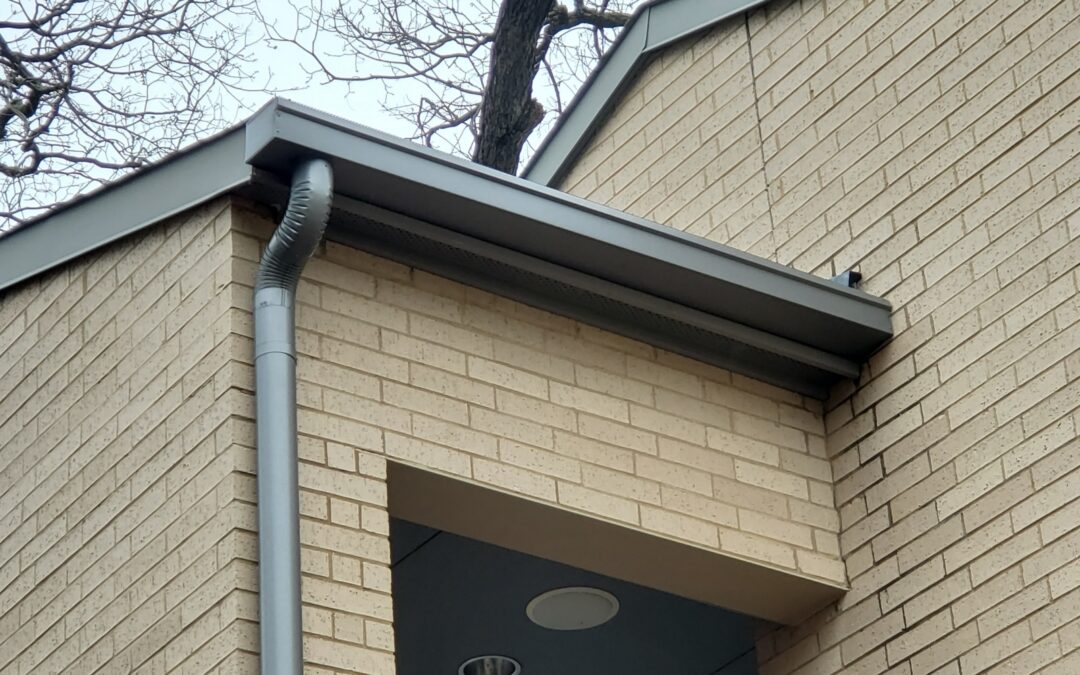
Gutter size is hard to change once the gutters are up, and it’s easy to get wrong. Most homes in North Texas end up with either 5-inch or 6-inch K-style seamless gutters. From the street, the two look nearly the same. During a heavy storm, the difference between them can decide whether water goes down the downspouts or over the front edge and onto your foundation.
The right gutter size comes down to three things: how much roof area drains into each run, how steep that roof is, and how hard the rain falls when it comes. None of those are obvious from the ground, which is why a sizing recommendation should come from measurements of the actual roof and not from what the house next door happens to have.
What 5-Inch and 6-Inch Actually Measure on a Gutter
The number refers to the width across the top opening of the gutter. A 5-inch K-style gutter has been the standard on residential homes for a long time, and it still works well on plenty of houses. A 6-inch K-style gutter is wider and deeper, and it handles roughly 40 percent more water than a 5-inch gutter.
Part of that extra capacity comes from the downspouts each size is paired with. A 5-inch system usually gets 2×3 downspouts, while a 6-inch system gets larger 3×4 downspouts. A 3×4 downspout moves roughly twice the water of a 2×3, so on a 6-inch system the gutter holds more and empties faster. That combination is what makes the larger size so effective under a big roof.
How Roof Area and Pitch Affect Gutter Sizing
Roof area is the starting point. Every inch of rain that falls on 1,000 square feet of roof produces roughly 623 gallons of water, and all of it has to leave through the gutters below. A long, uninterrupted roof plane sends that entire volume into a single run. Two homes with the same square footage inside can have very different roof planes outside, and that’s the measurement that matters.
Pitch changes how the water arrives. On a low-slope roof, rain moves slowly and drops straight into the gutter. On a steep roof it picks up speed, and during a hard storm it can shoot across a narrow 5-inch trough and over the outer lip. A wider 6-inch gutter gives fast-moving water more room to land.
Roof Valleys and Concentrated Flow
Valleys are the spots where two roof planes meet, and they act like funnels. Water from both slopes collects in the valley and pours into one short section of gutter. If you’ve ever watched a gutter overflow in the same corner every time it rains while the rest of the run stays fine, a valley is often the reason. Sizing up, adding a downspout near the valley, or both can usually correct it.
Why North Texas Storms Favor Larger Gutters
The Dallas-Fort Worth area averages roughly 37 to 40 inches of rain a year, but that rain doesn’t arrive evenly. A good share of it comes in spring and fall storms that can drop inches of rain in under an hour. Gutters aren’t sized for an average day. They’re sized for the hardest few minutes of the worst storm they’ll see, because that’s when overflow does its damage.
When a gutter can’t keep up, the water lands right at the base of the wall. North Texas clay swells when it’s wet and shrinks as it dries, so it’s better to keep water from soaking the same stretch of soil beside the slab every time it rains. Overflow can also stain brick, wash out flower beds, and keep the fascia board behind the gutter wet long enough to soften it.
When a 5-Inch Gutter Is the Right Choice
A 5-inch gutter isn’t a downgrade. On a single-story home with modest roof planes, a moderate pitch and enough downspouts, a 5-inch seamless gutter carries the water without trouble. It costs a little less per foot, and on a smaller house its proportions can look better along the eaves.
The key is that a 5-inch system leans on its downspouts. If there’s a downspout every 30 to 40 feet of run and none of the runs sit under a large valley, a 5-inch gutter is often all the home needs. When a 5-inch gutter is enough for the roof, that’s what we’ll recommend.
When We Recommend 6-Inch Seamless Gutters
We usually point homeowners toward 6-inch seamless gutters in a few situations:
- Two-story homes where large upper roof planes drain into the gutters along the eaves.
- Steep roofs where water reaches the gutter fast enough to overshoot a narrower trough.
- Runs that sit under one or more valleys.
- Long runs where there’s no good spot to add another downspout.
- Homes where the existing 5-inch gutters overflow in heavy rain even when they’re clean.
For very large roofs, an oversized 7-inch K-style gutter is another option. It’s less common on homes, but it can be the right answer where a single run collects water from an unusually large roof area.
Upgrading to 6-Inch Gutters During a Replacement
The most practical time to change gutter size is when the old system is coming down anyway. A full gutter replacement lets the new runs be sized, pitched and laid out for the roof as it is today, including downspouts in the spots where they’ll do the most good. If you’re in Far North Dallas or Northwest Dallas and your gutters are due for replacement, that’s the natural time to decide whether to move up a size.
Upsizing isn’t the only fix, though. Sometimes an overflow problem comes from too few downspouts, a gutter that’s lost its pitch, or a clogged outlet. When we look at a home, we’ll tell you if adding a downspout or correcting the slope would solve the problem without replacing the whole system.
Choosing a Gutter Size Around Grand Prairie, Coppell and the Mid-Cities
We measure and install seamless gutters throughout western Dallas County. Homeowners researching gutter installation in Grand Prairie or seamless gutters in Coppell ask us the same sizing question on one-story and two-story homes alike, and the answer always comes from the roof itself.
To the west, we also measure and install gutters for homeowners in Bedford, Euless and Haltom City. You’ll find the rest of the work we do in that part of the area on our Tarrant County gutter services page.
What 5-Inch and 6-Inch Seamless Gutters Cost
Every figure here is a starting range, and the final price depends on the measurements of your home. Current ranges for aluminum K-style seamless gutters are:
- 5-inch K-style in aluminum: $7 to $14 a linear foot.
- 6-inch K-style in aluminum: $8 to $16 a linear foot.
- Oversized 7-inch K-style in aluminum: $20 to $28 a linear foot.
All new gutter work carries a $500 minimum charge. Downspouts are priced separately, starting at $7 per foot for 2×3 aluminum and $8 per foot for 3×4 aluminum, with a $250 minimum on downspout work. For a sense of scale, plan on roughly 150 to 200 linear feet of gutters and downspouts for a 1,500 square foot house, 200 to 300 feet at 2,500 square feet, and 350 feet or more once a home reaches 3,500 square feet.
Because the per-foot ranges for the two sizes overlap, the price difference between them is usually modest. You can read more about how our seamless gutters are formed on site and cut to the exact length of each run. Estimates are always free, and every quote is written and itemized from real measurements.
5-Inch vs. 6-Inch Gutter Questions
Are 6-inch gutters always better than 5-inch gutters?
No. A 6-inch gutter carries more water, but that only matters if the roof sends it that much water. On a smaller single-story home with enough downspouts, a 5-inch gutter performs just as well and costs a little less.
Can you put 6-inch gutters on a one-story house?
Yes. Single-story homes with large roof planes, steep pitches or valleys over a run can benefit from 6-inch gutters. The number of stories matters less than how much roof drains into each section of gutter.
Do 6-inch gutters need bigger downspouts?
Not necessarily, but they’re usually paired with them. Pairing a 6-inch gutter with 3×4 downspouts is what lets the system empty fast enough to use its extra capacity, since a 3×4 moves roughly twice the water of a 2×3.
Will 6-inch gutters look too large on my house?
On most two-story homes and larger single-story homes, a 6-inch gutter looks proportional along the fascia. On a small, low house, a 5-inch profile may look cleaner. We’re happy to talk through both looks during the estimate.
Can I upgrade only some of my gutters to 6-inch?
Yes. If the overflow happens only under a large roof plane or a valley, those runs can move up a size while the rest of the house stays at 5-inch. We’ll tell you at the estimate whether that, or simply adding a downspout, solves it.
What are the signs that gutters are too small?
Watch them during a heavy rain. If water spills over the front edge in the same places every storm, especially under valleys or on long runs, and the gutters and downspouts are clear, the system is probably undersized for that part of the roof.
Get a Gutter Size Recommendation From Creative Gutter
We’re a family-owned company that’s been installing gutters in North Texas since 1984, with thousands of systems behind us. Every new installation comes with a 5-year warranty on our workmanship, plus the manufacturer’s 20-year warranty on materials. If you’re weighing 5-inch vs. 6-inch gutters for your home, we’ll measure the roof and recommend the size that fits it.
Contact Creative Gutter to request a free estimate on 5-inch or 6-inch seamless gutters, or call 214-324-4674 to talk through your home. Our service area covers Dallas, Collin, Denton, Rockwall and Tarrant Counties.