

Gutter Installation In Parker, TX
Gutter Installation in Parker TX: Getting Water Off the Roof and Off the Lot
Parker is large-lot by design, a city of custom homes on an acre or more set well back from the road on open prairie ground with tree lines along the creek bottoms, and that changes which part of gutter installation in Parker is hard. Sizing a trough is straightforward. Deciding where several thousand gallons goes after it leaves the downspout is not, because an acre gives you enough ground to route water properly and enough grade to route it badly. Creative Gutter designs the discharge, not just the gutter.




The Trough Is the Easy Part of a Parker System
On a quarter-acre subdivision lot there is only one place for roof water to go, and that is why nobody thinks about it. The downspout drops, an extension carries it a few feet, and the rest is the yard’s problem. On a Parker acre you are making an actual decision. There are low corners, natural swales, tree lines, a long drive, and often a detached structure between the house and wherever the ground finally falls away.
That decision matters more here than the gutter profile does, because a properly sized system that dumps in the wrong place is still a foundation problem. The Blackland Prairie clay under this county expands with moisture and pulls back hard when it dries out, and the ring of soil immediately around a slab is the part that does the moving. Every storm that empties a roof at the corner of the house is running that swell-and-shrink cycle on purpose.
Parker is the home of Southfork Ranch, and the surrounding land still reads the way that suggests: open pasture, tree lines along the creek bottoms, and houses sitting a long way off the road. That layout is an advantage. On most lots here there is somewhere good to put the water, and the job is finding it and getting the water there intact.
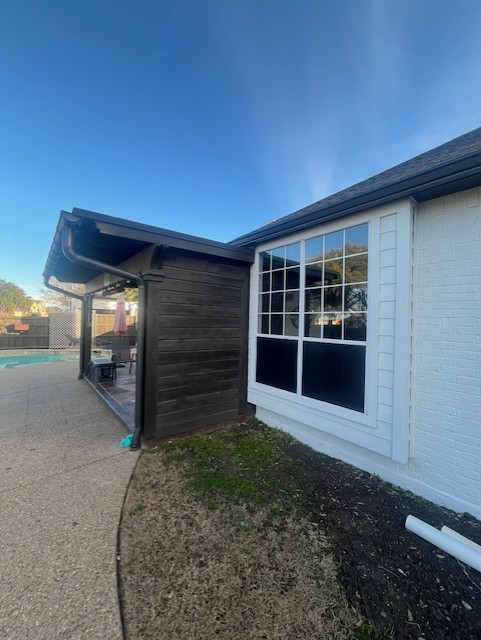
How Far Does the Discharge Actually Need to Go?
Further than most people think, and the reason is not distance for its own sake. When a foundation is excavated and then backfilled, the soil that goes back into the trench is looser than the undisturbed ground around it. That backfill ring stays more permeable for the life of the house. Water released onto it does not run off across the surface, it sinks along the edge of the slab, precisely where you do not want it.
So the target is not a fixed number of feet. The target is ground that is past the disturbed backfill and that falls away from the house on its own. On a flat side yard that may mean carrying the line a long way. On a lot with real fall it can be a short run to a point where gravity takes over. We walk the perimeter and look at where water already goes during a storm before deciding, because the lot will tell you if you read it.
Volume is the other half of it. A large custom roof in Parker can shed a remarkable amount of water in one spring cell, and concentrating all of that at a single point creates a soft, saturated patch that stays wet for days. Splitting the discharge among more outlets, rather than heroically oversizing one, spreads the load and keeps any one spot from turning into a bog. It is the same logic as getting the water past the slab edge in the first place, applied to the yard.
Above-Grade Extensions or a Buried Line?
Both are legitimate, and the right answer depends on the run length, the mowing, and the grade. An above-grade extension is cheap, visible, and easy to inspect. If a leaf mat plugs it you can see it and clear it in a minute. The drawbacks are equally obvious: it is in the way of a mower, it gets kicked out of alignment, and on a long run it needs enough fall to work without becoming a trip hazard.
A buried line disappears, and that is why it wins on lots where the discharge has to cross open lawn. It is also the option people get wrong most often. A buried line is not a place to bury a problem, and a few details separate the ones that work from the ones that silt up in three years.
- Solid, smooth-wall pipe. Not the flexible corrugated tubing sold for yard drainage. Corrugation catches grit and organic fines and slowly builds a bed of sediment that never flushes out.
- Continuous fall from the downspout to the outlet. A buried line with a dip in it holds standing water at the low point, and that is where the plug forms.
- A real outlet. Either daylighting where the grade drops, or a pop-up emitter set in a spot the water can leave from. A pipe that ends in the middle of a lawn with nowhere to go is just an underground reservoir next to your house.
- Access for cleaning. A cleanout or a removable connection at the downspout means the line can be flushed. Without one, a plugged line means digging.
- Locates before trenching. Irrigation mains, low-voltage lighting, propane, and utility service on a large lot are rarely where you assume they are, and the free locate call is worth making before a shovel goes in.
We will tell you when a buried line is over-engineering. If the ground already falls away on the side of the house in question, an extension and a splash zone do the same work for a fraction of the money.
Reading the Grade Before You Pick an Outlet Point
The most useful thing a Parker homeowner can do before an estimate is watch the lot during a storm. Where does water already collect? Which side of the driveway does it cross? Is there a low corner that stays soft for two days afterward? Those observations decide downspout placement more reliably than a site plan does, because a site plan shows intended grade and a storm shows actual grade.
There are places a discharge should not end up. Not toward a neighboring property, which turns a drainage improvement into a dispute. Not into the driveway, where the water will find the low edge and undermine it, and where it will ice over on the handful of nights a year that matters. Not into an existing low spot that already holds water, because you are simply making a wet area wetter and moving the problem rather than solving it.
Tree cover complicates it further. Mature natives on a wooded acre have root systems the trenching has to respect, and the ground under a heavy canopy dries slowly because it is shaded. Routing around a root plate and out to open ground costs a little more pipe and prevents both a dead tree and a permanently soggy patch.
Long Driveways, Detached Garages, and Everything Between the House and the Road
Deep setbacks are part of what people buy here, and they add pieces to the drainage picture that a subdivision lot does not have. A long driveway is a large impervious surface of its own. When roof discharge is released uphill of it, that water joins the drive’s sheet flow and all of it arrives at the garage apron together, and that is why some homes get a puddle at the overhead door in every storm even though the gutters are working perfectly.
Where a discharge line genuinely has to cross a drive, it goes under it, not over it. Running an extension across a driveway surface guarantees it gets crushed, and channeling water across the concrete edge undercuts the base. Detached garages, guest quarters, workshops, and covered parking need the same consideration as the house: gutters where the drip line matters, and a discharge point chosen with the same care rather than an elbow pointed at the nearest grass.
The other structure worth attention is the porte-cochere or covered entry that many Parker homes have. Those low roofs collect from an upper plane and then discharge right where cars and people are, and a properly placed outlet there is the difference between a dry entry and a permanent wet spot on the approach.
Sizing a Large Custom Roofline
Parker homes tend toward complex rooflines: multiple gables, long valleys, roof-to-wall transitions, and second-story planes discharging onto first-story roofs. Complexity concentrates water. Two or three planes feeding one inside corner will overwhelm a 5-inch gutter and a 2×3 downspout in a spring storm even though the system is perfectly clean, because the trough at that corner is receiving a share of the roof far larger than its length suggests.
On these houses we specify by contributing area rather than eave length. Large or steep planes get 6-inch K-style. Corners taking multiple planes get 3×4 downspouts, which move roughly twice the water of a 2×3, and they get extra outlets rather than one downspout doing all the work. Hangers go on tighter centers where a run carries weight, because a full 6-inch trough is heavy before you add wet debris. Every run is cut from coil on the drive in one continuous length, which matters more on a 50-foot custom elevation than on a small house.
Material and profile are worth a real conversation on this housing stock. Aluminum is the standard and it is the right answer on most of the house. Half-round reads better against stone and stucco than K-style does, and copper with conductor heads shows up regularly on feature elevations. The half-round and copper options we fabricate are worth looking at before you settle the elevation.
Downspouts on an elevation you do not want to look at
Homeowners with a custom front elevation almost always ask whether the downspouts have to be there, and the honest answer is that placement has more flexibility than size does. We can often move an outlet toward a corner or a return where it reads as part of the trim rather than a line down the middle of the stone. We can color-match the downspout to the field material so it disappears rather than contrasting with it.
What we will not do is under-drain the front to keep it clean. If a large plane is above that elevation, the water has to leave from somewhere, and the alternative to a well-placed downspout is water sheeting over the front lip onto the entry. On higher-end elevations a conductor head is often the answer: it becomes a deliberate architectural element instead of something you are trying to hide, and it gives the drop a visible overflow point.
What a Parker Acre Actually Drops Into the Trough
The cover on a Parker lot is not one species and it is not continuous. Cedar elm follows the creek bottoms and the old fence lines, live oak and pecan stand close to a good many of the houses, and the pasture in between drops almost nothing at all. Each keeps its own calendar, and on an acre here those calendars overlap rather than taking turns.
Cedar elm is the one that decides the screen. Its seed wafers are thin enough to pass a coarse opening, and they come down through September and October with the small leaves following on behind them into December. Live oak works the other end of the year, clearing last season’s growth and dropping catkins from late February into April, just ahead of the storm months. Fine material at both ends of the calendar is the argument for a mesh rather than a slotted screen.
That mix matters more on a Parker property than it would in town, because of what sits underground here. Everything the trough passes goes into the buried line, and fine elm seed mixed with roof grit is the exact material that silts a pipe up from the inlet outward. A strainer at each outlet and a cleanout at the head of every buried run is the difference between flushing the line with a hose in ten minutes and opening a trench across the lawn to find the plug.
Cadence follows the trees rather than the calendar. Where a tree line reaches the roof, and on this kind of lot it often does, plan on three clearances. Two is the floor anywhere. If a pecan is standing over the house, make it four. A buried discharge line rewards that schedule more than the trough above it does, because the line is the part you never see filling.
What Gutter Work Costs on a Parker Acre
The per-foot ranges are the same across the metro, but the totals here run higher than in subdivision cities for one simple reason: there is more eave. A large custom home carries considerably more linear footage than a 2,000 square foot tract house, and there are frequently outbuildings on top of that.
- Seamless aluminum: $4.50 to $12 per linear foot, installed.
- 150 to 200 feet of eave on a single-story: the footage is the first thing we tape, because a per-foot rate only means something once somebody has measured the run that is actually there.
- Two-story or complex rooflines, which describes most of Parker: a second story adds a staging setup on every elevation, so the total climbs faster than the extra footage on its own would explain.
- Steel, where a run needs extra stiffness or takes abuse: $9 to $20 per linear foot.
- Copper on a feature elevation: $25 to $40 per linear foot.
- Cleaning, depending on height and access: quoted per structure, because a house, a barn, and a detached shop are three separate ladder setups even when they sit on one deed.
Buried discharge lines are quoted separately, because the cost depends entirely on run length, what has to be crossed, and how much of the yard is in the way. That is a case where the estimate has to happen on the property. These figures are ranges rather than quotes, and the estimate is free, including the one where we tell you the existing system needs a re-hang and two new outlets rather than replacement.
You Can Take a House This Size One Elevation at a Time
A large custom home does not have to be done all at once, and frequently it should not be. The elevations do not wear out at the same rate, because they are not doing the same work. A back corner receiving three roof planes can be badly overloaded while the front, draining one simple gable, has performed fine since the house was built.
So we price by elevation and let you sequence it. The corner that overflows in every storm gets the 6-inch trough and the larger drop now. Elsewhere, tightening hanger spacing, resetting fall toward the outlet, and resealing tired miters can usually be corrected without replacing anything, for a small fraction of the cost, and it buys years.
The argument for doing the whole house at once is a different one: a spec that was wrong for the roof from the day it went up, fascia that has been rebuilt, or hail that has worked over every front on the property. That is a real decision on a house this size, and it helps to know how a full replacement is sequenced before you pick a week for it. Either way the work carries a 5-year workmanship warranty and a 20-year manufacturer warranty on the material.
Questions We Get on Parker Properties
Do I need a strainer at the head of a buried line?
On a wooded Parker lot, yes. Without one, every seed wafer and every handful of roof grit the trough carries ends up in the pipe, and the line silts from the inlet outward rather than at the far end where you might notice it. A strainer at the outlet plus a cleanout you can get a hose into keeps a Parker discharge line maintainable instead of disposable.
Why is my estimate higher than my sister’s in Plano?
The gutter itself is not different. Everything on either side of it is: what stands over the roof, how many separate structures sit on the property, and how far it is from a downspout to anywhere the water can usefully go. Two houses of identical size, one on a Parker acre and one on a quarter acre in town, produce very different estimates for those three reasons alone.
Can I just run my downspouts into a French drain?
We would advise against it, and the reason is that the two systems have opposite jobs. A French drain is perforated pipe in gravel, designed to collect groundwater out of saturated soil. A roof discharge line is meant to move a large concentrated volume away from the house. Feed hundreds of gallons of roof water into perforated pipe near the foundation and you are actively injecting it into the soil you were trying to keep dry. Roof discharge belongs in solid pipe.
How far from the house should a buried line daylight?
Far enough to clear the backfill and reach ground that falls away, which varies lot to lot. We look at where water already runs during a storm and pick a point downgrade of the house that has somewhere to go. A number pulled off the internet is less useful than fifteen minutes spent walking your own grade.
Do pop-up emitters clog?
They can, mostly when the line feeding them is corrugated, has no fall, or was installed without any way to flush it. A solid-wall line with continuous fall and a cleanout at the downspout stays serviceable. The emitter itself is the easiest part of the system to lift and clear.
My driveway floods at the garage even though the gutters are clean. Why?
Usually because roof discharge is being released uphill of the drive and joining the sheet flow already coming down it. The fix is not a bigger gutter. It is moving that discharge point downhill of the drive or carrying it under the drive so it is not adding to what the concrete is already delivering to the apron.
Do I need gutters all the way around a house this size?
Not always. Elevations where the drip line falls onto open ground that slopes away, with no walkway, no bed, and no foundation concern, can sometimes be left alone. Elevations over an entry, over a patio, above a lower roof, or on the side where the ground runs back toward the house need them. We will walk it and mark which is which.
Will trenching damage my trees?
It can if the route is chosen carelessly. Running a line straight through the root plate of a mature native is avoidable in nearly every case by routing around the canopy edge. On a wooded lot we plan the run around the trees first and the shortest path second.
How long does gutter installation in Parker take on a large home?
Most Parker homes are a single crew day for the gutters themselves, with a second day when there are outbuildings or a buried discharge line involved. Fabricating on-site means no waiting on materials once the crew is there.
Acreage Communities We Work Around Parker
Parker sits among several places with the same low-density character, and we run them on the same schedule. Lucas, off the northeast corner, has lots and tree cover much like these, and directly north gutter installation in Allen puts us a few minutes away most weeks. Go west and the acreage runs out into subdivision, where the east Plano streets sit on the same route for us. South of here Murphy’s newer subdivisions are a different job on a different lot size, and east we cover Wylie along with the small parcels around St. Paul. Everything here is handled by the same Collin County crews.
Have Us Walk the Lot, Not Just the Roofline
If water is collecting somewhere it should not, or a new build needs the drainage thought through before it becomes a problem, call Creative Gutter at 214-324-4674. We will measure the roof planes, look at where the ground falls, and give you a written range that covers both the system and where it discharges. Family-owned, working across Dallas, Collin, Denton, Rockwall, and Tarrant counties since 1984.
Contact us today to schedule a FREE on-site consultation for gutter installation or repair for your home or business in Dallas, Collin and Rockwall Counties.
214-324-4674