

Gutter Installation In Lucas, TX
Gutter Installation in Lucas TX: Tree Debris, Guard Choice, and Where the Water Goes
Two things shape gutter installation in Lucas more than roof size does. The native bur oak and cedar elm on these acreage lots produce a genuine debris load, and cedar elm leaves are small enough to slip straight through most coarse screens. And a large share of properties here run on septic, which takes parts of the yard off the table as a discharge point. Creative Gutter plans for both before anything gets hung.




Bur Oak and Cedar Elm Are Two Different Debris Problems
Homeowners usually describe their tree problem as one thing. It is not. The native canopy on a Lucas lot drops two kinds of debris with opposite behavior, and the system that handles one can be completely defeated by the other. Understanding which one is filling your gutter is what determines whether a screen helps you or wastes your money.
Bur oak drops a big, thick, lobed leaf that is slow to break down, along with an acorn heavy enough to sit where it falls. The leaf lands on top of whatever is there, it does not pass through a screen, and it holds moisture for a long time. On an open gutter it builds a mat that fills the trough and gets heavy. The weight is the real damage: a wet leaf mat in a full-length run is what pulls hangers out of fascia and puts a sag in the middle of an otherwise sound gutter.
Cedar elm is the sneaky one. Its leaves are small and stiff, and they come down in volume in the fall. They pass through quarter-inch hardware cloth and through most of the coarse gutter screens sold at building supply stores as if the screen were not there. Once inside, they combine with roof grit and settle at the outlet. The classic Lucas failure is a trough that looks reasonably clean from a ladder and a downspout that will not take water because the throat is packed solid.
Spring adds a third wave that catches people out. Oaks shed catkins and pollen tassels as new growth pushes, usually late February through April, and that debris is fine, stringy, and arrives immediately before the heaviest rain months of the year. A gutter cleaned in December can be plugged again by the time the April storms land. Bur oak and live oak catkins are the specific offenders here, and they are fine enough to defeat a coarse screen.
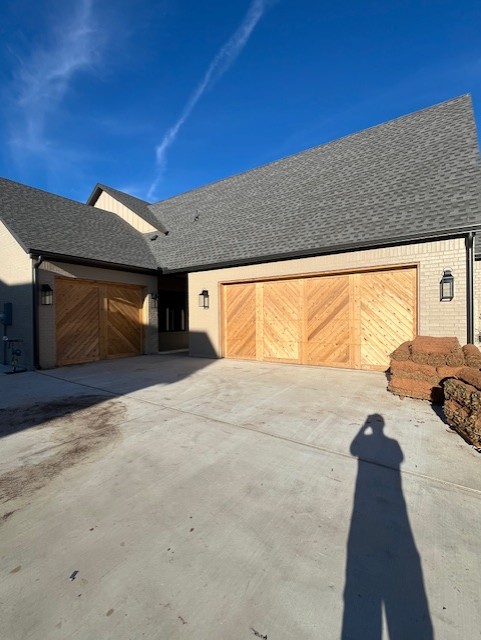
Which Guard Survives Small-Leaf Debris?
Guards are not one product, and on this canopy the differences are decisive. What follows is the trade-offs, which is more use to you than the brochure.
- Coarse screen and hardware cloth. Stops bur oak leaves, acorns and twigs, passes cedar elm leaves and grit. On a lot with elm in it, the trough stays cleaner while the outlet still plugs, which is the failure that causes overflow.
- Foam inserts. Cheap and easy to drop in. They also hold moisture, collect fine debris inside the foam itself, and in this part of the country seeds sprout in them. They tend to become the thing you have to clean.
- Reverse-curve and surface-tension systems. They rely on water adhering around a nose and into a slot. In an intense North Texas downpour on a steep plane, water can carry past the curve instead of following it, and debris rides the nose in windy conditions.
- Fine stainless micro-mesh on a rigid frame. The openings are small enough that cedar elm leaves and grit stay out, and the frame keeps a wet bur oak mat from collapsing into the trough. This is what we recommend on Lucas lots with real canopy overhead.
Two caveats belong on every guard estimate. Nothing on the market turns a gutter into a zero-maintenance component, and a company telling you otherwise is selling. What micro-mesh buys on a lot like this is a change in the job: instead of scooping a packed trough off a ladder ahead of every storm season, you are brushing off the mesh surface and checking the outlets. The second point is that any guard costs a little capacity, so the trough has to be right before you screen it. The guard systems we install are quoted by the foot, and the product decides the rate.
Screening the whole house is usually unnecessary. Elevations sitting directly under a crown are the ones that fill. An elevation facing open pasture with nothing over it was never the problem, and leaving it open keeps the cost down without giving anything up. On a typical acre that usually works out at two elevations screened and two left open.
Septic Systems Decide Where the Water Cannot Go
This is the constraint that separates a Lucas job from a subdivision job, and it is the one most often ignored. A drain field disposes of effluent by letting it percolate into unsaturated soil. Its ability to do that depends entirely on the soil around and beneath it having room to accept water. Saturate that ground from above and the field’s capacity drops. That is a septic problem rather than a gutter problem, and a far more expensive one.
Roof water is not a trickle. A single spring storm on a large custom roof delivers a concentrated volume in a short time, and directing that onto or immediately upgrade of a drain field is exactly the wrong place to put it. The right approach is to plan discharge away from the field entirely, and downgrade of it where the grade allows, so that roof water is never adding to what the field is already being asked to absorb. The same reasoning applies to the reserve or replacement area set aside for a future field, and to the spray area if the system is an aerobic one.
Knowing where the field is comes first. Most owners have a site plan or as-built for the system somewhere in their closing documents, and if you do not, that is worth tracking down before anyone puts a shovel in the ground. Trenching blind across a field can crush laterals, and a buried discharge line routed over one is a mistake you pay for twice. We plan discharge routing around what you can confirm, and where nothing can be confirmed we stay above grade rather than guess.
Beyond the field, the ordinary North Texas rule still applies. Blackland Prairie clay swells when wet and shrinks in drought, and water released at a slab corner drives that cycle harder than anything else on the property. Moving the discharge out past the foundation and toward ground that falls away is cheap compared to what pier work costs, and on an acre lot there is normally a route that satisfies both the foundation and the septic constraint at once.
Sizing for Weight, Not Just Water
Under real canopy, the load a gutter carries is not only rain. It is rain plus a saturated mat of leaf litter, and that combination is what bends a trough and works hangers loose. So on wooded Lucas lots we size for both. Weight is also why a run sags in the middle rather than at the ends.
Large or steep roof planes get 6-inch K-style rather than 5-inch, because the extra cross-section keeps working when there is debris in it. Corners fed by more than one plane get 3×4 downspouts. The larger section carries close to double what a 2×3 does, and more to the point on a wooded lot, a wet leaf slug cannot bridge it. We add outlets rather than asking one drop to handle everything, tighten hanger spacing on any run that will be holding wet litter for weeks at a time, and form each length on-site in one continuous piece so there are no mid-run seams for debris to hang on.
What a Storm Leaves Behind on a Screened Run
Hail season runs March through June, and on a wooded Lucas lot a storm leaves two things in the trough at once. The first is shingle granules, which come off the roof by the handful after a hard fall of ice and settle at the outlet as a dense paste instead of washing through. The second is wood. A mature bur oak sheds small limbs in a straight-line wind, and a screened run catches them on the surface where an open trough would have swallowed them.
Screens change what you check afterward rather than removing the need to check. Micro-mesh dented by hail can sit low enough to touch the water standing in the trough, which stops it draining across the surface the way it is supposed to. A limb lying across a frame can lift one edge and open a gap that lets everything in. Neither of those shows from the ground on a Lucas lot with a two-story elevation. An hour after the rain stops, water still standing in a run is the signal worth acting on.
The repair is usually small if it is caught early. A bent length of screen comes off and goes back, granules flush out of an outlet before they set, and a dented front bead is cosmetic unless the hanger behind it has moved. That is the argument for treating a post-storm walk as part of owning a system rather than as an emergency. We specify with that season in mind, which is part of why we lean toward heavier stock on the exposed elevations.
A Realistic Cleaning Schedule for a Wooded Acre
Open gutters under a Lucas canopy need attention twice a year at minimum: once after the cedar elm and oak finish dropping in late fall, and once in early spring after the catkin drop and before the March through June storm season. Lots with heavy crown directly over the roof often justify a third visit. With micro-mesh in place, those two visits become a look at the mesh surface and the outlets rather than an hour of scooping, but the schedule itself does not drop below two.
Cleaning a two-story custom home on an acre is not a ladder-and-an-hour job. Two things set the price on a lot like this, and neither is square footage: how much of the roof sits under canopy, and how far the crew has to carry ladders to reach it. A home with post oak leaning over three elevations fills its troughs faster than a neighbor with the same plan and clear sky above the eave. Booking both visits at once is easier than remembering the second one, so we will carry the property on a schedule if you would rather not watch the calendar.
What Gutter Work Costs in Lucas
Metro-wide ranges apply, and Lucas homes tend to land in the upper half of them because there is simply more roof and more eave than on a subdivision lot. Aluminum runs $4.50 to $12 the linear foot once it is on the fascia. Most houses here carry well over 200 feet of eave, so the footage does more to the total than the choice of material does, and the two-story and complex rooflines that dominate Lucas add staging time on top of the extra footage. Heavy-duty steel is $9 to $20 a foot, and copper with conductor heads on a feature elevation is $25 to $40.
Half-round is worth pricing on stone and stucco elevations where a K-style profile fights the architecture, and the full range of profiles and finishes we carry is worth a look before you commit. These are ranges, not quotes. Roof height, the number of inside corners, whether the fascia needs work first, and how the discharge has to be routed all move the number, and the estimate is free either way. Installations carry a 5-year workmanship warranty and a 20-year manufacturer warranty on materials.
Questions From Lucas Homeowners
My gutters look clean but they still overflow. What is happening?
Check the outlet, not the trough. Cedar elm leaves and roof grit pack the downspout throat while the rest of the run looks fine from a ladder. If water stands in the gutter an hour after the rain stops, the outlet is blocked even if you cannot see anything wrong.
Can I bury my downspout lines if I am on septic?
Often yes, but the route has to be planned around the drain field and its reserve area, and you need to know where those are before trenching. Where the field location cannot be confirmed, above-grade extensions carried to a safe discharge point do the same job with none of the risk. Most owners have that site plan in their closing documents even if they have never opened it.
Will roof water really hurt a drain field?
Saturating the soil over and around a field reduces its ability to accept effluent, because the disposal depends on unsaturated ground. That is why discharge planning is part of every job that sits on an acreage lot, rather than a landscaping detail handled afterward.
Should I have the limbs over my roof cut back?
It helps, and it is worth doing for the roof as much as the gutters. Limbs resting on shingles abrade them, and overhanging crown drops debris directly into the trough. Clearance will not eliminate the debris on a wooded lot, but it reduces the volume meaningfully and it slows the branch traffic that squirrels use to reach the roof.
A limb came down and bent one section. Does the whole run have to come off?
Rarely. A seamless run is one continuous length, so a damaged stretch cannot simply be unclipped, but it can be cut out and a new length formed and joined at a corner or an outlet where a joint belongs anyway. Where the damage is confined to the screen, only the screen comes off. What we look at first is the hanger behind the dent, because a limb heavy enough to deform the front bead has usually moved the fastener with it. That is repair work, and we handle it as a repair call rather than re-quoting the whole system from scratch.
Do I need guards on every elevation?
Usually not. Screen the runs sitting under a crown and leave the open elevations alone. Partial screening cuts the cost substantially without reducing the benefit, because the sides with nothing over them were never filling in the first place. A house facing open pasture on two sides is the easy version of that decision.
Is 5-inch gutter enough on my house?
It depends on the plane above it rather than the length of the eave. Steep pitches, large planes, and inside corners fed by two or more planes justify 6-inch, and under heavy canopy we lean toward 6-inch anyway because a partially obstructed 6-inch trough still moves water. If a run is sagging or separating, that is frequently a hanger and pitch repair rather than a replacement.
Where Else We Work in This Part of Collin County
The acreage belt around Lucas and the rest of this side of the county runs together, and we schedule it as one area. Fairview runs along the northern border with similar lots and similar crown over the roofs, and Allen just west gives us a steady route through here. Southwest of town the acreage lots in Parker sit under the same kind of canopy. South we handle gutter installation in Wylie, and the smaller parcels around St. Paul sit off the southeast corner. All of it is served by our Collin County operation.
Get the Trees and the Septic Factored In
If your gutters are filling every season, or you are planning a new system and want the discharge routed with the drain field in mind, call Creative Gutter at 214-324-4674. We will look at what is over the roof, recommend screening only where it earns its place, and lay out where the water should end up. Family-owned and working across DFW since 1984.
Contact us today to schedule a FREE on-site consultation for gutter installation or repair for your home or business in Dallas, Collin and Rockwall Counties.
214-324-4674