

Gutter Installation In Melissa, TX
Gutter Installation and Replacement in Melissa, TX: What Builder-Grade Gutters Get Wrong on a New Home
Melissa filled in fast along US 75, and most of the housing stock here is under fifteen years old: two-story brick, steep pitch, large uninterrupted roof planes, and landscaping still too young to drop anything worth cleaning. Debris is rarely what brings us out. Most gutter installation in Melissa is a sizing correction instead: the problem is almost always a builder gutter package that was priced against a bid sheet rather than sized against the roof above it.




Why a Builder Gutter Package Comes Up Short
On a production home the gutter is a subcontracted line item with a price per foot attached to it. The specification that wins that bid is 5-inch K-style with 2×3 downspouts and outlets placed wherever the run happens to end. It is a legitimate system. It is also the smallest one that can be called complete, and on the roofs going up here it runs out of capacity in a hard spring rain.
Nothing has failed when that happens. The gutter is not clogged, the hangers are tight, the sealant is intact, and water is still coming over the front lip. That is the signature of a capacity problem rather than a maintenance problem, and it is the most common reason we get called out to a house that is only four years old.
Three features of a current Melissa roof make it harder to drain than a 1980s ranch of the same square footage. Steeper pitch means water accelerates down the plane and reaches the eave with momentum, so it wants to jump the front edge instead of dropping into the trough. Larger unbroken planes mean more contributing area feeding every foot of gutter. And valleys where two planes meet deliver a concentrated stream into one corner rather than spreading the load along the run.
North Texas averages roughly 37 to 40 inches of rain a year, which sounds moderate. It does not arrive moderately. It comes in intense bursts from March through June and again in the fall, and gutters have to be sized for peak intensity rather than for the annual total. A system that handles a gentle all-day rain perfectly well can be overwhelmed in the first ten minutes of a real storm.
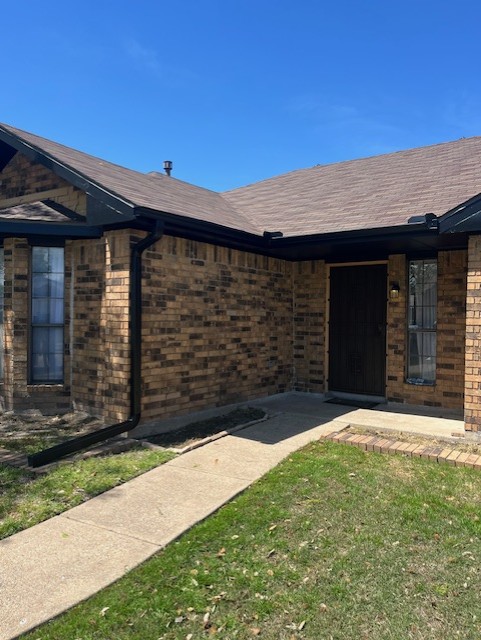
The Four Things We Change on a Melissa Production Home
Correcting a builder system is usually not a tear-off. It is four specific adjustments, and on most houses only two or three of them are needed. We would rather fix the elevations that are failing than sell you a perimeter of gutter you do not need. On most houses here two elevations carry the problem and the other two are fine as built.
Move the loaded elevations to 6-inch
A 6-inch K-style trough carries substantially more water than a 5-inch, and just as importantly it sits further out under the drip edge, so fast-moving water off a steep plane lands inside it instead of skipping past. We specify 6-inch on planes over roughly a thousand square feet, on pitches of 8:12 and steeper, and on any elevation fed by a valley. A front elevation with only a small porch roof above it often stays 5-inch without any trouble at all.
Go from 2×3 downspouts to 3×4
This is the cheapest meaningful upgrade on the list. Stepping the outlet up to 3×4 roughly doubles the throat area, and the clog resistance matters more than the extra volume does. A new composition roof sheds a slug of granules into the gutter for its first couple of seasons, and after a hailstorm it sheds a great deal more. A 2×3 throat is exactly the size that packs solid with that grit while a 3×4 keeps taking water.
Add outlets instead of asking one drop to do everything
Builders place downspouts where they are least visible from the street, which is not always where the water is. A forty or fifty foot run draining through a single outlet at one end has to carry that entire elevation’s volume past every foot of trough to get there, and the far end floods first. Adding a second outlet halves the distance water has to travel, and it is a small change relative to the rest of the system.
Get the discharge away from the slab
Most builder downspouts end at a splash block set right against the foundation. That puts the whole roof’s volume into the few feet of soil that matter most. Extensions, a buried line to a pop-up emitter, or simply carrying the discharge to where the lot falls away all solve it. On a brand-new house the reason this matters is specific enough to deserve its own section. It is also the item most often left out of a builder scope entirely.
Hanger Spacing Is the Fifth Thing, and It Costs Almost Nothing
Hidden hangers on a production install are set to a spacing that satisfies the specification and no more. That is fine on a short, sheltered run. It is thin on a long back elevation carrying a 6-inch trough, because a full gutter is heavy before you add anything to it, and North Texas storms deliver enough volume to fill one briefly even when the outlets are working.
Tightening the centers on the runs that carry the most water is the least expensive improvement available on a new house, and it is also the one homeowners never think to ask for. It also matters more in Melissa than it would in a wooded neighborhood, because the open ground north of McKinney gives storm fronts less to break against, and a gutter with wide hanger spacing has more front lip free to lift in a gust. When we upsize an elevation we re-hang it on closer centers as a matter of course rather than reusing the original spacing.
Fresh Backfill and Why Discharge Matters More on a New House
When a slab goes in, the ground around it is excavated and then backfilled. That backfill is looser than the undisturbed soil beside it, and it keeps consolidating for years after the house is finished. Water finds it, because loose soil is the path of least resistance, and it travels straight down along the foundation rather than running off across the yard. Lots here were graded and backfilled recently enough that this is still going on under most of them.
North Texas sits on Blackland Prairie clay, which swells when it takes on water and shrinks when it dries out. That cycle is the primary driver of slab movement in this part of the state, and the fastest way to run it hard is to concentrate a roof’s worth of water into one spot at the slab edge. A downspout emptying onto a splash block does exactly that, thousands of gallons at a time over the course of a wet spring.
A new lot compounds it in one more way. Young landscaping has almost no root mass and very little canopy, so there is nothing intercepting rainfall and nothing holding the soil in place. Thinly established sod erodes at the discharge point, a shallow channel forms, and within two or three seasons the grade near the house is running the wrong direction. Getting the discharge out past the disturbed backfill and onto ground that carries it away is the cheapest foundation work anyone will ever sell you on a new lot.
If the House Is Not Finished Yet, Three Decisions Are Cheap Right Now
If your Melissa house is still under construction, three things are cheap this week and expensive later. The first is a sleeve under the driveway and the front walk. A short length of pipe laid before the concrete goes down costs almost nothing, and it is the only practical way to get a discharge line from one side of a drive to the other afterwards without a saw and a patch. Ask for one at each corner nearest the flatwork, whether or not you plan to bury anything yet.
The second is the trench window. If a buried discharge line is going in at all, it wants to go in while the yard is bare dirt, before sod and before the irrigation is set. Once heads and lateral lines are in the ground, a trench across a Melissa back yard is slower, costs more, and stands a good chance of cutting something. Bare dirt is the cheapest condition your lot will ever be in.
The third is where the water is meant to end up. Final grade gets set once, right before sod, and a bench that falls back toward the slab is far easier to correct at that point than after the landscaping has established itself. Walk the perimeter with the builder and look at the direction of fall on each side. It is the one part of this that has nothing to do with metal, and on a new lot it is the part that pays back first.
Year One, Year Three, Year Five: A Checklist for a New Build
Gutters on a new house do not need the constant attention they would under mature canopy. They do need to be looked at on a schedule, because the things that go wrong on a new build tend to happen in a predictable order.
The first spring
Stand outside during the first real storm, not after it. Overflow tells you where the system is undersized, and it only shows itself while water is moving. Note which corners spill, which downspouts jet water past the splash block, and whether anything is running behind the gutter and down the fascia. Write those locations down. If your builder’s warranty period is still open, that list is what you take to them. A written list dated during your first storm season carries more weight than a phone call the following year.
Around year three
By now the backfill has settled and the landscaping has been through a few wet and dry cycles. Walk the perimeter after a rain and look for standing water close to the slab, for eroded low spots where a downspout discharges, and for extensions a mower has pulled loose. Check the long runs for a sag in the middle, which means a hanger has started to work its way out of the fascia. Year three is when most of these houses show their first real symptom.
Around year five
This is when sealant at the inside miters and the end caps begins to fail, and it fails quietly. A weeping corner drips onto one spot of foundation for months before anybody notices the stain on the brick. Most Melissa homes have also seen at least one hail cycle by then, so it is a reasonable point to look at the gutter fronts and downspout faces for denting. Resealing miters and correcting pitch at year five is a small job that prevents a much larger one.
Why Gutter Guards Are Usually Premature in Melissa
We talk homeowners out of guards more often here than almost anywhere else we work. A guard solves a debris problem, and on a subdivision lot with landscape trees still shorter than the second-story windows there is not much debris to solve. Every guard also costs the gutter a little intake capacity, precisely the wrong trade on a system that is already short of it.
Two exceptions are worth naming. If your lot backs a creek corridor, a greenbelt, or a stand of older trees that survived the development, that elevation carries a real debris load and should be screened even when the rest of the house does not need it. And while the neighborhood around you is still under construction, wind carries a surprising amount of sand, sawdust, and wrapping material onto finished roofs. An outlet strainer handles that far more cheaply than a full guard system. Screening one creekside elevation is a short job, and what fitting guards involves does not change because the rest of the house stays open.
When the trees around your house eventually mature, the calculation changes, and at that point the guard options and what each type stops becomes a conversation worth having. For a house finished in the last few years that is a decade or more out. Sizing the system correctly now is what pays off in the meantime.
What It Costs to Correct a New-Build System
Seamless aluminum installs at $4.50 to $12 per linear foot across the metroplex. A single-story plan here rarely tapes past 200 feet of eave, and that measurement against the rate is most of the answer. The two-story and complex-roofline homes that make up most of Melissa price higher for a reason that has little to do with the metal: how many elevations a crew can work off a ladder, and how many need scaffolding or a lift set up and then moved. Very few houses here work entirely off ladders, which is worth knowing before you compare quotes.
A correction is a different conversation from a replacement, and it is usually a much smaller one. Upsizing two loaded elevations to 6-inch, converting the downspouts on those runs to 3×4, and adding an outlet or two costs a fraction of doing the whole perimeter, and on most builder systems that is all the house actually requires. That is what you will hear, rather than a quote for a tear-off you do not need.
- Steel, used where the work is heavy-duty or commercial, is roughly $9 to $20 a foot.
- Copper, on feature elevations and with conductor heads: $25 to $40 per linear foot.
- Gutter cleaning: priced per visit on run length and on how many elevations can be worked from a ladder rather than staged.
- Gutter guards: a per-foot number, and the type you actually need is decided by the trees over the house rather than by a sales sheet.
Those are ranges rather than quotes, and they move with linear footage, roof height, and how well a crew can stage a back elevation. Everything we run is formed to length on the truck at your house, and every installation carries a 5-year workmanship warranty with a 20-year manufacturer warranty on the materials. Estimates are free, including the ones where we tell you to wait. It is worth reviewing the available profiles, sizes, and factory finishes before you settle on a color.
Questions From Melissa Homeowners
My house is only four years old. Isn’t it too early to be replacing gutters?
Almost certainly, and we are not suggesting you replace them. What we usually suggest is upsizing the two or three elevations that overflow and leaving the rest alone, because most of that work on a house this new is a partial correction rather than a whole new system. Age is not the issue on a house like this. The original specification is.
Can I keep the 5-inch gutters and just add more downspouts?
Often you can, and it is a sensible first move. An added outlet shortens the distance water travels inside the trough and relieves the far end of a long run. Where it does not work is on a steep plane where water is jumping the front lip before it ever enters the gutter, because no amount of drainage helps water that never landed in the trough to begin with.
Water stands against my foundation after every storm. Is that the gutter’s fault?
It is usually the discharge rather than the gutter. Splash blocks put roof water into the loosest, most settlement-prone soil on the property, and on the clay under Collin County that is the fastest route to slab movement. Extending the discharge past the backfill zone solves most of it, and correcting the low spot solves the rest. On a new lot that low spot is usually where the sod never took.
Is 6-inch gutter overkill on a house this size?
It depends on the roof, not the house. A 2,400 square foot two-story with a 10:12 pitch and two valleys feeding one corner needs a larger trough than a 3,000 square foot single-story with a simple hip roof. We measure the contributing plane and the pitch instead of the footprint, and on plenty of these homes only two elevations need to change.
Should I do anything different while the subdivision is still being built?
Check the outlets more often than you otherwise would. Active construction nearby puts grit, sand, and scrap into the air, and a new roof is shedding granules on top of that. Outlet strainers are inexpensive and they keep the downspout throats clear until the dust settles, in the literal sense. Plenty of streets here still have a build site within sight of the roof, so this is not a short-lived problem.
We close in six weeks. What is worth asking the builder to change?
Three things, in the order of what they cost to put right later. Sleeves under the driveway and the front walk on a Melissa lot, because you cannot add those afterwards without cutting concrete. A second outlet on whichever back elevation drains the largest plane, which is a small change while a crew is still on site. And discharge that ends past the backfill rather than on a splash block against the wall.
None of that is a specification upgrade in the expensive sense. Asking for it now avoids paying for corrections two springs from now, which is what most of our work on a young house actually amounts to.
Should the gutter be one color or two?
Match the trough to the fascia it hangs on and the downspout to whatever it runs down, which on most Melissa elevations means two colors on one house. A trough painted to the fascia disappears into the shadow line under the eave and reads as trim depth rather than as a gutter. A downspout painted to that same fascia color and then run down twenty feet of brick draws a stripe across the front of the house instead. Builders order one color for the whole package because it is simpler to buy, not because it looks better, and changing it costs nothing at the point of order.
Does hail damage mean the gutters have to be replaced?
Not always. Dents in the front face are cosmetic until they deform the profile enough to change how water enters the trough, and a dimpled downspout usually still carries full flow. What matters more after hail is the granule load sitting in the troughs and outlets, because that is what causes the overflow people tend to blame on the dents.
Where We Work Around Melissa
Melissa sits in the middle of a group of north Collin County towns we cover on the same routes, so we can usually handle several properties in the area on one trip. McKinney is immediately south and keeps us on this stretch of US 75 daily. Anna, just up the highway, has a very similar mix of new subdivisions. South and east of here we cover gutter installation in Princeton, and to the west we handle the acreage properties around Weston along with the newer construction in Prosper. All of it runs through the crews we keep in Collin County.
Get the Sizing Checked Before the Next Storm Season
If your gutters are overflowing on a house that is barely broken in, the fix is smaller than you expect and it is worth doing before spring. Call Creative Gutter at 214-324-4674 and we will measure the roof planes, tell you which elevations need to change, and leave a written range with you at no charge. We have been hanging gutters across DFW since 1984, and you can see how an installation runs from estimate to final water test before you commit to anything.
Contact us today to schedule a FREE on-site consultation for gutter installation or repair for your home or business in Dallas, Collin and Rockwall Counties.
214-324-4674