

Gutter Installation In Anna, TX
Anna, TX Gutter Installation: Two Housing Stocks, Two Different Fixes
Anna has two housing stocks and they fail in opposite directions. Around the original town grid the homes are older, smaller, and frame-built, and the weak point is almost always the fascia board the gutter hangs on rather than the gutter itself. In the subdivisions filling in along US 75 the structure is new and solid and what runs out is capacity. The first thing we work out on an estimate for gutter installation in Anna is which of those two houses you own.




On the Older Anna Homes, the Gutter Is Rarely the Real Problem
The frame houses near the original downtown are modest, simply roofed, and old enough that the wood behind the gutter has been outdoors for decades. When one of those runs starts sagging, tipping forward, or dropping at one end, the trough itself is usually still serviceable. What has given up is the fascia, or the fasteners driven into it, or both at once.
A lot of these systems were hung with spikes and ferrules, which was standard practice for a long time. A spike is a single nail driven through the front lip of the gutter, through a spacer tube, and into the fascia. Every hot afternoon and cold night works that nail a fraction of a millimeter, and over twenty or thirty years it backs out far enough to leave a gap. Water gets in behind the gutter, sits against the board, and the wood softens from the back, out of sight.
You can check it in about five minutes, half from the ground and half from a ladder. Look for a gutter that has dropped at one end while the rest of the run is still level. Look for dark staining on the fascia or on the soffit directly below the gutter line. Press the board with the handle of a screwdriver where it looks weathered. If the wood gives, hanging new gutter on it is throwing money away, because the new hangers will pull out of the same soft wood the old spikes did.
The other thing worth checking on this stock is the profile size. Plenty of these houses still carry 4-inch or narrow 5-inch gutter, which was reasonable for the roof when it went up. What changed is that the trees planted around the original grid have had decades to grow over it. A trough sized for a bare lot is a different proposition once there is real canopy dropping into it every October.
What Happens Under a Pier-and-Beam House on the Older Anna Blocks
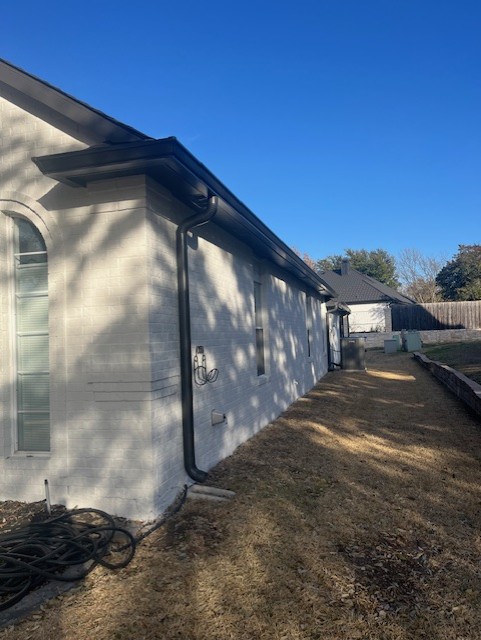
A good share of the frame houses on the older blocks sit on pier and beam rather than a slab, and that changes what misdirected roof water does. On a slab the damage collects at the perimeter beam. On pier and beam it goes under the floor, into a crawl space that is supposed to stay dry and vented. Wet ground under a house keeps the joists damp long after the storm has moved on.
The symptoms show up indoors before anyone thinks about the gutter. Floors that feel cold and slightly soft, a musty smell in a back bedroom, and skirting vents packed with silt washed in off the drip line. None of that is a plumbing fault. It is roof water that was never carried away from the foundation wall in the first place, and on these houses it is the cheapest problem on the property to solve.
The fix is discharge, not capacity. Getting the leader out past the skirting vents is the whole job, and where a town lot is too narrow to run a full extension to the side we carry the line forward or to the rear and let the established grade take it. Getting the discharge point out past the drip line costs a fraction of drying out a crawl space.
Repair First, Replace Second
The older half of Anna is a practical market and the right answer is usually the smaller one. A sound gutter that has dropped at one end is a re-hang: pull the spikes, replace the section of fascia that has gone soft, and reset the run on hidden hangers screwed into solid wood at closer centers than the original spacing. That costs a fraction of a new system and it buys years.
The same logic covers the other common complaints on these houses. Separated corner miters get cleaned back and resealed. A downspout that was never long enough to matter gets extended. A run that holds standing water after a rain gets re-pitched toward the outlet, which is a fastener adjustment rather than new material. Targeted repairs on a system that is otherwise sound are the right answer far more often than a sales call would ever suggest.
Replacement earns its place on these houses in three situations. The fascia has to come off anyway, which means the gutter is coming down regardless of its condition. The existing profile is undersized for the trees now standing over the roof. Or the run has been patched so many times that there is more sealant than metal at the joints. If you are weighing the two, it helps to know when starting over is the better value before you decide.
The New Subdivisions Have the Opposite Problem
Cross to the newer Anna neighborhoods that have gone up along the highway and none of the older diagnosis applies. The fascia is a few years old, the hangers are hidden hangers screwed into fresh wood, and the sealant has not had time to fail. Those systems overflow anyway, and they do it while completely clean, which confuses people who expect a gutter problem to look like a clogged gutter.
The reason is geometry. These are two-story brick homes with steep pitches and large roof planes. Water coming down a steep plane arrives at the eave fast enough to carry past the front lip instead of dropping in, and valleys concentrate two planes’ worth of runoff into a single corner. Meanwhile the system hung on them is 5-inch trough with 2×3 downspouts, because that is what the builder’s gutter allowance covered.
What we change on those houses is specific and limited. The loaded elevations move to 6-inch K-style so the trough sits further out under the drip edge and holds more. The downspouts on those runs go to 3×4, which carries roughly double what a 2×3 does and does not pack solid with roof grit. And we add outlets where a long run is trying to drain through one drop at the far end. On a typical house that is two elevations out of five, not the whole perimeter. That is what sizing rain gutters to the roof looks like on a house of this era.
It is worth being clear that this is not a defect and it is not neglect. Nothing on that house is broken. The system was specified to a budget and the roof above it was designed by somebody else, and the two were never reconciled. That is a normal condition on production housing everywhere, and it is simply more visible in a town where most of the houses went up in the same few years.
What Each Half Costs
Metro-wide ranges apply, and the two halves of Anna land in different parts of them because they are different sizes of job. Aluminum, formed seamless on site, comes to $4.50 to $12 a foot. Two counts decide where a given house sits inside that rate: the total linear feet of eave, and how many corners the run has to turn. Most of the older stock is a simple rectangle with a short perimeter and four outside miters. The newer two-story plans carry more footage and stack inside and outside corners at every break in the roofline, and each one is a fabricated miter that has to be cut, sealed, and hung true.
Repairs sit well below the cost of a full perimeter, which is the whole point of leading with them. Re-hanging a dropped run, replacing a few feet of fascia, resealing miters, or correcting pitch is priced by the work rather than by the full perimeter. On the newer houses, upsizing two elevations and converting their downspouts is likewise a fraction of a full replacement and usually resolves the complaint completely.
- Steel, the call on heavy-duty and commercial work, is roughly $9 to $20 a foot.
- Copper, on high-end elevations: $25 to $40 per linear foot.
- Cleaning: priced on the perimeter we have to walk and the number of corners where debris packs in and has to be lifted out by hand instead of flushed through.
- Guards and leaf screens: the screen type sets the rate and the number of feet you choose to cover sets the total, so screening two elevations and leaving the rest open is a normal outcome here.
These are ranges, not quotes. Roof height, access around the house, and whether the fascia needs work before anything can be hung all move the number, and that is why we look at the property instead of pricing it over the phone. Every run we install is cut to length on-site from a single coil, and installations carry a 5-year workmanship warranty with a 20-year manufacturer warranty on the materials.
Questions We Hear in Anna
My gutter has pulled away from the house at one corner. Does the whole system need replacing?
Almost never. That is a fastener and fascia question. If the board behind it is still solid, it is a re-hang. If the board is soft, the board gets replaced and then it is a re-hang. Either way you are not buying a new system to solve it.
My house is on piers, not a slab. Does that change anything?
The same trough and the same hangers as anywhere else, with far more attention paid to where the leaders end. We look at the skirting vents and the ground line around the perimeter before pricing anything, because a downspout emptying beside a vent is putting water straight under the floor. If the fascia is original we probe it on the same visit, since these houses tend to hand us both problems at once.
Should I put 6-inch gutters on an older house near downtown Anna?
Only if the tree load justifies it. These roofs are small and simply pitched, and 5-inch is usually plenty of capacity for the rain alone. What changes the answer is heavy canopy overhead, because a partially obstructed 6-inch trough still moves water while a partially obstructed 5-inch trough stops.
My house is three years old and the gutters overflow in every heavy rain. Is that a defect?
It is a specification, not a defect. Builder packages are sized to a budget, and on a steep two-story roof a 5-inch trough with 2×3 downspouts will spill while perfectly clean. Upsizing the elevations that overflow generally solves it without touching the rest of the house.
Do I need gutter guards in the new subdivisions?
Not yet, in most cases. The trees are too small to produce the debris that guards exist to stop, and every guard costs a little intake capacity on a system that is already short of it. Simple outlet strainers are the sensible version of the same idea while the roofs are still shedding granules.
Does gutter installation in Anna include replacing rotted fascia, or do I need a carpenter first?
We handle the fascia work as part of the gutter job on most houses. The board has to be sound before anything gets hung on it, so inspecting it and replacing what has gone soft is part of the work rather than a separate trade you have to schedule around us.
How much difference does a 3×4 downspout actually make?
It carries roughly twice the water of a 2×3 and it is much harder to plug. On a house where one elevation is doing most of the work, changing that downspout section is often the highest-value single change on the estimate.
Will hail damage to my gutters be covered?
That is between you and your carrier, and we do not make that determination for you. What we can do is document the condition of the fronts, the miters, and the downspouts so you have something specific to submit rather than a general impression.
Two Cleaning Schedules in the Same Zip Code
Debris load in Anna depends entirely on which half you are in, and the schedules are different. Around the original grid there are mature trees that were standing long before the current growth, and those roofs need the troughs cleared three times a year, four where a heavy pecan stands over the roof: twice through the fall as the leaves come down, and once more in early spring before the March through June storm months arrive.
The newer subdivisions run on a different clock. Landscape trees planted with the houses are years away from producing meaningful debris, so those roofs sit at the low end of what we recommend anywhere, which is two visits a year rather than the three or four a heavy canopy needs.
What those homes do need is attention at the outlets, because a new composition roof sheds granules heavily for its first couple of seasons and a 2×3 downspout throat is exactly the size that packs with grit. If you would rather not track the timing, we can handle the clearing on a set schedule and put it ahead of the storms rather than after the overflow.
Where the Water Ends Up Matters on Either Kind of House
Anna sits on the Blackland Prairie clay that runs under most of Collin County, and that soil takes on water and swells, then dries out and shrinks. That cycle moves foundations, and the quickest way to drive it is to concentrate a roof’s worth of water into one spot beside the house. This is why discharge placement matters more in North Texas than it does in most of the country, and it applies to a small frame house near the old grid and a 2022 two-story equally.
The specifics differ. On an older lot the grade around the house has been settled for decades and there is usually an established path the water already takes, so the job is extending the downspouts far enough to reach it. On a newly built lot the backfill around the foundation is still consolidating and the sod has almost no root mass, so a downspout sitting on a splash block will cut a channel and reverse the grade within a few seasons. Either way, carrying the discharge clear of the house is the least expensive line on the estimate and the one with the largest payoff.
Nearby Towns We Serve
Melissa sits immediately south of Anna on the same highway and is almost entirely new construction, which makes it a useful comparison to the split you have here. Due east we cover Westminster, farm country with a very different building stock from either half of Anna. About eleven miles further out, east and a little south, gutter work out in Blue Ridge puts us in the same kind of country. Southeast we handle the older housing in Princeton, and to the west, out where the county opens into acreage, we work in Weston. Everything else is on our Collin County coverage area.
Tell Us Which Anna House You Have
Describe the house and we will tell you what it needs, including the times when the answer is a repair rather than a replacement. Call Creative Gutter at 214-324-4674 for a free estimate. We will check the fascia, measure the roof planes, and hand you a written range with nothing owed either way. Somebody who has been up a ladder answers that phone, not a call center, and if we are out on a job we will ring you back the same day. Family-owned and working across Dallas, Collin, Denton, Rockwall, and Tarrant counties since 1984.
Contact us today to schedule a FREE on-site consultation for gutter installation or repair for your home or business in Dallas, Collin and Rockwall Counties.
214-324-4674