

Residential Gutter Installation in Dallas
Residential gutter installation is the work of fitting a house with a gutter system sized for its roof, pitched so it drains, and laid out so the water ends up away from the foundation. Creative Gutter installs seamless aluminum gutters, and copper where a house calls for it, on homes throughout Dallas and the surrounding counties, and every system is measured and sized for the house it’s going on. Our page on rain gutters in Dallas covers installation, repair and cleaning across the area.
A home’s gutters have a harder job than their size suggests. The roof over a typical house collects an enormous amount of water in a storm, and all of it arrives at the eaves within minutes. What happens next depends on whether the gutters are large enough, whether there are enough downspouts, and whether the runs were hung with the right fall. Getting those three things right is what separates a gutter system that works in a Texas downpour from one that only works in a drizzle.
What a Residential Gutter Installation Includes
A complete home gutter installation covers more than the horizontal troughs. It includes the gutter runs along each eave, the mitered corners where runs meet, end caps, outlets, the downspouts with their elbows and straps, and, where the water needs to travel, an above-ground extension at the bottom of a downspout, which is priced as its own item. Gutter guards are optional, and they’re easiest to add when new gutters go in.
The residential gutter installation jobs we see fall into a few categories. Some homes have never had gutters, or have them only over the front door. Others have an aging sectional system that leaks at its joints, or gutters that are in fair shape but too small for the roof. Additions, patio covers and detached garages often need new runs tied into a plan that makes sense with what’s already there. In every case the approach is the same: measure the roof edge, size the system, and decide where the water should go.
For a deeper look at the installation service itself, including replacement and repair work, our main gutter installation page goes into more detail. This page concentrates on the choices that are specific to houses.
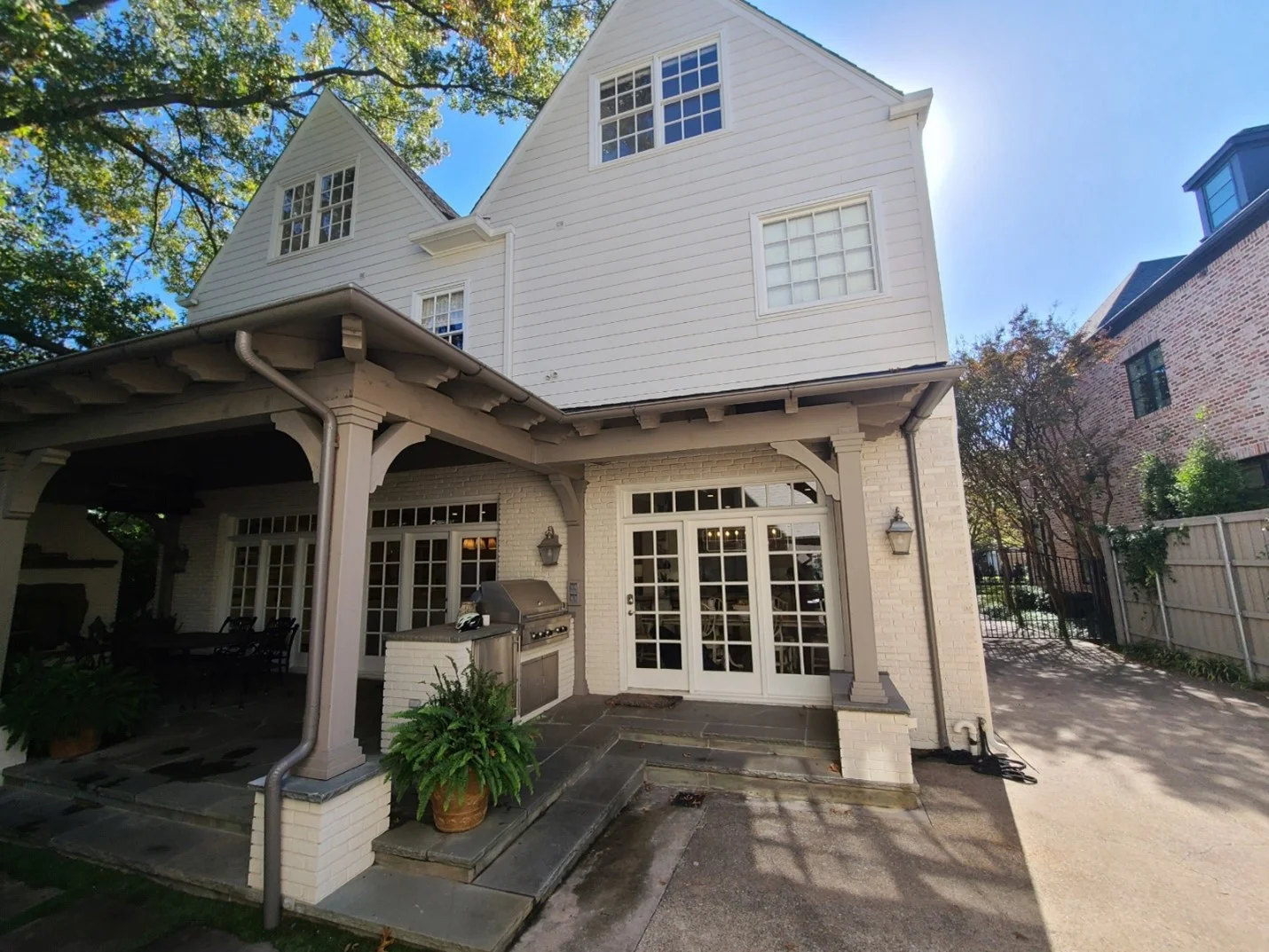
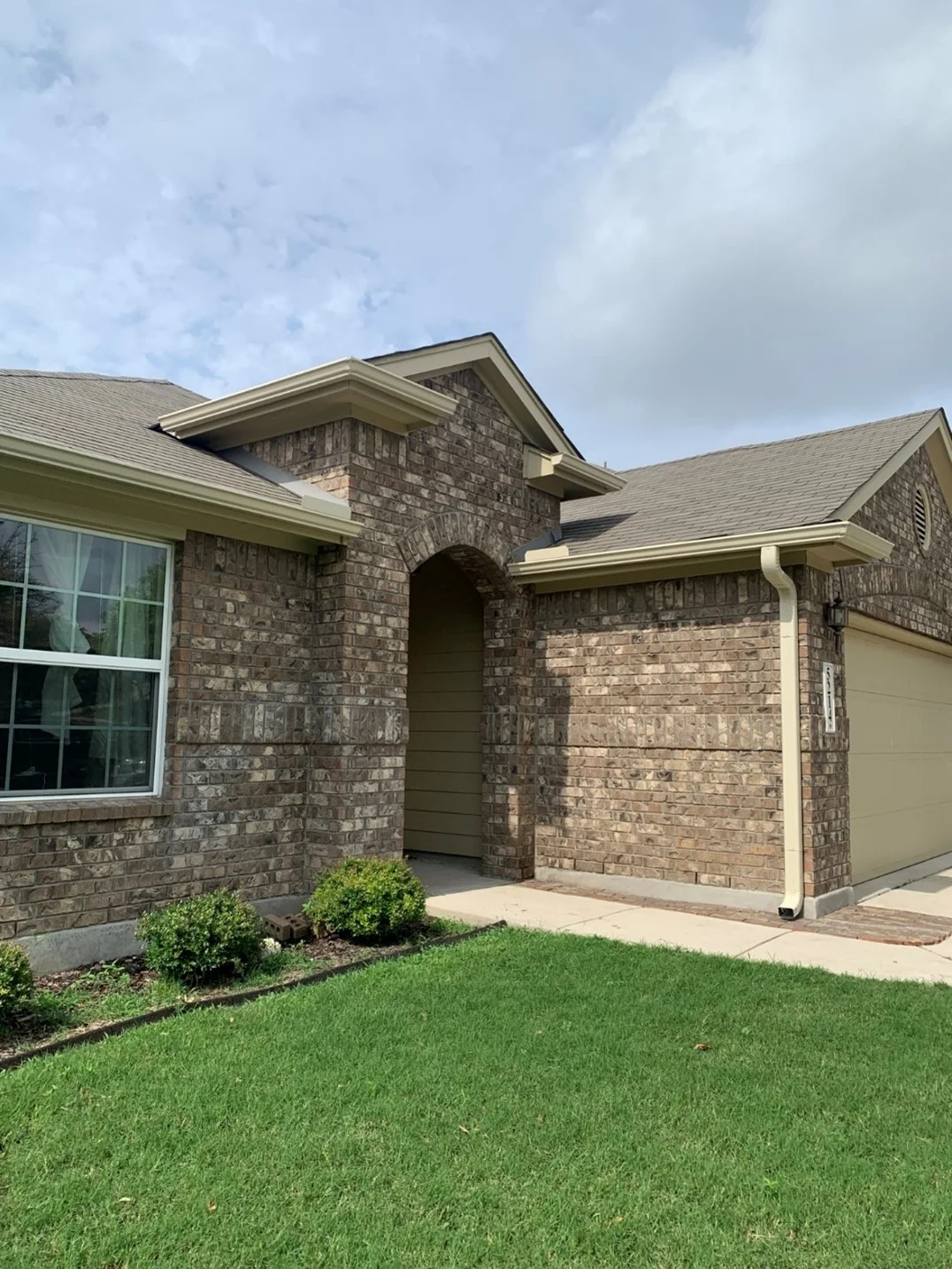
How Residential Gutters Protect a North Texas Home
Rainfall across the Dallas-Fort Worth area comes to roughly 37 to 40 inches a year, and very little of it falls gently. Much of it comes in short, violent storms that can drop inches in less than an hour. A roof without gutters sheds that water in a sheet along every eave, where it digs a trench in the beds, splashes soil onto the walls, and soaks into the ground along the whole perimeter of the slab.
That last effect is the one that matters most in this region. The clay soils common across North Texas expand when they’re wet and contract when they dry out. Uncontrolled roof runoff keeps the soil along the foundation cycling between those two states, and uneven moisture around a slab is a recognized contributor to foundation movement. Gutters collect that water and release it at a few chosen points, where it can be directed away from the house.
There are everyday benefits too. Gutters keep water from pouring across entryways and garage doors, protect wood trim and door thresholds from constant wetting, and stop the splash-back that stains brick and rots the bottom edge of siding. They also protect the fascia, the board the gutters attach to. Soft or rotted fascia is often a sign of long-term overflow behind an undersized or clogged gutter.
Residential Gutter Sizes: 5-Inch, 6-Inch and Oversized
Size is the first decision, and it’s based on how much roof feeds each run and how steep that roof is. Five-inch K-style gutter has been the residential standard for decades and still suits many single-story homes with modest roof planes. It’s the most economical option and looks proportionate on a lower eave.
Six-inch K-style handles roughly 40 percent more water than 5-inch, and on many houses that added capacity is what keeps water inside the gutter during a downpour. It’s generally the better fit for larger or steeper roof planes, long uninterrupted runs, and any eave that sits below a valley. Newer homes can have larger and more complex roofs than older ones, and those roofs frequently push past what a 5-inch system can carry.
For the largest roof planes, 7-inch and other oversized K-style gutters are available, and they’re usually reserved for very large homes or specific trouble spots. A house doesn’t have to use one size throughout. It’s common to put 6-inch on the long rear elevation that takes most of the roof and keep 5-inch on a small porch roof, provided the profiles look right together from the street.
Residential Gutter Materials and Profiles
Seamless aluminum is what most Dallas homeowners choose, for good reasons. It doesn’t rust, it’s light enough that it doesn’t strain the fascia, it holds a factory-applied finish for many years, and it comes in many colors, so you can pick one that sits well with the trim. Because each run is formed on site from a continuous coil, it’s custom-cut to the length of the eave. A 37-foot eave gets one 37-foot gutter, with joints only at corners, end caps and outlets.
Copper is the premium choice. It needs minimal maintenance, is exceptionally long-lived, and changes from bright metal to brown and eventually to a green patina. Copper suits custom homes, historic architecture and accent areas such as an entry or a bay window. One rule applies without exception: copper and aluminum are never placed in contact, so the hangers, downspouts and fasteners on a copper system are copper-compatible as well.
Profile is the shape of the gutter. K-style, with its flat back and decorative front that resembles crown molding, is the most common residential profile and carries more water than a half-round of the same width. Half-round is a smooth, open trough that suits older and architectural homes, and it’s typically paired with round downspouts. Box gutter is a third option for certain modern designs. You can compare gutter styles and sizes in more detail on our gutters page.
Downspout Layout for Residential Gutters
A gutter is only as good as its outlets. Each run has to be pitched slightly toward a downspout, and the downspout has to be large enough to empty the run as fast as the roof fills it. The two rectangular sizes used on homes are 2×3 and 3×4, and the larger one moves about twice as much water. It’s the natural partner for 6-inch gutter, and it’s far less likely to clog because leaves and twigs pass through it.
Placement is worked out corner by corner. Long runs usually get a downspout at both ends so that water never has to travel the full length of the house. A spot below a roof valley may warrant its own outlet. At the same time, a downspout shouldn’t come down in the middle of a front entry, empty onto a walkway, or land where the ground slopes back toward the house.
The bottom of each downspout deserves as much thought as the top. We look at where the ground falls and where the water needs to go, then finish each one so it releases onto grade that drains away from the foundation. What we install runs above ground. If your lot calls for carrying water a greater distance, bring it up during the estimate so it can be discussed.
How Roof Design Shapes a Home Gutter Installation
No two roofs load their gutters the same way. A simple gable sends water to two long eaves, so both runs carry a heavy, even load. A hip roof spreads the water around all four sides and creates four outside corners to miter. Valleys concentrate the flow from two planes into a narrow stream that can overshoot a gutter entirely in a hard rain, which is why the gutter size and outlet location below a valley get special attention.
Pitch matters as well. Water leaves a steep roof faster than a shallow one, so the same square footage delivers its runoff in a shorter burst. Two-story homes often have an upper roof that empties onto a lower one, which means the lower gutter handles both. Metal and tile roofs shed water faster than composition shingles, and that can influence both gutter size and how the gutter is positioned relative to the roof edge.
These details are the reason an installation quote is finalized after a site visit. Seeing the house lets us validate the measurements, work out the elbow and miter configurations, and check whether offsets are needed to bring downspouts around trim, brick ledges or wide overhangs.
Adding Gutter Guards During a Residential Installation
If trees overhang the roof, the easiest time to add gutter guards is while the new gutters are going up. We install two kinds. Expanded Steel (Roll Lock) screen starts at $5 per foot and keeps out leaves, twigs and other large debris. Micro-mesh, in stainless and aluminum, starts at $10 per foot and also stops fine material such as seed pods, pine needles and the grit that washes off shingles.
Guards reduce cleaning but don’t eliminate it. Debris can collect on top of any guard and should be brushed off from time to time. We recommend having gutters cleaned 1 to 3 times a year. The right number depends on how much tree cover is over the house, what kind of trees they are, and how many storms come through. A house in an open yard with no trees close by may not need guards at all.
Our Residential Gutter Installation Process
It begins with a free estimate. We measure the roofline and give you a written, itemized quote, so you can see the footage of gutter, the number and size of downspouts, and any options such as guards, each listed separately. The quote is confirmed after a visit to the property, for the layout reasons described above.
When we arrive to install, the first task is taking down whatever gutters are already on the house. The seamless aluminum is then formed on site, run by run, to the measured length of each eave. New runs are hung and pitched toward their downspouts, corners are mitered and sealed, and the downspouts are placed where water can be released away from the foundation. When the work is finished, the site is left clean.
For a typical house, the installation itself is a matter of 2 to 4 hours. Only a very large home stretches that to a full day, or on rare occasions into a second one.
Residential Gutter Installation Cost in Dallas
Gutters are priced by the linear foot, and the price per foot depends on material, size and profile. The ranges below are our starting prices. Each is a range because height, roof complexity, the number of corners and access all affect the work, and new gutter work carries a $500 minimum charge.
Aluminum K-style is where most homes land, in Dallas and across North Texas. Expect a range of $7 to $14 for each foot of 5-inch seamless, while the 6-inch version is quoted between $8 and $16 a foot. Oversized K-style, meaning 7-inch and up, is a specialty item at $20 to $28 a foot.
Other profiles and metals sit higher. Half-round in aluminum is $13 to $25 a foot, and box gutter is $20 to $30. Copper is the top of the scale: K-style copper falls between $40 and $55 a foot, and half-round copper between $45 and $60.
Downspouts are priced separately. Aluminum 2×3 starts at $7 per foot and 3×4 at $8 per foot, while round smooth downspouts start at $14 per foot in aluminum and $45 per foot in copper. If a downspout needs an above-ground extension at the bottom, that item begins at a $250 minimum.
To estimate footage, a 1,500 square foot home typically needs 150 to 200 linear feet of gutters and downspouts combined. At 2,500 square feet the usual figure is 200 to 300 feet, and at 3,500 square feet and up it’s often 350 feet or more. Two houses with the same floor area can differ a good deal, since a single-story home has more roof edge than a two-story of equal size. A measured quote is the only reliable number, and ours are free.
New Gutters or Repairs to the Ones on Your House
Not every gutter problem calls for a new system. A single leaking corner, a run that has lost its pitch, a few failed hangers or a downspout that has pulled loose can all be repaired, and each of those repairs is priced from a $250 minimum charge. If the gutter is seamless, correctly sized and in sound condition, a repair is usually the sensible route.
Replacement makes more sense when the problems are spread across the whole house or built into the system. Sectional gutters leaking at many joints, runs pulling away on several sides, gutters that overflow even when they’re clean, and metal that’s creased, corroded or badly dented are all in that category. We do both kinds of work, so we’ll tell you which one your house needs.
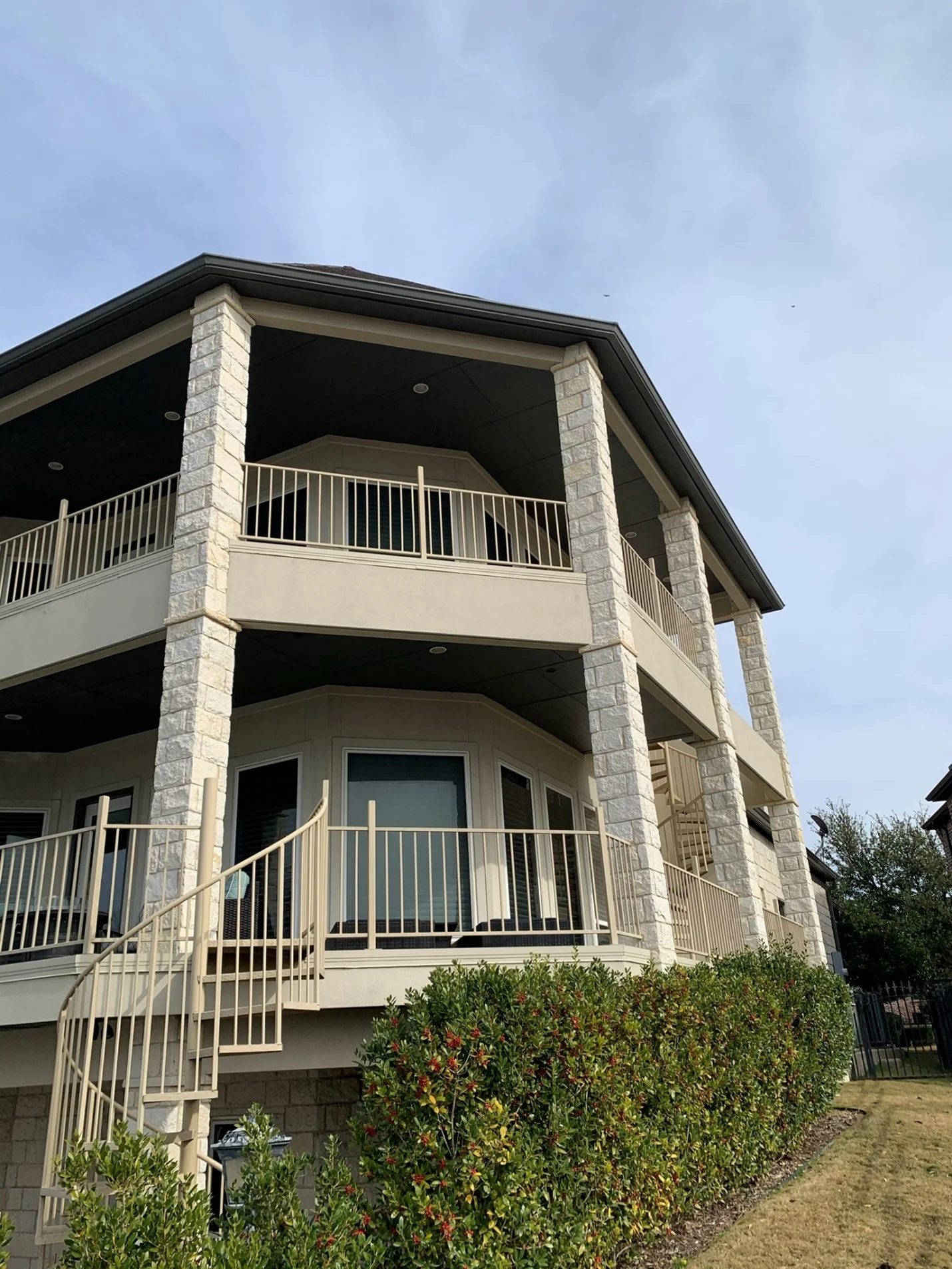
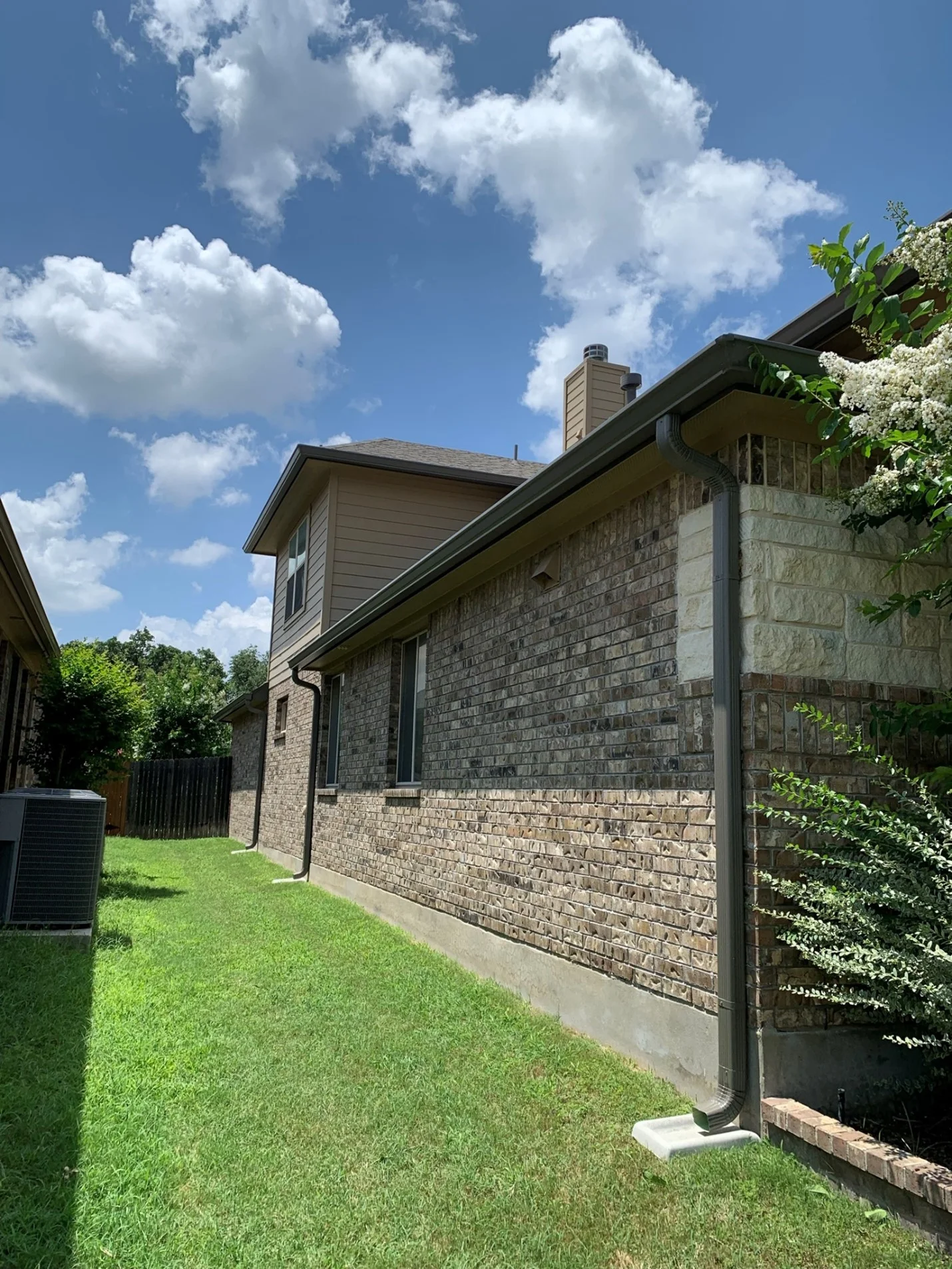
Warranty and Experience Behind Every Residential Gutter System
Creative Gutter has been family owned and operated since 1984, and in more than 40 years we’ve installed thousands of gutter systems across North Texas. Every installation is backed by a 5-year workmanship warranty, and the materials carry a 20-year manufacturer warranty. We’re based at 1515 Fuller Dr in Dallas, we’re fully insured, and the work is done to meet code requirements.
Homeowners have given us 4.9 stars across 140+ reviews on Google. We offer a wide selection of materials, profiles and colors at competitive prices, and we have the experience, equipment and crew capacity to take a project from the first measurement to the finished system.
Residential Gutter Installation Questions From Homeowners
How much does residential gutter installation cost in Dallas?
Seamless aluminum K-style gutter runs from $7 to $14 per foot in the 5-inch size and $8 to $16 per foot in 6-inch, with a $500 minimum on new gutter work. Copper, half-round and oversized profiles cost more. Your total depends on footage, the number of downspouts, height and roof complexity, which is why we measure before quoting.
Do I need 5-inch or 6-inch gutters on my house?
It depends on the roof. Smaller single-story homes with simple rooflines often do well with 5-inch. Larger or steeper roof planes, long runs and eaves below valleys generally benefit from 6-inch, which carries about 40 percent more water. The right size can differ from one side of the house to the other.
How long does it take to install gutters on a home?
Most residential jobs are finished in 2 to 4 hours. On a very large home the work can stretch to a full day, and occasionally into a second.
Are seamless gutters better than sectional gutters?
For most homes, yes. Sectional gutters have a joint wherever two lengths meet, and every joint is a potential leak and a place for debris to catch. Seamless gutters are formed in one piece for each run, so the only joints are at corners, end caps and outlets. They look cleaner, too, with no visible seams along the eave.
What color gutters should I choose?
Most homeowners match the gutters to the fascia or trim so they blend into the roofline, and choose downspouts that match the wall behind them. Others prefer a deliberate contrast with the trim. Seamless aluminum is available in many colors, and copper is left to weather naturally.
Can gutters be installed on only part of a house?
They can. Some homeowners start with the areas that matter most, such as over entries, above the garage, or along a side where water pools. Keep the $500 minimum charge in mind, and consider that partial systems leave the remaining eaves draining directly beside the foundation.
Will new gutters help protect my foundation?
They help by controlling where roof water goes. Instead of soaking the soil around the entire perimeter, the water is collected and released at downspouts, where it can be directed away from the slab. On the expansive clay found across North Texas, keeping moisture near the foundation consistent is a worthwhile goal.
Should gutter guards be installed at the same time as new gutters?
If you have trees over the roof, it’s the most convenient time, since fitting guards to a brand-new gutter is simpler than retrofitting them later. Homes without nearby trees may not need them. If you’re unsure, that’s worth raising at the estimate.
Request a Free Residential Gutter Installation Estimate in Dallas
If your home needs new gutters, or you’d like to know whether the ones you have are up to the job, Creative Gutter is ready to help. Call 214-324-4674 or use our website to request a free estimate for residential gutter installation. We serve homeowners across Dallas, Collin, Denton, Rockwall and Tarrant counties, and you’ll receive a written, itemized quote based on real measurements of your house.
Contact us today to schedule a FREE on-site consultation for gutter installation or repair for your home or business in Dallas, Collin, Rockwall, Denton and Tarrant Counties.
214-324-4674