

Gutter Installation In Celina, TX
Seamless Gutter Installation in Celina, TX
The subdivisions filling in around Celina are built with tall, steeply pitched two-story rooflines, and a steep roof is the reason a perfectly clean gutter can still overflow. Water leaves a 10:12 plane with enough forward speed to jump the front lip instead of dropping into the trough. Out on open prairie north of Frisco, wind adds to that. Creative Gutter approaches gutter installation in Celina by positioning and sizing the gutter for the pitch above it, not for the length of the eave below it.
Why a Clean Gutter Still Overflows Here
Homeowners call us convinced something is blocked. Then we get up there and the trough is spotless. What is happening on these newer Celina roofs is not a blockage and not a capacity failure in the usual sense. It is trajectory. A shingle surface offers roughly the same friction no matter how the roof is framed, so the steeper the plane, the more of gravity acts along the surface instead of pressing into it. Water arrives at the eave moving, and it leaves the drip edge on an arc.
On a shallow 4:12 ranch roof that arc is short and the water essentially falls off the edge. On a 10:12 or 12:12 plane it can carry several inches horizontally before it drops, and in a hard downpour that is enough to clear the front bead of a gutter set in the standard position. From the ground it looks exactly like an overflow. The difference is that the water never got into the gutter in the first place.
You can confirm it yourself without a ladder. Stand back during a real rain and look at where the sheet leaves the roof. If it is arcing past the front of the gutter and landing on the mulch line, that is overshoot. If the trough is visibly full and spilling over the lip along its length, that is a capacity or blockage problem, and it is a different fix.
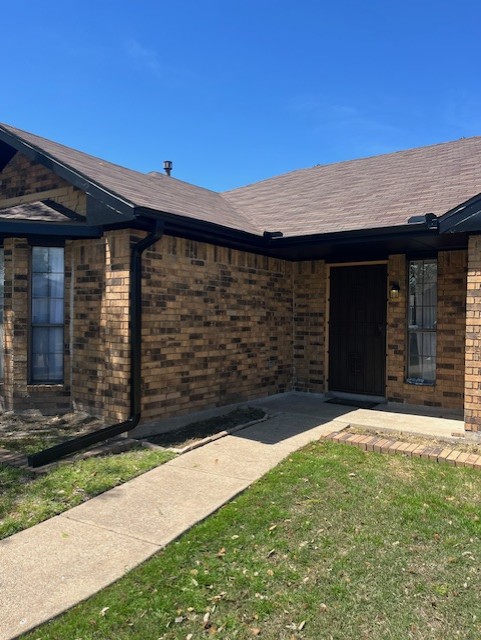
Where the Trough Belongs
The positioning rule installers use is simple to state and easy to get wrong. Sight along the plane of the roof and extend that line past the eave. That extended line should pass into the gutter opening, ideally striking somewhere at or just inside the front bead. If the line clears the front of the gutter entirely, the gutter is too low, too far in, or both, and no amount of cleaning will help it.
Two things follow from that on a steep roof. The back of the trough has to sit high enough to catch water leaving the drip edge, tucked under the shingle overhang rather than dropped down the fascia. And the front of the trough often has to sit farther out from the wall than it would on a shallow roof, because the discharge point has moved outward. Hanger position, fascia wedges, and in some cases a bracket that carries the trough proud of the board all serve that adjustment.
There is a limit to how far you can chase it. Drop the gutter too far to chase a steep discharge and you open a gap between the roof edge and the back of the trough that wind-driven rain will find, and you expose the back edge to hail sliding off the plane. Push it too far out and it looks wrong and hangs poorly. On the steepest Celina elevations the answer is usually a combination: correct position plus a wider trough to give the water a bigger target.
Valleys Are Where These Roofs Fail
The complex rooflines on new construction around Celina throw two or three planes into a single valley, and a valley is a channel. Instead of a broad sheet arriving evenly along forty feet of eave, you get a concentrated stream arriving at one point with real velocity behind it. That stream does not politely enter the gutter. It hits the trough, and a good portion of it keeps going, straight over the far side or straight out the end of the run.
The fix is not a bigger gutter along the whole house. It is local hardware at that one point. A splash guard, sometimes called a valley shield, is a formed piece that rises above the back and outer edge of the trough where the valley terminates and turns the stream down into the gutter. It costs almost nothing and it solves a problem that people otherwise live with for years.
The second half of the fix is putting an outlet close to where that volume lands, rather than making it travel thirty feet along the trough to a downspout at the corner. Water entering a gutter with momentum wants to keep moving in the direction it was already going, and if that direction is uphill against the pitch, it will pile up and spill before it turns around.
What Size Does a New Celina Two-Story Need?
The size question gets answered off the roof, not off a tape measure at the fascia. We look at the contributing area of each plane, the pitch, and how many planes drain into one place. On the two-story stock going up around town, that usually lands in the same place.
- 6-inch K-style on any large plane, on anything 8:12 and steeper, and on every elevation fed by a valley. The extra width is as much about giving fast-moving water a target as it is about volume.
- 3×4 downspouts rather than 2×3 at the loaded corners. The larger section moves close to twice the water and it does not jam on a slug of shingle granules after a hailstorm.
- More outlets, not bigger ones. Two 3×4 drops on a long elevation beat one heroic downspout, and they cut the distance water has to travel inside the trough.
- Splash guards at every valley terminus and at any point where an upper roof discharges onto a lower run.
- Kickout flashing where a roof edge meets a wall. That is roofing work rather than gutter work, but it is the detail that keeps water out of a wall, and we will point it out if it is missing.
All of it is rolled to length on-site so a 44-foot elevation gets a single 44-foot piece with no mid-run seam to open up in year three. Gauge and finish get settled at the same time, since a heavier aluminum holds its shape better on a long unsupported span.
Hanger Spacing and Open Prairie Wind
Celina sits out where the land opens up, west of the wooded creek bottoms and north of the built-up parts of the county. There is not much between an approaching storm front and your house. That has two practical consequences for a gutter, and neither one is about leaves.
The first is uplift. Wind that gets under the front lip of a gutter tries to peel the run off the fascia, and it works on the fastener at the weakest point first. We hang on hidden hangers at 24 inches on center as standard, with screws driven into solid framing rather than anything relying on a nail. On the exposed elevations out here we tighten that to about 18 inches, so no single fastener is carrying the length of trough that a gust would otherwise work against.
The second is wind-driven rain. Rain that arrives at a steep angle rather than falling vertically strikes the pitched face of the roof, which means a tall windward roof plane intercepts more water than its footprint alone suggests. That is a real load factor on the windward side, and it is one reason the same house can overflow on one elevation and stay dry on the other three during the same storm. Sizing the windward runs up rather than sizing the whole house up is usually the economical answer.
The Downtown Square and the Older Stock Around It
The preserved commercial buildings around the Celina square are a completely different job from a new subdivision house, and they need a different conversation. Older masonry storefronts frequently have parapet walls, flat or low-slope roofs draining to internal or scupper outlets, and in some cases original built-in box gutters concealed behind the cornice line. None of that is served by a standard K-style profile bolted to a fascia.
Box gutter work is a trade of its own. The trough is part of the building rather than an accessory hung on it, so a failure shows up inside the structure as stained brick, a wet ceiling, or rotted framing at the wall line, and it is usually well advanced before anyone sees it. We line, repair and rebuild built-in and box gutter systems, and on a period building that is nearly always the right approach rather than converting to a hung gutter that looks wrong on the facade. Our guide to the gutter profiles and metals we work in sets out what goes back into a trough like that.
On older residential stock near the square, half-round is worth pricing. The profile suits period architecture better than an Ogee K-style does, it is easier to keep clean because there is no square inside corner to trap silt, and paired with a conductor head it looks correct on a house that predates the subdivisions.
Copper is the premium version of that and it develops a patina rather than needing paint. Most homeowners near the square start with plain rain gutters and what the options cost and then decide how far toward period-correct they want to go. For the storefronts themselves, commercial and light-industrial gutter work generally means heavier steel and oversized downspouts sized for a flat roof rather than a pitched one.
Fresh Sod, Swales, and Where a New Celina Lot Sends Its Water
A finished lot in a new Celina subdivision has been graded to a plan, and that plan usually sends water between the houses into a swale running front to back. It works when the grade is intact and the sod has knitted. In the first couple of years neither is guaranteed, and a downspout aimed into a shallow swale cut in loose fill will channel through it before the grass has rooted properly.
What we do about it here is unglamorous. Extensions carry the discharge past the disturbed ground next to the slab, never closer than four feet, six as the working target, and ten where the lot allows it. Where the swale is the only available route, a splash pad or a short run of buried line under the sod keeps the flow off the surface until it is clear of the foundation.
The steep roofs that make this town interesting also make the discharge more energetic. Water leaving a leader after a two-story drop arrives with real force and will excavate a bed that a slower flow would leave alone. Where a downspout lands in new landscaping we terminate it on something solid rather than on bark mulch, which otherwise ends up against the brick after the first hard cell.
What Gutter Work Costs in Celina
Cost follows linear footage, roof height and access, so the newer two-story stock lands higher in the ranges than the older single-story homes in town. Aluminum, cut seamless on the drive, is $4.50 to $12 a linear foot installed. Pitch is the quiet driver on the new construction. A steep plane means a ladder cannot go up wherever the crew would like it, valleys have to be reached from one workable angle, and the safe positions are fixed by the roof rather than chosen. That is slower going than a low ranch eave with open ground beneath it, and slower going is what separates the two ends of a range.
- Steel, for commercial and heavy-duty applications: roughly $9 to $20 per linear foot.
- Copper with conductor heads on a feature elevation: $25 to $40 per linear foot.
- Cleaning: quoted once we have seen the pitch and where a ladder can safely stand, because a steep two-story eave is slower to work than a low one of the same length.
- Guards and leaf screens: a micro-mesh system costs meaningfully more per foot than a basic screen, so the specification drives this line as much as the length does.
Those are ranges, not quotes. A three-story entry elevation with no side-yard access takes longer to stage than a wide-open corner lot with the same footage. Estimates are free. Every installation carries a 5-year workmanship warranty and a 20-year manufacturer warranty on the materials.
Celina Questions We Hear Most
My house is four years old. Why is it already overflowing?
Nothing has failed. It was almost certainly built with 5-inch gutter and 2×3 downspouts across the whole house to hold cost down. That is fine on a shallow roof and inadequate under a steep one. Moving the worst two elevations to 6-inch with 3×4 downspouts, adding an outlet, and putting a splash guard at the valley usually fixes it without touching the rest of the house.
Water is shooting past the gutter. Do I need a bigger one?
Maybe, but check position first. Sight the roof plane out past the eave and see where that line lands relative to the front of the trough. Overshoot on a steep roof is a positioning problem as often as a sizing one, and re-hanging a sound gutter costs far less than replacing it.
Do the extensions come with the system, or are they extra?
They come with it. A gutter that stops at the elbow has moved the problem about three feet, so we do not treat the discharge as an add-on. On a new Celina lot the useful question is not how long the extension needs to be but where the builder’s grading plan says the water is meant to end up. We read that first and run the discharge to it rather than guessing at a direction.
Do I need gutter guards in a new subdivision?
Usually not yet. Guards solve a debris problem, and a neighborhood where the trees are still shorter than the second-story windows does not have much debris. What these houses have is a capacity and trajectory problem, and a screen does nothing for either one. It slightly reduces capacity. Spend the money on correct sizing first.
What can I do about water pooling at the foundation?
Get the discharge away from the slab. North Texas sits on clay that swells when it is wet and shrinks in drought, and water released at a corner drives that movement harder than anything else. On a new build the grading is often still settling, which makes running the discharge well clear of the slab worth doing early rather than after you see a crack.
Can gutters be matched to the trim on a new build?
Yes. Aluminum comes in a wide range of baked finishes and we bring the color options out to the estimate so you are matching against the actual brick and trim in daylight rather than a screen. Some neighborhoods here require exterior color approval before work starts, in which case we can supply the spec sheet and a color chip for that submission.
Does gutter installation in Celina mean starting over, or can the builder gutters be repaired?
It depends on what is wrong. Sagging, separated miters and bad pitch are repairs on the existing run. A trough that is simply too small for the plane above it cannot be repaired into adequacy, and that is when a full replacement is the right call rather than good money after bad.
The builder graded my lot. Can the downspouts be moved?
Within the lot’s own drainage pattern, yes. What we will not do is redirect roof water across a property line into a neighbor’s yard, because the lot was graded to shed its own water and that is where it has to go. On most Celina lots there is a better route forward to the street or back to the rear swale that nobody has looked at yet.
Our Territory North of Frisco
Celina and the rest of north Collin County run together and we schedule them as one territory. Prosper sits immediately south along the Preston Road corridor with much the same new-construction roof profile, and the smaller acreage places around Weston are just east. Southeast we handle gutter installation in Melissa, and south of Prosper we cover Frisco.
Celina does not stop at the Denton County line. The west side of the city sits in Denton County and the rest of it in Collin, so depending on which side of that line your address falls on, the work runs through our Denton County coverage or our crews working Collin County. Neither the specification nor the price changes at the line.
Have Us Look at the Pitch Before You Buy a Bigger Gutter
If water is coming off your roof faster than the gutter can take it, the answer might be size and it might be position, and those cost very different amounts. Call Creative Gutter at 214-324-4674 and we will measure the planes, check where the trough sits against the roof line, and give you a written range at no charge. Family-owned, fabricating on-site across DFW since 1984.
Contact us today to schedule a FREE on-site consultation for gutter installation or repair for your home or business in Dallas, Collin and Rockwall Counties.
214-324-4674