

Gutter Installation In Wylie, TX
Gutter Installation in Wylie TX: Sizing for Steep Roofs and Mature Trees
Wylie splits into two very different gutter jobs, and the right system depends on which side of that split your house sits on. The 1950s and 1960s blocks around Ballard Avenue sit under sixty years of pecan and cedar elm canopy on shallow, simple rooflines. The subdivisions that filled in after 2000 are two-story brick with steep pitches and large roof planes that overwhelm an undersized gutter in a hard spring rain. Creative Gutter approaches gutter installation in Wylie by sizing each one on its own terms.




Wylie Is Really Two Different Gutter Jobs
Drive from the original blocks near Ballard Avenue out to the neighborhoods that filled in along FM 544 and SH 78 after 2000, and the roof in front of you changes completely. The older core is single-story stock with shallow pitch, long uncomplicated runs, and mature trees that have had six decades to lean over the eave. The newer half of the city is two-story brick with steeper pitch, more valleys, more roof-to-wall transitions, and young landscape trees that shed almost nothing worth talking about.
Those two houses fail in opposite ways. The old ones clog. The new ones overflow while perfectly clean, because a steep roof plane concentrates a great deal of water into one inside corner very quickly, and a 5-inch gutter feeding a 2×3 downspout simply cannot move it. Selling both homeowners the same package is how a contractor ends up back on the same ladder in September.
Wylie is also a three-county city, which matters more for scheduling than for specification: most of it sits in Collin County, with the southwest corner crossing into Dallas County and a slice on the southeast side falling in Rockwall County. Wherever the address lands, the first thing we do on an estimate is measure the roof, not the eave. Square footage of the contributing plane, pitch, and the number of planes dumping into a single corner tell us the size. Eave length by itself is a material takeoff and nothing more.
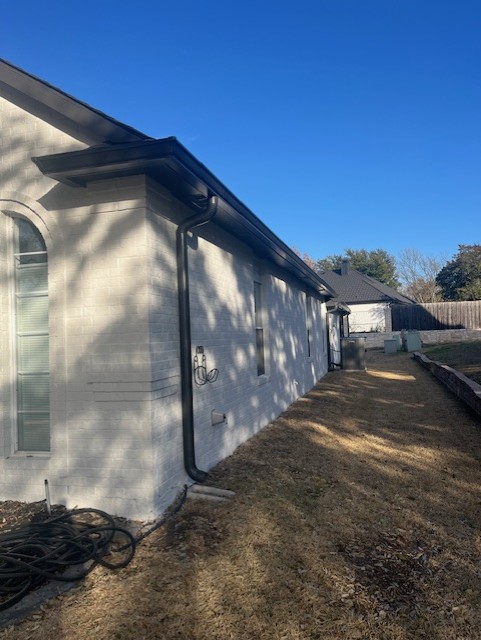
Sizing a Two-Story Wylie Roof: Where 6-Inch Earns Its Keep
Annual rainfall here lands between 37 and 40 inches, and none of it arrives politely. It shows up in hard March-through-June bursts. Peak intensity is what a gutter gets sized against, not the yearly total. On a steep 2010s roof, water accelerates down the plane instead of sheeting slowly, which means it arrives at the gutter faster and with more momentum. That is the condition where a 5-inch trough sheds water over the front lip even though nothing is blocking it.
On the newer Wylie two-stories we specify this way:
- 6-inch K-style wherever a single plane runs past about 1,000 square feet, wherever the pitch reaches 8:12, and at every corner where a valley brings two planes together.
- 3×4 downspouts under those corners in place of 2×3. The bigger leader carries roughly double the volume, and a slug of shingle granules passes through instead of bridging the throat.
- Extra outlets instead of one hard-working drop. A single opening asked to empty a 40-foot elevation becomes the bottleneck no matter how big the trough above it is.
- Hidden hangers on tighter centers anywhere the run carries real weight, because a 6-inch trough flowing full is heavy before ice or wet leaves get involved.
All of it is fabricated on-site in one continuous piece, so a 46-foot elevation gets a 46-foot gutter with no mid-run seams to open up in the second or third year.
The Older Homes Around Ballard Avenue
The original Wylie stock is a different animal. Many of these houses still carry 4-inch or 5-inch gutters hung on the original fascia, sometimes on spikes and ferrules that have been working loose for decades. Under sixty-year-old canopy, that undersized trough fills with leaf litter, holds water, and the added weight pulls the spikes out of softened wood. By the time anyone calls us, the board behind the gutter generally has to be dealt with first.
So the sequence here starts at the wood. We probe the fascia, cut out whatever has gone soft, correct the drip edge, and hang the new run on screwed hidden hangers biting into sound material. If the original trough was too small for what the canopy drops, we step up to 6-inch on a roof that never needed the water capacity. Debris volume is the constraint on these blocks, not roof area. Half-round is also an option on period homes where the K-style profile looks wrong on the eave.
Do Newer Wylie Subdivisions Actually Need Gutter Guards?
Often not yet, and we will say so out loud. A guard is a debris filter and nothing else. On a 2008 street where the landscape trees still stand shorter than the upstairs windows, there is very little to filter. Those roofs have a capacity shortfall instead, and screening does nothing for capacity except take a little away.
Where leaf screens and guard systems pay for themselves in Wylie is the older canopy near the original town grid, along creek corridors, and on any lot that inherited a large pecan or live oak from the previous era. There the trough fills every fall regardless of how careful you are. If your newer home does back up to mature trees on a greenbelt, that is a real case and we will make it. If it does not, save the money and put it toward correct sizing.
The 1990s Streets That Sit Between Wylie’s Two Halves
This page has been describing two Wylie houses, the mid-century core and the post-2000 subdivisions. There is a third group in between that gets left out of that framing, and it is a large one: the streets that filled in through the 1990s. Those homes are mostly single-story or modest two-story brick with moderate pitch, and the original five-inch trough on them is neither clearly right nor clearly wrong. It is borderline, which is a harder thing to diagnose.
What tips those houses over is time rather than geometry. The landscape trees planted with them are now thirty years old, and on a lot of these Wylie streets the crowns have just reached the eave line in the last few years. A system that coped for two decades with almost nothing falling into it is suddenly being asked to carry debris as well as water, and the first sign is standing water at one drop rather than an overflow along a run.
The answer on this stock is usually targeted rather than wholesale. Add an outlet so that thirty to forty feet is the furthest any water has to travel before it reaches one, put a three-by-four leader under the corner doing the most work, fit strainers where a crown sits overhead, and re-hang anything that has drifted off pitch. That is a small fraction of a replacement, and on a sound trough it buys years. Whole-house work on a 1990s Wylie home is the answer only when hail has been through the fronts or the fascia has gone.
It is also the group where the cleaning conversation starts for the first time. Owners who have never needed a schedule now do, and two visits a year is the floor for any house we look after. Work on this vintage is more often two elevations and a service interval than a new system.
What Gutter Work Costs on a Wylie Home
Pricing tracks linear footage, roof height, and access, so the two halves of Wylie land in different places. Seamless aluminum is $4.50 to $12 per linear foot fitted, and a complete home installation comes to $600 to $2,750. The post-2000 subdivisions carry the taller elevations and the extra valleys, so they sit toward the upper end of that, while the older single-story stock nearer downtown usually does not.
- Steel on heavy-duty and commercial runs: $9 to $20 a foot.
- Copper with conductor heads, where a show elevation calls for it: $25 to $40 a foot.
- Cleaning: priced on how compacted the load has gone since the last pass, which under the mature canopy on the older streets is a different job from a young subdivision.
- Guards: priced by product and profile, with the tree load overhead deciding which one is worth buying.
Anything that is not a house prices on a different basis. A shop building east of town, a church hall, a strip center on the highway or a working barn out toward the farmland all bring conditions a subdivision job does not: a parapet and scuppers instead of an open eave, a formed metal edge with no fascia board to fasten into, bracket detail engineered for that edge, and a lift where a ladder would do on a house.
Roof area rather than perimeter usually sets the sizing on those buildings, and the leader system is often the largest single item on the sheet. We walk them and price them one at a time rather than quoting a rate per foot that would not mean much.
Those are ranges, not quotes. A two-story with a steep back elevation and no side-yard access costs more to stage than a wide-open corner lot, so we look at the house rather than guess. Estimates are free and we do not charge to tell you a repair is the better call.
Where We Work Around Wylie
Wylie sits between several communities we cover on the same routes, so scheduling is usually straightforward. We work regularly in Sachse and handle gutter installation in Murphy just west of here. North and east toward the lake we cover Lavon and the smaller lots around St. Paul. Where the city crosses those lines into Dallas County and Rockwall County, we are working the same streets under a different county name. Further southwest, Rowlett homeowners deal with a similar mix of older stock and newer two-story builds.
Wind Off Lake Lavon and What Storm Season Does Here
East Collin County sits close to Lake Lavon, and the open water and open farmland east of town mean storm fronts arrive with less to slow them down than they have in the built-up parts of the metroplex. Two things follow from that. Straight-line wind gets under a loose gutter lip and peels a run away from the fascia, and hail season from March through June dents aluminum and fills troughs with shingle granules that settle into a paste at the outlet.
After a hard storm the first check is simple: look for a run that has dropped at one end, a downspout that has pulled off its strap, and water standing in the trough an hour after the rain stopped. Standing water means the outlet is packed. We handle storm damage on short notice across the east side of the county, and we can usually tell from the driveway whether it is a re-hang or an insurance conversation.
Repair, Re-Hang, or Replace
Not everything needs to come down. A gutter that is sound but sagging in the middle is usually a hanger problem, and adding hangers on tighter centers with a corrected pitch toward the outlet fixes it for a fraction of a replacement. Split miters, a downspout that never drained properly, and a length that holds a puddle for hours after a storm are all ordinary repairs on an existing system.
Three conditions push a house the other way. The trough is undersized for the plane above it. Hail has worked the fronts over badly enough to read from the street. Or new fascia has gone up and the old runs will not sit true against it. If you are weighing the two, it helps to understand what a full tear-off and re-run involves before deciding. Our workmanship is covered for five years, and the material itself carries a 20-year manufacturer warranty.
Questions Wylie Homeowners Ask
My house is only twelve years old. Why are the gutters already overflowing?
Almost always because the builder ran 5-inch gutter and 2×3 downspouts on a steep, large roof to hold cost down. Nothing has failed. The system was never sized for the plane above it. Take the two failing elevations up to 6-inch, put 3×4 leaders under them, add an outlet, and the rest of the house can stay exactly as it is. On the post-2000 subdivisions, that targeted upgrade is what most gutter installation in Wylie actually amounts to.
Water pools by my foundation after every storm. Is that a gutter issue?
It is a discharge issue, and it matters more here than in most of the country. Collin County sits on Blackland Prairie clay that swells when wet and shrinks in drought, and water dumped at the slab edge is the single biggest driver of foundation movement in North Texas. Carrying the discharge well away from the slab is cheap insurance compared to what pier work costs.
My house is from the 1990s. Which half of Wylie do I belong to?
Neither cleanly, and that is the point. The roof geometry is closer to the older core than to the steep post-2000 planes, so capacity is rarely the whole story. What has changed is the canopy over it. Look for standing water at one drop an hour after rain rather than water over the front lip, because that is the failure this vintage produces first.
Can you just do the back of the house?
Often, on this housing in particular. Elevations do not wear at the same rate because they are not doing the same work, and the back of a 1990s Wylie house under a grown-in crown can be well past its spec while the front is fine. We price by elevation so you can take the one that is failing now and leave the rest until it needs it.
How often should gutters be cleaned in the older part of town?
Three under mature canopy, and four where a big pecan is over the roof. The first visit waits for the pecan and cedar elm drop to finish in late fall, the second lands in early spring ahead of the rain, and the others fill the gap in between. On the newer streets two visits cover it, and two is the fewest we recommend on any house.
Can you match the gutter color to my brick and trim?
Yes. The baked finishes run a wide range, and we bring chips out so you can hold them against the brick in daylight. A few neighborhoods here want exterior colors signed off first. We assemble the spec sheet and chip for that packet.
Will hail damage to my gutters be covered by insurance?
That depends entirely on your policy and adjuster, and we do not make that call for you. What we can do is document the condition of the runs, the fronts, and the downspouts so you hand the adjuster documentation rather than a description.
Do you work on metal buildings and shops out toward the county line?
Yes. Larger roof planes on shops and outbuildings usually call for heavier-gauge material and oversized downspouts, and we handle that alongside commercial and light industrial work throughout the area.
Get a Number on Your Roof
Tell us which Wylie you live in and we will tell you what your roof needs. Call Creative Gutter at 214-324-4674. We will measure the planes, probe the fascia, and leave a written range behind, at no cost and with nobody chasing you afterward. We have been hanging gutters across Dallas, Collin, Denton, Rockwall, and Tarrant counties since 1984, and we still fabricate every run on-site in your driveway.
Contact us today to schedule a FREE on-site consultation for gutter installation or repair for your home or business in Dallas, Collin and Rockwall Counties.
214-324-4674