

Gutter Installation in Rockwall, TX
Gutter Installation in Rockwall, TX
About three quarters of the single-family houses in Rockwall were built after 1990, and roughly half the city is still open ground waiting for the next phase. That changes what gutter installation in Rockwall actually involves. Very little of our work in this town is remediation of a forty-year-old system on rotten fascia. Most of it is getting capacity right the first time on a large modern roof, or replacing a builder package that was specified to a price and not to the roof it went under. Both jobs start with a tape measure on the elevation, not with a catalog.




Builder-Grade Gutter Capacity on a Nearly New Roof
The gutter that comes with a new house is chosen the way the doorknobs are chosen: one specification, applied across an entire section, at the lowest number that satisfies the contract. Five-inch K-style with two-by-three downspouts is that specification almost everywhere in North Texas, and on a straightforward single-story elevation it’s genuinely adequate.
It stops being adequate on the plans that sell best in Rockwall. Two-story fronts, steep pitches, deep gables and long valleys all concentrate water into short stretches of trough, and a valley is where you’ll see the first overflow. Water arriving from two roof planes at once hits maybe eight feet of gutter, and no amount of cleaning fixes an eight-foot section being asked to carry a thirty-foot roof.
The tell is simple and you can check it yourself in the next storm. If water is coming over the front lip of a gutter that you know is clean, the trough or the outlet feeding it is undersized. Age has nothing to do with it.
Five-Inch and Six-Inch Gutter, and the Oversized Exception
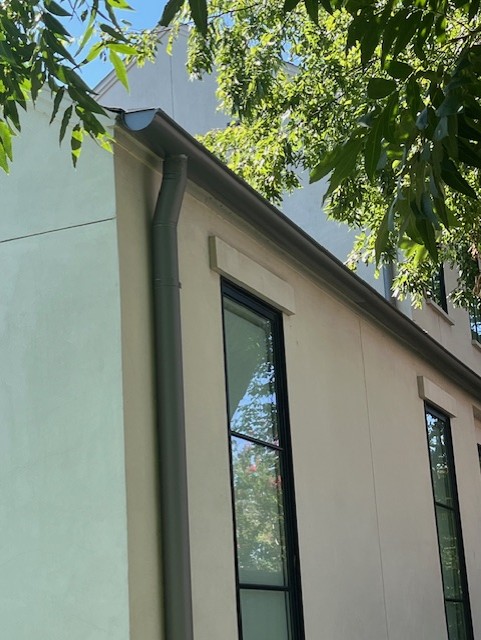
Five-inch stays on the house where the roof supports it, because there’s no sense charging for capacity nobody needs. Six-inch goes on two-story elevations, steep pitches, long valleys and anything sitting under real tree cover. The extra inch is worth a lot of water, it clogs less readily because debris has room to move past, and it pairs with a three-by-four downspout instead of a two-by-three.
Seven-inch and oversized troughs are a specialty size and priced like one. In Rockwall they come up on the larger lakeside custom homes and on commercial roofs along the I-30 corridor, not on tract product. Our gutter styles and sizes page sets out the full range if you want to compare before we visit.
Wind Off Lake Ray Hubbard and What It Does to Fasteners
Lake Ray Hubbard runs along the western edge of the city and covers close to an eighth of Rockwall County. That’s a large stretch of open water with nothing on it to slow air down, and the houses at Chandlers Landing, The Shores and everything else facing that fetch take wind loads that inland streets do not.
Two things follow from it. The first is fastening. Hidden hangers screwed through the back of the trough into the fascia hold in a way that the old spike-and-ferrule method never did, and on exposed lakeside elevations we tighten the spacing beyond what a sheltered street needs. The second is wind-driven rain, which doesn’t fall into a gutter so much as get thrown across it. On a windward elevation, capacity and outlet placement both have to allow for water arriving sideways.
Old spikes are worth a look from the ground if your house has them. A fastener that has backed out even a quarter of an inch is telling you the fascia has already given a little, and that’s cheaper to catch now than after a run comes down.
Gutter Profiles and Metals for a Rockwall Elevation
K-style is the profile on essentially every house built here since 1990, and it suits the brick, stone and stucco combinations the local builders use. Its curved front face reads a little like crown molding and it carries more water than a half-round of the same nominal size.
Half-round belongs on traditional architecture, and in this city that means the streets around the downtown square and the Old Town Rockwall Historic District far more than the newer sections. It has no interior corners for grit to settle into, so it sheds debris well. Copper half-round with round smooth copper leaders and a conductor head at each drop is the detail on the custom elevations out toward the lake, and the head does real work as well as looking the part, since it gives a two-story leader somewhere to take water faster than the pipe can swallow it.
Box gutter is a different animal again. It’s built into the roof structure instead of hung off a fascia, and around the square it sits behind parapet walls on the older commercial buildings, out of sight, where a failed seam puts water inside the wall rather than down the face of it. Box gutter is $20 to $30 per linear foot, residential or commercial.
For metal, aluminum does the work on nearly every house we touch. It doesn’t rust, it takes a baked-on finish that holds color through a Texas summer, it’s light enough not to load the fascia, and we roll it seamlessly on site so a long elevation gets one continuous piece with no joint in it. Copper is the other option, in K-style and half-round, installed for how it looks as much as how long it lasts.
Galvanized steel we won’t quote. Turning steel into a gutter means cutting it, screwing it and seaming it, and every one of those breaks the coating that’s the only thing standing between the metal and a Rockwall spring. Rust starts at those breaks and works outward, staining the elevation on its way down. Aluminum has no coating to breach and carries an identical volume of water.
Discharge, Cracking Clay, and the Rock Under Your Yard
Rockwall County soils are Blackland Prairie throughout: light to dark, slightly acidic, loamy to clayey at the surface with cracking clayey subsoils underneath. Cracking clay is the operative phrase. It takes on water and swells, it dries out and shrinks, and a downspout emptying a whole roof at the slab edge drives that cycle hard in exactly the place you least want it.
The fix is unglamorous and cheap against what it prevents. Above-ground extensions carry the discharge out past the foundation to where the fall of the yard takes over, starting from a $250 minimum. What we fit runs above ground, and the reason is the ordinary one: anything below grade silts up at its low point, it is awkward to reach once that happens, and cracking clay works the joints out of alignment over a few seasons of wet and dry. What you can see, you can clear.
The town’s own name is a reminder that the ground here isn’t uniform. The naturally jointed sandstone dikes that well-diggers hit in 1851 and mistook for a man-made wall are still down there, and they turn up whenever somebody tries to trench a drainage line and finds rock a spade’s depth down. That’s one more reason everything we run stays on the surface.
Downspout sizing follows the trough. Two-by-three aluminum runs from $7 per foot and is fine on short runs. Three-by-four moves roughly twice the water and belongs under any six-inch gutter, from $8 per foot. Round smooth aluminum starts at $14 per foot, round smooth copper at $45. Anything involving downspouts sits behind a $250 minimum.
Gutter Guards on a Young Rockwall Canopy
We’ll tell you plainly that a lot of Rockwall lots don’t need guards yet. With three quarters of the housing built after 1990 on ground that was open prairie before it, most of the trees over most of these roofs were planted by the builder or the first owner and aren’t dropping much of anything. Paying by the foot to solve a problem you don’t have is a poor trade. Get the trough size and the drop count right first, and come back to guards once something over the roof is actually shedding onto it.
Where a guard does earn its keep: Old Town and the streets off the downtown square, where the trees are genuinely old, and the creek-line lots where the native bois d’arc, elm, oak, mesquite and pecan survived the subdivision. Expanded steel screen, the Roll Lock type, is from $5 per linear foot and handles leaf and coarse debris. Micro-mesh in stainless and aluminum is from $10 and catches seed, roof grit and fine litter as well, sold as Leaf Blaster, Hydroflow and Flow Shield. Hinged and heavy-gauge covers aren’t something we fit, and neither product ends cleaning. There’s more on our gutter guard page.
Gutter Cleaning in a Town With Little Leaf Litter
Low leaf load doesn’t mean no maintenance. What fills a gutter on a newer Rockwall roof is composition grit washing off the shingles, wind-blown seed and dust off open ground, and the wasp and bird activity that finds any sheltered trough. Outlets and elbows plug before troughs do.
Most houses here are fine on an annual look, where an old East Dallas street needs two visits a year. Expect a $500 minimum where gutter is involved, and $250 where the work is downspouts, repair, cleaning or a cleanout. What you get is the trough cleared, the outlets proved, the fasteners checked and a straight answer about whether anything needs doing. Our maintenance page has the detail.
Gutter Repair in Rockwall, and the Old Town Exception
On stock this young most faults are single-point faults, and repair is nearly always the right answer. Each item starts from a $250 minimum charge: pulling a sagging run back to line, re-pitching a stretch that ponds, cutting out and resealing a corner miter, closing a leaking seam or joint, swapping tired hidden hangers, fitting a new end cap, and reattaching a downspout that has come off the wall.
Old Town Rockwall is where the other kind of work lives. Pre-1990 stock in this county sits almost entirely in the historic cores around the square, and on those houses fascia condition, profile matching and the method of hanging stop being formalities and become the whole conversation. If water is already getting into the structure, that’s an emergency repair and not something to leave for a scheduled slot.
Gutter Replacement on a System That Came With the House
The replacement conversation in Rockwall is almost never about a worn-out gutter. It’s about a system that has been quietly wrong since the day the house was handed over, or one that took hail hard enough to dent and deform a trough along a whole elevation.
Here’s the line we draw. If the fault sits in a stretch or two and everything around it is sound and correctly sized, repair it and leave the rest alone. If fasteners are letting go along several elevations, if the fascia has softened behind more than one run, or if the trough never had the capacity for that roof, repairing it means paying for the same job twice inside a couple of years. Replacement is also the one moment when going up a size is close to free, because the ladder work and the tear-off cost the same whichever trough goes back on. Our gutter replacement page walks through how we make that call.
The I-30 Corridor: Commercial and Industrial Roofs
Commercial Rockwall is concentrated almost entirely along I-30, with SH 205 as the north-south spine, and it’s a real inventory of large low-slope roof rather than a run of shopfronts. Manufacturing and food-processing buildings sit alongside the retail at The Harbor and the strip work on the highway, and every one of them sheds rain the same way.
Those buildings get sized for a burst and not an average. Most are low-slope roofs behind parapet walls, so water leaves through scuppers, conductor heads and leaders instead of over a front edge, overflow has to have somewhere to go that isn’t the interior, and the work has to happen without shutting the tenant down. Commercial installation starts from a $750 minimum, and commercial downspouts run from $20 per linear foot with a $300 minimum on those.
What Gutter Work Costs in Rockwall
Gutter work carries a $500 minimum charge. Downspouts, extensions, cleaning and every repair item carry a $250 minimum. Past those floors, price follows footage, size, material and how hard the elevation is to get at.
| Starting figures for a Rockwall roofline | Per linear foot |
|---|---|
| Aluminum 5-inch K-style, seamless | $7 to $14 |
| Aluminum 6-inch K-style, seamless | $8 to $16 |
| Aluminum half-round | $13 to $25 |
| 3×4 aluminum downspout | from $8 |
| Micro-mesh guard, stainless and aluminum | from $10 |
Copper and box profiles are priced separately, and the full range is on our gutter styles and materials page.
Read every figure as a starting point or a range with a minimum sitting behind it, never a fixed quote. Put a 2,500 square foot Rockwall house at 200 to 300 feet in six-inch aluminum and you can bracket your own number closely enough to know whether to keep reading. Two stories, a difficult approach over planting, extra drops or guards going on at the same time all push it upward.
How Much Gutter a Rockwall House Actually Takes
A 1,500 square foot house generally takes somewhere between 150 and 200 linear feet of gutter and downspout. At 2,500 square feet the range moves to 200 to 300 feet. Past 3,500 square feet you’re into 350 feet and upward, which is where a good deal of the newer Rockwall product sits.
Drops matter as much as footage and get talked about far less. A long elevation draining to a single downspout will back up at the outlet no matter how generous the trough above it is. We count drops off the roof, never off the existing gutter, because on a builder house the existing gutter is frequently the thing that was wrong in the first place.
How a Job Runs From Call to Water Test
We measure in person. Pricing gutter work over the phone means guessing at the two variables that move the number most, which are how many drops the roof genuinely needs and what condition the fascia behind the old run is in.
At the visit we measure each elevation, count corners and valleys, check the fascia, and walk the perimeter with you pointing out where water is going now against where it ought to go. You get a written figure with gutter, downspout and extras on separate lines. On the day, seamless gutter is formed on the truck in your driveway to the exact length of the run, so a forty-foot elevation gets forty feet of unbroken metal. Corners, end caps and outlets are the only joints left and they get sealed properly. Old material leaves with us, and we run water through the system before we pack up. Single-story houses are usually a day. Details of the sequence sit on our installation page.
The Gutter Warranty We Put in Writing
Every installation carries a five-year workmanship warranty from us and a twenty-year manufacturer warranty on the materials. Creative Gutter has been a family business in this trade since 1984, over forty years, and we still answer our own phone when somebody calls back about a job we did.
Rockwall County and the Towns Around It
Rockwall is the county seat and we cover the whole county along with Dallas, Collin, Denton and Tarrant. That takes in Heath on the south shore, McLendon-Chisholm out along FM 550, Fate up the I-30 corridor and Mobile City just east of the city limits. Across the lake we work in Rowlett, which straddles the Dallas and Rockwall county line at Dalrock Road, and inland in Garland, where the housing stock is thirty to forty years older and the job looks nothing like it does here. The Rockwall County page covers the rest of it.
Questions We Get From Rockwall Homeowners
There’s a box gutter behind the parapet on our downtown building. Do you work on those?
Yes. Box gutter is $20 to $30 per linear foot, residential or commercial, against the $500 gutter minimum, and the work takes in the conductor heads and leaders carrying water down the outside of the wall. On a parapet building the seam and the fall are what we look at first, because a box gutter that lets go drains into the structure.
Do I need gutter guards on a new build?
Often not yet. Most Rockwall lots carry young planted trees and very little leaf load, so a guard is holding back nothing. Wait until the canopy reaches the roofline, then look at it again.
Can you bury the downspout extensions so they are out of sight?
Our extensions run above ground, from a $250 minimum, and on most lots here they can be routed somewhere they are hardly noticed. A buried line collects silt at the low point, there’s no practical way to clear one once it blocks, and the cracking clay under this county pulls the joints apart over a few wet and dry seasons.
Are gutters near the lake a different job?
The fastening is. Open water gives the wind a long run at your house, so hanger spacing tightens and outlet placement has to allow for rain arriving at an angle.
Can you match what the builder put on so it looks consistent?
Usually. Aluminum comes in a wide range of baked-on finishes and we bring samples to the house. An exact match to fifteen-year-old faded metal isn’t always achievable, and you’ll hear that from us at the measure and not after the metal is on the wall.
Is the estimate free, and how long does it take?
Free, and done at the house. You get the number in writing, broken out line by line, so gutter, downspout and anything else the roof turns out to need are each visible on their own.
What is the least you will come out for?
The floor on gutter work is $500. Downspouts, repairs and cleaning each start at $250. Under those figures the drive out costs more than what goes on the house.
Do you handle commercial buildings on the I-30 corridor?
Yes. Commercial work carries a $750 minimum. Commercial downspout runs are $20 a foot and up, behind a $300 minimum.
Book a Measured Gutter Estimate in Rockwall
If a clean trough is still overflowing, if a builder system is coming up on replacement, or if you’re putting the first gutter on a roof that has never had one, we’ll come out, measure it and hand you a written number. Creative Gutter is a family company working out of 1515 Fuller Drive in East Dallas, covering Rockwall, Dallas, Collin, Denton and Tarrant counties. Call 214-324-4674 or request a quote and we’ll get a date on the calendar.
Contact us today to schedule a FREE on-site consultation for gutter installation or repair for your home or business in Dallas, Collin and Rockwall Counties.
214-324-4674