

Gutter Installation in Lake Dallas, TX
Gutter Installation in Lake Dallas, TX
A good share of the gutter calls that come out of Lake Dallas turn into a conversation about wood before they ever turn into a conversation about metal. The oldest houses here went up small, cheap and close to the water, built as weekend cabins and modest year-round places long before anyone drew a subdivision. Plenty of them have fascia that runs out halfway along an elevation, or fascia that’s really just a rafter tail with a board tacked to it, or no fascia at all. You can’t hang a trough on nothing, so that’s where the work starts.




Fascia That Was Never Meant to Carry a Gutter
Gutter hangs off the fascia board, and everything else about a system is downstream of whether that board is sound, straight and continuous. On the older Lake Dallas stock, and especially around the original Garza townsite, all three are open questions.
What we find varies by house. Sometimes the board is there and simply soft, forty years of overflow having gone into it from behind where nobody could see it. Sometimes it is sound on the front elevation and absent on the back, because the back was added later. Sometimes the rafter tails are exposed with no fascia at all, which was a normal way to finish a small lake house and a real obstacle to hanging seamless gutter on it now.
We have been taking old gutter off North Texas fascia since 1984, and this town produces more surprises behind the run than almost anywhere else we work. We tell you on the estimate visit if we expect to find more once the old system comes down.
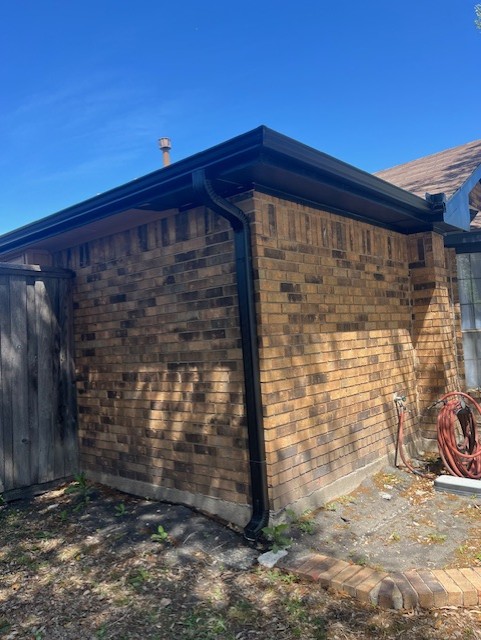
Building a Mounting Point Where There Is Not One
Where there’s no usable board, we create one before any metal goes up: new fascia fixed to the rafter tails, run true enough that a gutter set to a deliberate pitch does what it should. Where the roof line steps or an addition sits at a different height, that board gets worked out elevation by elevation. A single line carried straight round the house would put the pitch wrong on at least one of them.
A board that rotted in place, as opposed to one that was never there, gets replaced before the new gutter goes on. That’s the only sequence the job can run in, and it belongs on the estimate, not on an invoice you see afterward.
Old lake houses also need the holes dealt with. Spike-and-ferrule hanging was standard for decades and leaves a row of punctures through the front of the board, and those get filled and made good. Hiding a row of holes behind new metal just keeps water going into the same places it has been going for forty years.
Three Housing Eras Inside Two and Seven Tenths Square Miles
Lake Dallas is a small town with a long spread of housing inside it: a pre-war and mid-century core at the original townsite, the bulk of the city built out between the 1970s and the 1990s, and 2000s infill scattered through both. Three eras of fascia inside a couple of square miles, which is why an estimate here takes longer than the size of the town suggests.
Each layer fails its own way. The old core has the fascia problem. The seventies and eighties tract streets carry five-inch gutter that was standard-issue then and undersized for the roofs it went on, especially where trees have since grown up over them. The newer infill has sound boards and builder gutter nobody has ever looked at.
Five-Inch That Was Too Small From the Start
The most common thing we get called out to in this part of Denton County is not a leak. It’s a system that was never big enough for the roof above it, put on because five-inch went across the whole subdivision without anyone checking which houses had steeper pitches or longer valleys.
Six-inch belongs on a two-story elevation, a steep pitch, a roof with long valleys, and any house under real canopy, which covers most of the older streets here. The extra inch takes a larger downspout and clogs less readily, because there’s more room around the debris for water to keep moving. A full gutter installation here is usually a one-day job.
For rough budgeting, figure 150 to 200 linear feet of gutter and downspout on a 1,500 square foot house, 200 to 300 on a 2,500 square foot house, and 350 feet or more once you pass 3,500.
Profiles, Metals and What Looks Right on a Lake House
K-style is the profile most people picture and it suits nearly everything built here since the 1950s. Half-round is the historically correct choice on the older cottages, hangs on visible brackets, and sheds debris better because there are no interior corners for grit to collect in. Box gutter turns up on some older commercial roofs along the corridor.
Aluminum goes on the large majority of what we do. It does not rust, it takes a baked-on finish that holds color for decades, it’s light enough not to stress an old fascia board, and we form it seamless on the truck in your driveway. Copper is the other end of the range, installed for how it looks as much as how long it lasts, and it does both. The complete list of shapes, metals and sizes is on our gutter styles and materials page.
Galvanized steel is one thing we won’t quote. Steel begins failing where it was cut, drilled and lapped, and mornings this close to open water keep those spots damp long after an inland street has dried out. Weight is the second reason. On a 1950s board that’s already marginal, steel is precisely the wrong load to hang. Aluminum moves the same water at a fraction of the weight and has nothing in it to rust.
Leaves From the Ridge, Seed From the Bottom
Lake Dallas sits on the Eastern Cross Timbers, the sandy belt that runs through central Denton County along the Elm Fork corridor, and the canopy here is mature and genuinely mixed. On the upland ground you get post oak, blackjack oak, cedar elm, hickory and eastern red cedar. Down near the water the mix turns bottomland: bur oak, American elm, cedar elm, pecan and sugar hackberry. The soil follows the same pattern, sandy on the uplands and alkaline clay along the lake and river bottom.
Post oak is the one that changes how a gutter behaves. The leaf is broad, tough and slow to rot down, so instead of softening and washing through it lies flat, stacks, and holds standing water above the pile until the run carries weight the hangers were never spaced for.
Fall Seed, Then a Second Round in Late Winter
Cedar elm times its seed drop to early fall, and the samaras are fine enough that only a tight mesh keeps them out. They are small, light and there are a great many of them, and they pass straight through a coarse screen to settle as a dense mat in the bottom of the trough. American elm, common in the bottomland here, drops its samaras in late winter instead, so a house with both overhead fouls twice on a schedule most people don’t expect.
Gutter work carries a $500 minimum. Downspouts, repair calls, cleaning and cleanouts start from $250. Twice a year is the rhythm under this canopy: once after the fall drop, once before the spring storm line. Post oak directly over the roof sometimes earns a third look.
Which Screen Belongs on Which Roof Here
Guards earn their place where something genuinely overhangs the roof. We fit two kinds and say plainly when a house needs neither.
Expanded steel screen, the Roll Lock type, starts at $5 per linear foot and it’s the right product where the debris is bulk: post oak, blackjack oak and hickory leaf. It keeps the load on top of the metal and lets water through underneath, though a thick mat of post oak will eventually sit on the screen and shed water off the front, so it wants sweeping once a season. Micro-mesh, stainless and aluminum, starts at $10 per linear foot and has a weave fine enough to stop cedar elm seed, shingle grit and pollen as well as leaves. Leaf Blaster, Hydroflow and Flow Shield are the names in that category.
Neither one retires the ladder. Both cut the frequency substantially and both prevent the packed clog that puts water over the front edge in a real storm.
Open Water on One Side and What That Does to Fasteners
Houses close to the shoreline take wind that inland streets don’t, since nothing between the roof and the far side of the lake slows it down. Two things follow. Wind-driven rain arrives at an angle and overshoots a trough set slightly too low or too far out, and uplift works at the hangers steadily rather than in one event.
The answer is the fastening schedule, not heavier metal. Hidden hangers screw through the back of the trough into the fascia, and on exposed elevations we tighten that spacing well past what a sheltered inland run gets. On the older houses it also means confirming the board behind can actually hold the screws before anybody counts on it.
The Town Kept the Name, the Lake Did Not
This trips up people new to the area and it is worth clearing up, because it affects how you describe your own property to a contractor. The water beside Lake Dallas is called Lewisville Lake today. The original reservoir behind Garza Dam, from 1928, was named Lake Dallas. In 1957 the old dam was breached and the impoundment merged into the Garza-Little Elm Reservoir. A 1971 Corps of Engineers naming policy gave a combined lake the name of its downstream dam, so it became Lewisville Lake, and the signage caught up by 1976.
The town kept the old name. The lake didn’t. There’s no separate body of water called Lake Dallas now, and the city itself was settled in 1852 as French Settlement and constituted as Garza in 1881 before it took the reservoir’s name in the 1920s.
Drops, Elbows and Getting Water Off the Lot
A big gutter feeding a small downspout overflows, every time. Two-by-three is the standard rectangular downspout and it works on short runs and small roofs. Three-by-four moves roughly twice the water and belongs on six-inch gutter, on two-story elevations, and anywhere a long run drains to a single drop. Round smooth downspouts are the tidier option.
Where the water goes after the last elbow matters. On the alkaline clay near the water, discharge at the slab edge works ground that swells and shrinks, and that movement drives most of the foundation trouble around here. On sandier upland ground the concern shifts to scour and runoff tracking back along the footing. Above-ground extensions carry discharge past the foundation, from a $250 minimum. What we install runs above ground. Anything below grade silts up quietly, and you learn about it only when water is already standing where it should not be. On a lot where that is genuinely the only route, tell us at the estimate.
Boat Barns, RV Covers and the Second Roof on the Lot
Lake towns collect outbuildings. Boat storage, RV covers, detached garages and workshops are all over Lake Dallas, most of them shedding water straight onto a driveway or the side of the house. Those roofs take gutter well, in the same profiles and metals we hang on the house itself.
Two things change on an outbuilding. The structure is often lighter, so the fixing method has to be worked out on the spot. And the discharge point has to be worked out from scratch, because there’s no existing routing to follow. We sort that on the estimate rather than on the day.
Swisher Road and the Commercial Side of Town
For a city this size Lake Dallas has real commercial property, and nearly all of it sits on Swisher Road, FM 2181, which is also the road feeding the toll bridge across to Little Elm. The retail along there is storefront work with hung gutter over the walkways, and it fails the way storefront gutter always fails, at a strap over a doorway. The light industrial going up on the same corridor drains from the middle of the roof outward instead, so on those buildings every piece of metal we handle is on the wall face.
Commercial roofs get treated differently. The calculation on a building runs off short, violent rainfall rather than a yearly figure, overflow has to discharge clear of the interior, and access is planned around whoever is operating below. Commercial jobs open at a $750 minimum, and commercial downspouts run from $20 per foot against a $300 minimum. Work fits around a business that stays open.
What This Work Costs in Lake Dallas
None of these are fixed quotes. Each is a starting price or a range, and gutter work sits behind a $500 minimum with downspouts and repairs behind a $250 one.
| Starting figures on a Lake Cities house | Per linear foot |
|---|---|
| Aluminum 5-inch K-style, seamless | $7 to $14 |
| Aluminum 6-inch K-style, seamless | $8 to $16 |
| 2×3 aluminum downspout | from $7 |
| 3×4 aluminum downspout | from $8 |
| Expanded steel (Roll Lock) screen | from $5 |
Half-round, copper, oversized and box profiles are priced separately, and the full range is on our gutter styles and materials page.
The thing that moves a Lake Dallas quote most is the fascia. A nineties tract house with sound boards and clear access sits near the bottom of the ranges. A 1950s cottage that needs a fascia board built before anything can hang on it carries carpentry the newer house does not. Height, access, corner count and drop count do the rest.
What We Fix Without Replacing
Plenty of what we do in this town never becomes a replacement. A repair call opens at a $250 minimum, and the usual items are a run that has started to drop, a stretch holding water because the fall went off, an open miter that needs stripping and sealing, a weeping seam, hangers that have lost their bite in old wood, a split end cap and a downspout hanging off its straps.
What sends a Lake Dallas house the other way is almost always the board or the size. If the perimeter is tight and one run has gone, fix the run. If hangers are coming out in three places because the fascia behind them is soft, the carpentry has to happen anyway, and putting the old metal back onto new wood is the wrong end of that trade. The same answer applies when a clean, empty trough still spills over the front lip in ordinary rain, because that gutter was too small the day it went up.
Two Warranties, and What They Cover on an Old House
Workmanship is warranted five years. Material carries a twenty-year manufacturer warranty. On the older stock here the first one is doing the heavy lifting, because our workmanship includes any fascia we built or replaced, and that’s the part of the job you can’t inspect afterward. The written estimate names which lengths of board were renewed and which were left alone, so nobody has to reconstruct it from memory later. Creative Gutter has been the same family business since 1984 and the phone number on this page has never changed hands. The full sequence of an install sits on our gutter installation page.
Around the Lake Cities and the Rest of Denton County
Lake Dallas belongs to the Lake Cities grouping with Corinth, Hickory Creek and Shady Shores, formal enough to have its own municipal utility authority and chamber of commerce, and we work throughout it. The wider Denton County page covers the rest of our ground up here. Nearby city pages include Lewisville, Lakewood Village and Bartonville.
Lake Dallas Questions, Answered Plainly
My house has no fascia board at all. Can I still have gutters?
Yes. We build a mounting point first, fixing new fascia to the rafter tails and running it true enough to set a proper pitch on. That adds carpentry to the job, and it goes on the written number before you agree to anything.
Is the lake here still called Lake Dallas?
No. The water is Lewisville Lake and has been officially since a 1971 naming policy, with signage changed by 1976. The town kept the older name from the original 1928 reservoir behind Garza Dam.
Why do my gutters clog in fall even with screens on them?
Almost certainly cedar elm seed. The samaras come down in September and October, they are small enough to pass a coarse screen, and they settle as a mat in the bottom of the trough. Micro-mesh is the product that stops them.
Will you put gutters on my boat barn or RV cover?
Yes, and it’s common work in this town. The fixing method gets looked at because those structures are lighter than a house, and we work out where the discharge goes before we start.
Can you run the downspout underground so it is not in the way?
What we install runs above ground, and there is usually a route that keeps it out of the way without going under the grass. Buried lines block up out of sight, and by the time you notice, water has been sitting against the foundation for a while.
My gutters are the ones the builder put on in 1985. Repair or replace?
Look at where it fails. If one run has sagged and the rest holds, repair it. If it overflows when clean, it was undersized from the start and a repair won’t change that.
Do the lake winds actually damage gutter?
Steady uplift works at hangers over time and wind-driven rain overshoots a trough that’s set slightly wrong. Neither is dramatic and both are fixable with tighter hanger spacing and correct positioning at install.
What is your minimum charge?
Gutter work starts at a $500 minimum. Downspouts, repairs, cleaning and cleanout each start at a $250 minimum.
Let Us Come Look at the Boards First
Here the estimate does more work than it does in most towns, because the thing deciding your price sits behind the old gutter where nobody can see it from the street. Somebody gets up there, looks at the board, and tells you what’s actually holding your roof edge together. It costs nothing and you keep the written number whichever way you go. Call 214-324-4674 or request a quote. The shop is at 1515 Fuller Drive in East Dallas and has been since 1984.
Contact us today to schedule a FREE on-site consultation for gutter installation or repair for your home or business in Dallas, Collin and Rockwall Counties.
214-324-4674