

Gutter Installation In Rockwall, TX
Gutter Installation in Rockwall TX: From Lakefront Elevations to the Downtown Square
Rockwall is the county seat, and it carries a wider range of buildings than anywhere else in the county. Lakefront customs sit on the east shore of Lake Ray Hubbard. Two-story brick subdivisions from the 1990s through the 2010s fill in behind them. Older masonry commercial buildings ring the historic downtown square. Those three need three different gutter systems, and Creative Gutter has been doing gutter installation in Rockwall on all three since 1984.
Most cities we work in have one dominant housing era and one dominant roof problem. Rockwall does not. Inside the same city limits you have shoreline homes with deep architectural overhangs and metal roof sections, inland tract two-stories with steep pitch and tight valleys, small older frame houses on the streets closest to the original grid, and commercial storefronts whose roofs drain in ways no residential gutter ever does.
That matters because the wrong spec on any one of them fails in a predictable way. A shoreline house hung with standard-spacing hangers loses a run in a spring front. A steep inland two-story with 5-inch gutter and 2×3 downspouts overflows while perfectly clean. A parapet-wall storefront handed a hung K-style gutter does nothing useful at all, because the water was never going to reach the eave in the first place.
So the first question on any estimate here is not how many feet of gutter you need. It is what is above the eave, what is behind it, and where the water has to end up. We work the whole spectrum across Rockwall County, and the buildings in the county seat are where that spread is widest.
Box Gutters, Parapets, and the Older Buildings Around the Downtown Square
Older commercial buildings drain on a completely different principle from a house. A period Rockwall storefront typically has a low-slope or nearly flat roof behind a parapet wall, which means there is no exposed eave to hang anything from. Water collects behind the parapet and leaves through an internal drain, a scupper cut through the wall, or a lined box gutter built into the roof edge itself. When one of those fails, the water does not spill harmlessly into a flower bed. It goes into the wall assembly.
Box gutters are the ones that generate the most calls on buildings of that vintage. A box gutter is a rectangular trough framed into the roof structure and lined with metal, and the lining is the entire system. When the seams open, when the metal fatigues at a corner, or when a previous repair laid roofing cement over a moving joint, water gets under the liner and into the framing below. Owners usually find it as staining on an interior ceiling or as soft brick mortar on the inside face of the parapet.
Rebuilding one properly means stripping the failed lining, checking the wood below it for rot, correcting the slope toward the outlet, and installing a new continuous metal liner with expansion joints where the run is long enough to need them. We do this work regularly and keep a plain explanation of how the older trough profiles work for owners deciding between a patch and a real repair. A patch on a box gutter buys a season. It rarely buys more.
Scuppers and conductor heads are the other half of the job on these buildings. A scupper is only as good as the head that catches it, and an undersized or clogged conductor head will back water up behind the parapet until it finds the weakest seam. On the Rockwall square and on the older commercial stock along the surrounding streets, we typically specify heavier-gauge steel or copper rather than standard residential aluminum, because the collection points on these buildings take abuse residential hardware was never designed for.
Access is its own problem downtown. Storefronts share walls, sit directly on the sidewalk, and often have no side yard at all, so staging happens from the front or from the roof. We schedule that work around business hours where we can and keep the sidewalk clear while the crew is up. If you own or manage a building here, our commercial gutter division handles the assessment, the drawing, and the install as one scope rather than sending a residential crew at a building problem.
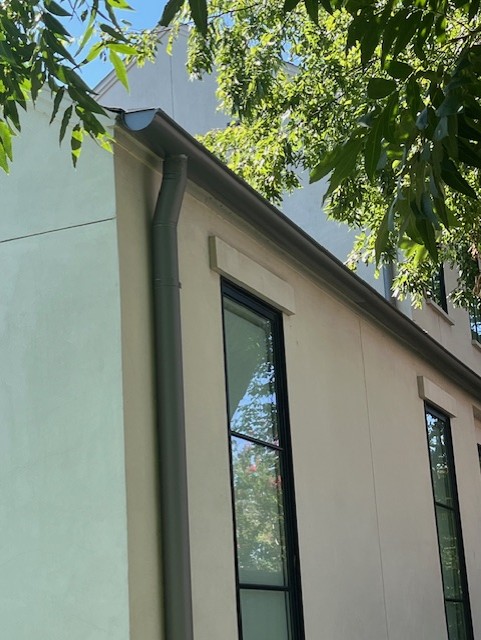
Why Lakefront Homes Lose Hangers Before Anything Else Fails
On the shoreline side of Rockwall, gutters almost never fail because the metal wore out. They fail because the fastener that was holding them gave up. Lake Ray Hubbard gives wind a long, unobstructed approach to the back of a lakefront house, and unlike a gusty inland lot, that loading is sustained. The trough is pushed and released, pushed and released, thousands of times across a single front. Hardware does not like being cycled.
The failure sequence is consistent enough that we can usually predict it from the driveway. A hanger screw backs out of the fascia a fraction of a turn at a time. The run develops a low spot between two hangers. Water ponds in the low spot, which adds weight exactly where the support is already weakest. The next storm pulls that section down, and it takes the two hangers on either side with it. Homeowners describe this as sudden. It was not sudden.
Lakefront architecture in Rockwall makes it worse in three specific ways. Deep architectural overhangs mean the gutter is hung further out from the wall on a longer fascia return, so it has more leverage working against the fastener. Custom elevations often carry long unbroken runs of 40 feet or more with nothing interrupting them, which gives wind an uninterrupted surface to push on. And many of these homes have standing-seam or panel metal roof sections over porches, dormers, and bay elements, which shed water faster and with more force than a shingle plane of the same size.
What we change on a lake-facing elevation is the fastening schedule, not the material. Hidden hangers go in on noticeably tighter centers than the standard we would use on an inland street. Every hanger gets a screw into solid fascia, never a spike, and if the fascia has already been chewed up by a previous re-hang, we replace the board rather than hunting for fresh wood beside the old hole. Downspouts get extra straps, because an unsupported downspout on a two-story lake elevation will oscillate in wind until it tears its own strap out of the brick.
Angled rain is the second lake-side problem, and it is the one homeowners misdiagnose most often. When rain arrives at 30 or 40 degrees off vertical, it sheets across the roof plane and leaves the shingle edge with horizontal momentum. A minimum-width trough set tight to the fascia simply does not catch it. The homeowner sees water at the foundation, assumes the gutter is clogged, cleans it, and sees the same thing next storm. The fix is a wider trough and correct drip-edge alignment, not a cleaning.
Every run we hang is cut to length on the truck in your driveway, which matters more here than almost anywhere. A seam is a hinge. On a wind-loaded 48-foot elevation, a mid-run joint becomes the point where the whole system flexes, and it will open before anything else on the house does.
Copper, half-round, and conductor heads on custom elevations
A fair number of the custom homes on the east shore were designed with a specific exterior language, and a standard K-style aluminum gutter reads wrong on them. Half-round profiles suit traditional and Mediterranean elevations far better, and they carry a practical advantage as well: a half-round has no interior corner for debris to pack into, so it sheds silt and shingle grit more readily than a K-style of the same nominal size.
Copper is the other request we see on these homes. It costs considerably more than aluminum and it is worth being honest about why people choose it. Copper does not need paint, it will not dent from ordinary handling the way thin aluminum does, and it develops a patina rather than degrading. On a house where the gutter is visible from the water and part of the architecture, that matters. On a house where it is not, aluminum in a matched baked finish is the better value and we will say so.
Conductor heads belong on this kind of work too. A conductor head is an open collection box where the gutter outlet meets the downspout, and on a high-volume elevation it does two useful things: it gives a surge somewhere to go instead of backing up into the trough, and it makes a blockage visible from the ground instead of hiding it inside a closed outlet. We size and fabricate them alongside the gutter rather than buying a stock box and hoping it fits the run.
Sizing the Inland Housing Stock
The 1990s through 2010s two-story brick belt
Behind the shoreline, most of Rockwall is two-story brick built between the mid-1990s and the 2010s. These are the houses that overflow while spotlessly clean, and the reason is almost always original builder spec. A 5-inch trough feeding a 2×3 downspout is the cheapest system that passes inspection, and on a modest single-story roof it is adequate. On a steep, large two-story plane it is not.
North Texas gets roughly 37 to 40 inches of rain a year, but the number that determines gutter size is intensity, not annual total. Our rain arrives in concentrated bursts, mostly March through June with a second wet stretch in the fall. A steep pitch accelerates that water down the plane instead of letting it sheet slowly, so it hits the trough faster and with more energy. Two planes meeting in a valley then dump the combined volume into one inside corner.
On those homes we size this way:
- 6-inch K-style on any contributing plane over roughly 1,000 square feet, on 8:12 pitch and steeper, and at every valley discharge point.
- 3×4 downspouts in place of 2×3 at high-volume corners. A 3×4 moves close to twice the water and is far less prone to jamming on a slug of shingle granules after hail.
- Additional outlets rather than one heroic downspout, so a long elevation is not asking a single opening to drain the entire side of the house.
- Tighter hanger centers on the weight-bearing runs, since a full 6-inch trough is heavy before you add debris or a freeze.
- Sealed mechanical miters at inside corners, where valley volume concentrates and where cheap corner work separates first.
We measure the roof rather than the eave to arrive at those numbers. Contributing square footage, pitch, and how many planes converge on a single corner determine the size. Eave length only tells us how much material to load on the truck.
The smaller older homes near the original grid
Not everything in Rockwall is new or on the water. The blocks closest to the original town grid hold a good deal of older frame and modest brick stock, and those houses have a different set of problems from either the lakefront customs or the tract two-stories. Roof area is small and pitch is shallow, so capacity is rarely the issue. Age is.
The common finding on these homes is an undersized 4-inch or 5-inch gutter hung on original fascia with spikes and ferrules. A spike is a nail driven through the front of the gutter, through a spacer, and into the fascia, and it holds by friction alone. Forty years of thermal movement and periodic loading works it back out. Meanwhile the trough sits under whatever canopy has grown up around the house since, fills with leaf litter, holds standing water, and the added weight finishes the job the wind started.
By the time someone calls about a sagging run on one of these, the fascia board usually needs attention before anything can be hung on it. We check the fascia and the drip edge first, replace soft or rotted board where it is needed, and re-hang with hidden hangers screwed into solid wood. Where the original gutter was undersized for the canopy above it, we move up in profile even though the roof is small, because on these houses debris volume rather than roof area is what sets the size. Half-round is also worth considering on period elevations where a K-style profile looks wrong against the trim.
Where Does the Water Go on a Lot That Slopes Toward the Lake?
Rockwall County sits on the same expansive Blackland Prairie clay as the rest of North Texas. That soil swells when it takes on water and shrinks hard through a dry August, and the swell-shrink cycle is what moves slabs. Roof water concentrated at a foundation corner is the single most reliable way to start that process, and that is why discharge placement matters more here than it does in most of the country.
Lots that fall toward the shoreline complicate it in both directions. Gravity is on your side, which is good. But fast-moving surface water on a graded slope cuts channels, undermines retaining walls and landscape beds, and carries soil away from the toe of the slope where you least want to lose it. Dumping a 3×4 downspout onto a splash block at the top of that grade concentrates the whole roof into one erosion path.
The right answer is usually to move the discharge well out from the slab and then spread it rather than concentrate it. That can be an above-grade extension, a buried solid line running to a pop-up emitter at the low end of the yard, or a discharge into an existing swale where one already exists. Getting the water released a real distance from the foundation costs a small fraction of what pier work costs, and it is the single cheapest thing most homeowners here can do for their slab.
One caution specific to clay: buried discharge lines should be solid pipe, not perforated. Perforated pipe is designed to let water into the soil, exactly the opposite of what you want when the soil under your slab is the thing you are trying to keep stable.
What Gutter Work Costs in Rockwall
Because the building stock is so varied here, the range is wide, and where your house lands depends mostly on height, linear footage, and how easy the crew can get to the run. Seamless aluminum here costs $4.50 to $12 for every foot installed.
Corners are the quiet cost driver. A stock box miter goes on quickly, while a corner cut and sealed on site to the actual angle of the roof takes longer, and an out-of-square return on a custom lakefront elevation needs the second kind. The two-story brick homes that make up most of the inland subdivisions carry more corners than their footage suggests, and each one is labor before it is material. Count the inside and outside corners on your own house and you will have a better sense of your number than square footage gives you.
- Steel: $9 to $20 per linear foot, which is what the downtown storefronts and the heavier residential work take.
- Copper: $25 to $40 per linear foot, which on a custom lakefront elevation buys fabricated conductor heads and a metal that weathers rather than fades.
- Gutter cleaning: roof height, run length, and whether a ladder can be footed without crossing a bed or a bulkhead are what decide the figure.
- Gutter guards and leaf screens: the tree load decides which system is worth installing, and a lakefront lot under mature elm screens differently from a young inland yard.
Tighter hanger spacing and extra downspout straps on lake-facing elevations show up as labor and hardware rather than a separate line item. Commercial box gutter and scupper work is quoted per building, because two storefronts of the same width can have completely different roof structures behind the parapet. None of these figures are quotes. They are the ranges we work within, so we look at the building rather than guess at it.
Hail, Straight-Line Wind, and What to Check After a Storm
Hail season here runs roughly March through June, and Rockwall sits on the open eastern edge of the metroplex where fronts arrive with less built environment to break them up. Two kinds of damage follow. Hail dents aluminum fronts and knocks loose enough shingle granules to pack an outlet into a paste. Straight-line wind separates corner miters, tears downspouts off walls, and drops sections into landscaping.
After a cell moves through, three checks tell you most of what you need to know. Stand at the street and see whether the gutter line still reads straight, since a dropped end is visible from thirty feet away. Look for a downspout hanging free of its strap. And an hour after the rain stops, look for standing water in the trough, which means the outlet is packed rather than the gutter being out of pitch.
That combination of a plugged outlet and a full trough on a wind-loaded run is exactly how a gutter comes down on the lake side of Rockwall. We take storm calls on short notice throughout the area and we work out on site whether you are looking at a re-hang, a section replacement, or something worth documenting for a claim. We do not make the insurance determination for you, but we will photograph the condition of the runs, fronts, and downspouts so you have something concrete to hand over. Everything we install carries a 5-year workmanship warranty and a 20-year manufacturer warranty on materials.
Ice Load on a Fastener the Wind Has Already Worked
North Texas does not get much winter, and that is exactly why the few nights that matter catch people out. A freezing rain event over Rockwall puts a rind of ice through the debris already sitting in a trough, and ice is far heavier than the wet leaf it forms around. On the shore side of Rockwall that load arrives on hardware that has spent the previous nine months being cycled by wind off Lake Ray Hubbard, which is a different starting condition from an inland gutter of the same age.
The sequence is the one described further up this page for Rockwall lakefront hardware, only accelerated. A hanger screw that has backed out a fraction under repeated loading is holding less than it was designed to hold. Add the weight of a frozen trough and the low spot between two hangers becomes a dip in one night rather than over a season. Rockwall homeowners find it the following week, when the ice has gone and the run is visibly out of line.
A plugged outlet is what makes a Rockwall freeze serious. A trough that drains keeps very little water to freeze. A trough with a packed drop holds standing water the full length of the run, and when that freezes solid the gutter is carrying its own weight plus a bar of ice along the whole elevation. That is why we would rather clear the drops on a Rockwall lake-facing house before Christmas than after, and why the standing-water check an hour after rain matters in December as much as it does in May.
None of this argues for different metal on a Rockwall house or for a heated system. It argues for the fastening schedule this page already recommends: hangers at twenty-four inches on center as the baseline, brought in to about eighteen on the exposed runs, every one of them screwed into sound fascia rather than into a Rockwall board that has already been re-hung twice. A system built to that standard on the lake side takes an ice night the way it takes a spring front, which is to say without incident.
Maintenance and Timing: What to Schedule, and When
When is the best time to have work done?
If you already know the system needs to be replaced, the best window is late winter through very early spring, before the March through June storm months. Doing it then means the new system is in place for the rain it was sized for, and it means you are not competing for a crew during the weeks when everyone in the county is calling at once. Gutter work is not weather-dependent the way roofing is, so a cool dry February day is a perfectly good install day.
The worst time to start looking is the week after a significant hail event. Every contractor in Rockwall County is booked, adjusters are backed up, and homeowners end up taking whoever answers the phone. If your system is already marginal going into spring, address it in the off season rather than gambling on availability.
Cleaning follows the trees rather than the calendar. Late fall, after the pecans and cedar elms have actually finished dropping, is the productive visit. Cleaning in October and then watching the trough refill in November wastes the trip. On heavily wooded Rockwall lots a second pass in late February clears whatever came down over winter and gets the outlets open before the first real spring cell.
Copper and custom half-round work carries lead time because the material has to be ordered, and fabricated conductor heads add to that. Standard aluminum does not. We run the coil and the forming machine on the truck, so a straightforward residential job is generally cut, hung, and finished in a single day without anything being ordered in advance.
Do you need guards in Rockwall, or just a cleaning schedule?
The honest answer depends almost entirely on which part of town you are in, and we will talk homeowners out of guards regularly. Guards solve a debris problem. In a subdivision built in 2009 where the landscape trees are still shorter than the second-story windows, there is very little debris to solve, and a guard does nothing for capacity. On a house that is overflowing because the gutter is undersized, adding a screen can make it slightly worse.
Where a properly fastened screen system genuinely pays for itself in Rockwall is under the older canopy near the original streets, on lots along creek corridors, and on any property that inherited mature pecan, live oak, or cedar elm from an earlier era. Those troughs fill every fall no matter how careful you are, and twice-yearly cleaning gets old.
One consideration specific to the lake side: drop-in foam inserts and loose screens that simply rest in the trough can lift in sustained wind. If a shoreline house needs screening, it needs a system that mechanically fastens to the gutter or under the shingle course, not something set in place by hand. On homes with light canopy, a late fall clear-out plus a look before the spring cells arrive is the low end of the two-visit minimum, and that is all the maintenance the system needs, along with a hardware check for loose hangers and staining on the fascia behind the trough.
Repair, Re-Hang, or Full Replacement?
Not every problem in Rockwall is a replacement, and on the lake side in particular a great many of them are not. A gutter that is structurally sound but sagging between two points is a hanger problem. Adding hangers on tighter centers, correcting the pitch back toward the outlet, and resealing the miters brings that run back to service for a small fraction of a tear-off. Separated corners, a downspout that never drained properly, and a section that ponds after rain are all straightforward things to fix in place.
Replacement is the right call when the profile is simply too small for the roof above it, when hail has dimpled the fronts badly enough that you notice from the driveway, when the fascia has been rebuilt and the old gutter no longer sits true against it, or when a run has been re-hung so many times the fascia is more hole than wood. If you are weighing the two, it is worth understanding what can be brought back rather than torn off before you commit to either.
On the commercial side the calculus is different again. A box gutter that has been patched repeatedly is usually past repair, because each patch traps water under it and accelerates what is happening to the wood beneath. On those we recommend a full liner rebuild and say so early, since a third patch is money spent on a problem that is going to come back.
Questions Rockwall Homeowners and Building Owners Ask
My gutters keep pulling away on the back of the house but not the front. Why?
Almost certainly exposure. If the back elevation faces open water or open ground, it takes sustained wind loading that the sheltered front never sees, and the fasteners on that side are being cycled far more. The fix is a re-hang on that elevation with screwed hidden hangers on tighter centers, plus fascia repair anywhere the old fastener holes have chewed up the board.
Does being near Lake Ray Hubbard mean I need corrosion-resistant material?
No. It is fresh water, so there is no salt-air concern and no reason to pay for a specialty alloy. Aluminum remains the correct standard choice on the lake side. What changes near the water is how the system is fastened and how wide the trough is, not what it is made of.
My house was built in 2004 and the gutters are clean. Why does it still overflow?
That is a capacity problem, not a debris problem. Builder-standard 5-inch gutter with 2×3 downspouts on a steep two-story plane cannot move peak-intensity rain. Moving the worst elevations to 6-inch with 3×4 downspouts and adding an outlet at the valley usually resolves it without touching the rest of the house. That is the most common form gutter installation in Rockwall takes on houses of that era.
Do I need to worry about ice in a Rockwall gutter?
Only where the drops are packed, and that is as true inland as it is on the Rockwall shoreline. A clear, correctly pitched run drains before it can freeze into anything that matters. A blocked one holds water down its whole length, and frozen standing water is heavy enough to finish off hangers that lake wind has already loosened. Clearing the outlets before winter is the entire precaution on a Rockwall property.
Does a freeze affect the buildings around the square the same way?
Not in the same place. A hung gutter on a house sheds its ice load through the fasteners. A lined box gutter behind a parapet on one of the older Rockwall buildings holds that load against the metal and the wood beneath it, and ice working into a seam that has already fatigued is how a liner opens. On those the winter check is the outlet and the conductor head rather than the hangers.
Is winter a bad time to have this done?
It is one of the better ones. Gutter work is not weather-dependent the way roofing is, and a cold dry January day is a perfectly good install day. The timing section further up this page covers the rest of it. What winter adds is that a system finished and water-tested in January has already sat through a freeze before it ever sees a spring cell.
I own a building near the square. Can you tell me whether my box gutter is repairable?
Usually, yes, and it takes a look at the liner and the wood beneath it. If the seams are opening but the substrate is sound, a rebuild of the lining is reasonable. If water has already been getting under the liner long enough to soften framing, that has to be addressed first, and we would rather tell you that up front than discover it mid-job.
How often should gutters be cleaned in Rockwall?
Twice a year under mature canopy, once in late fall after the pecans and cedar elms finish dropping and once in early spring ahead of the heavy rain months, and three where a pecan sits directly over the roof, four where the pecan load is heavy. Newer inland subdivisions with young trees can usually hold to the two-visit minimum. Lake-facing homes should add a hardware check to the routine even if the trough is clean.
Can you match gutter color to brick, stone, and trim on a custom elevation?
Yes. Aluminum comes in a wide range of baked finishes and we bring color options to the estimate so you can hold them against the actual material in daylight. Some neighborhoods in the area require exterior color approval before work begins, and we can provide the spec sheet and color chip for that submission.
Do you work on shops, barns, and metal outbuildings on the larger lots?
Yes. Large uninterrupted metal roof planes shed water fast and typically need heavier-gauge material, oversized downspouts, and a gutter set low enough to catch water leaving a slick panel with real momentum. We handle those alongside the house on the same visit when it makes sense.
Cities We Cover Around Rockwall
Our crews work the whole county on the same routes, so scheduling around Rockwall is usually straightforward. South along the shoreline we cover Heath, where lake exposure raises the same fastening questions. North and east we handle gutter installation in Fate and the small-town stock in Mobile City out toward SH 66. Southeast, the acreage properties around McLendon-Chisholm present a very different drainage problem, and west across the water we work throughout Rowlett.
Have Us Look at the Building, Not the Brochure
Whether you own a lakefront custom, a two-story in one of the inland subdivisions, or a storefront with a parapet and a tired box gutter, the spec should come from what is on your roof. Call Creative Gutter at 214-324-4674 and we will walk it, check the fascia and the fastening, measure the contributing planes, and put a written range in your hands at no charge. Family-owned, working DFW since 1984, and still fabricating every run on-site.
Contact us today to schedule a FREE on-site consultation for gutter installation or repair for your home or business in Dallas, Collin and Rockwall Counties.
214-324-4674